
The Indonesian Education for Social Reconstruction, Peace and Justice |
| Doni Koesoema A - Boston College | Media Framing and Education |
|
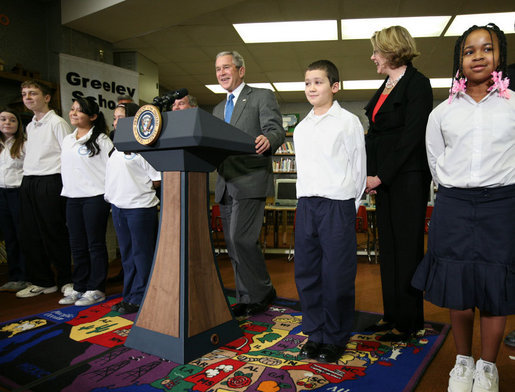
President George W. Bush visits with students Monday, Jan. 7, 2008, at the Horace Greeley Elementary School in Chicago, joined by U.S. Secretary of Education Margaret Spellings, right, where President Bush also delivered a statement highlighting the successes of No Child Left Behind and urged Congress to reauthorize it. White House photo by Joyce N. Boghosian. For video click here. |
|
|
No Child Left Behind: Truth and Consequences (From Youtube) |
|
|
Related Articles on the Media |
|
|
Related Documents |
|
|
No Child Left Behind - A Desktop Reference 2002, prepared by the Office Under Secretary |
Critical Analysis |
|
Media Framing and Ideology on NCLB Act "The philosophy behind No Child Left Behind was in return for money there ought to be results... That's what corporations ask -- if we're going to spend money, are we going to get a return on the money? That's what our schools ought to be asking, too." (George Bush) |

"Congress should also drop the absurd goal of achieving universal proficiency by 2014...Unless we set realistic goals for our schools and adopt realistic means of achieving them, we run the risk of seriously damaging public education and leaving almost all children behind. (Diane Ravitch) |
Media, both printed and electronic, have given deep impact on their audience. Media framing on a certain issue will influence its audience's decision making and behavior. To frame, in Entman's words (1992) means “...to select some aspects of a perceived reality and make them more salient in a communicating text, in such a way as to promote a particular problem definition, causal interpretation, moral evaluation, and/or treatment recommendation for the item described” (p. 52). While media journalist do cling to the rules of objectivity and avoid deliberate biased, typically provide partial accounts that assist some causes while damaging others (Entman, 1989, p. 36). To be critical to the media framing is important for enhancing our participation in the democratic society. This article will analyze how media frame issue on NCLB act. I have chosen 2 electronic media (one from the White House/WH and one from Youtube/Ytb), and 2 printed media (New York Time/NYT and Boston Globe/BG). I will explore how the media frame the issue at hand, what are left out in the discussion, and what ideology the media used to construct their argument. WH and Ytb Electronic Media framing are more complex than the printing one. It uses the multimedia, color, music, film, voices, letters that construct image and bring certain sensation to their audience. WH frames NCLB issues in a very optimistic tone, putting George Bush picture around the smiling respectful students at Horace Greeley Elementary School Chicago, Illinois. The headline is “President Bush Discusses the No Child Left Behind Act”, with sub title “ Fact Sheet: Six Years of Student Achievement Under No Child Left Behind ” which gives audience easy way to access data of the school success on implementing NCLB Act. In his speech, Bush expresses his satisfaction of the school as “a center of excellence”, having “a good principal”, “supported by the community”, “teachers who work hard” and “students willing to learn”. In this school Bush felt “proud” and “honored” because the school has set “high expectation and standard” using the objective ‘measure' to determine whether the standard is met”. Horace Greeley Elementary School , in his judgment has proved it to be the school that “is exceeding expectations because of high standards and using the accountability system as a tool to make sure that no child is left behind.” WH also frames Bush authority over Congress. He said that Congress need to “reauthorize' it, but if the “Congress passes a bill that weakens the accountability system in the NCLB,” he “will strongly oppose it and veto it.” In general, Bush felt that NCLB Act is successful. Ytb frames NCLB in a different way than WH. Ytb headline is critical that is, “Accountability: What really matters?” The sub-title is “NCLB: Truth and Consequences”. Ytb directly gives audiences the fact about the erosion of public support over the last four years on NCLB. “The more people know about the NCLB the less they like it.” Ytb also involved various sources for supporting its idea. They are Associate Professor of Literacy Studies School of Education Virginia Tech, Elementary School Principal, Educational Researcher and Author, Reading Specialist, Literacy Coordinator, Executive Director American Association of School Administrator, ESOL Teacher, Students (high school and 6 th grade). They are questioning the effectiveness of high standardized test on measuring student performance and development. For them, it is not real and authentic assessment because it is based on external assessment. The real assessment for student's learning should be on the classroom assessment, accommodating the diverse learner, and measure it continually. Further, Ytb express their concern about the impact of such a test for the future generation. The accountability matters when it is related to the development of the student growth, cultivating analytical thinking, experiencing problem solving, etc, that cannot be reached merely through standardized test. For the teachers high stakes assessment has killed the teacher learning and development as assessor. As a policy, NCLB is the weirdness and most punitive laws ever passed. It uses Adequate Yearly Progress with 37 criteria to evaluate school accountability. If any of these 37 is not met, whole school is failing. It means that NCLB made a generalization for school efforts to improve their score. |
|
White House |
|
 Youtube
Headline |
Pres. Bush Discusses on NCLB | Accountability:What really matters? |
Sub-headline |
fact sheet successful data | NCLB:Truth and Consequences |
Tone |
Optimistic | Critical |
Music |
No | Yes |
NCLB Result |
Success | Damaging |
About Congress |
Reauthorize, but not to weaken it | --- |
Source of Information |
One source | Multi sources |
Assessement |
Promoting objective accountability | Promoting authentic accountability |
Assessor |
State Standardized Test | Classroom teacher |
|
|
BG and NYT BG in its report put “Bush urges changes to ‘No Child' law” as headline, and “Vows a veto if Congress acts to weaken it.” The main paragraph strongly presents Bush's toughness on NCLB. “If the Congress doesn't reauthorize the No Child Left Behind education law, he will make as many changes as he can on his own. Bush also said that if Congress does renew the law but weakens it in the process, he would ”strongly oppose it and veto it.” The main problems BG found in the NCLB are whether schools to measure individual student's performance or using snapshot comparison of certain grade level, how to measure the difference among school to fulfill the 37 criteria on NCLB measurement, and whether school should be judged based on test score in subject other than reading and math. While BG reports Greeley School as the successful example of NCLB compared with an average of 64 percent for the entire Chicago public school system, it is the same fact that Chicago is an example of NCLB's lack of effectiveness. BG also focuses its reports on the law's funding, by affirming that schools should not have to comply with requirement that aren't funded by the federal governement. NYT Op-Ed Contributor (Diane Ravitch) in her column entitled “Get Congress Out of the Classroom,” in her first paragraph judge the NCLB is fundamentally flawed. “Despite the rosy claims of the Bush administration, the No Child Left Behind Act of 2002 is fundamentally flawed.” To support her opinion she said that the latest national test report show that academic gain since 2003 have been modest, less even than those in the years before the law was put in place. NYT also conclude that the main goal of the law, that all children in the United States will be proficient in reading and mathematics by 2014, is simply unattainable. Further, she said that the law fractures the limits on federal interference in the operation of local schools. NYT also frames the severe consequences of NCLB to the school who fail to meet the standard by forcing the to “provide tutoring for their student,” or the “replacement the entire teaching and administration staff”, “school to be turned over to state control” or, “converted into a charter school.” In fact, NYT reports that the sanctions have been “ineffective”, supporting only small portion of students, in rural area, students coming from the failing school has no better choice as the limit of school in the geographic area. Further, there is little evidence that failing schools improve if they are turned over to state control or converted to charter status. NYT proposes that more freedom should be given to the state and school district than federal government to design the particular reform. The Congress decision on this matter, by giving its sanction and penalties is beyond its competence. Thus, Congress should drop the absurd goal of achieving universal proficiency by 2014. NYT concludes, “Unless we set realistic goals for our schools and adopt realistic means of achieving them, we run the risk of seriously damaging public education and leaving almost all children behind.” |
|
Boston Globe |
|
Headline |
Bush Urges changes to ‘No Child Left Behind' law | Get Congress Out of the Classrom |
Sub-headline |
Vows a veto if Congress acts to weaken it |
|
| First Paragraph | If Congress doesn't reauthorize the NCLB education law, he will make as many change as he can on his own | NCLB act is fundamentally flawed |
Article's Tone |
Defensive | Critical |
NCLB core Problem |
Legal standing and measurement | Sanction and power subsidiary |
NCLB Result |
Modest improvement | Flawed |
Source of Informatin |
President, Senator, Education Secretary, Critics of Law, Chief US District Judge | One (Professor) |
Congress role |
Reauthorize, but not to weaken it | Reauthorize state and district to reform school |
What are left behind? WH . The White House Site is the presidential official site. No wonder that it covers only one side. Thus, WH left out much information about the NCLB from its opponents and critics (educators, teacher, principal, scholar, students, state and district administrator, etc.) Ytb . Youtube has very rich sources of information relevance for criticizing NCLB, but it left behind the government official voice. BG . Boston Globe concerns on discussing the legal standing of NCLB. It left out many opinions from educator's side (teacher, scholar, student, parents, public, etc). NYT . Because the frame is in a form of individual opinion, it left all others sources relevance to evaluate NCLB, especially opinions from the government side. In short, there is always an incomplete side of media report. This happens not only because media have their limits in representing realities, but they will select particular information while disregarding others based on the media interest and ideology. Ideological Stance Educational capitalistic ideology. The ideology behind the WH report on NCLB is capitalistic mark. Educational capitalistic ideology is the principle that educational works and efforts should be judged in terms of economic principle. It is clear from Bush statement about his philosophy behind the NCLB, "The philosophy behind No Child Left Behind was in return for money there ought to be results... That's what corporations ask -- if we're going to spend money, are we going to get a return on the money? That's what our schools ought to be asking, too." Thus, Bush considers education as a commerce. If you pay then you have right to have a good stuff. What is good stuff? It is the result of your education expertise. If you teach your student, then your teaching would bring about the result. The result is measured by standardized test as a means of school's accountability. That is why, if the school failed to meet the standard, the funding has its rights to retake the investment and even control your school. For those who succeed in improving the score, there would be incentive. This is what the educational capitalistic ideology works. Of course, the result would be injustice, as every school has its specific problem, especially in terms of cultural and social background. Only good school can survive, while others struggling school would sink. If the causes of these sinking schools are their economic and social background, then NCLB do injustice to them because NCLB gives guarantee to protect the weakest school in the society. Pedagogic Ideology. Youtube gives us another ideology on education, that is, pedagogic ideology. Pedagogic ideology considers educational business as the domain for educator in their relation to students and their parent. Thus, the sole person responsible for students' education growth is teacher and educators. It believes that evaluation and measurement on education should be at the benefits of the student's individual development and its measurement should count their authentic learning. Youtube is very clear in its ideology as it sorts their opinion only from the educator side. The pedagogic ideology believes on the norm of non-interference on education. Teacher is the sole responsible for measurement and evaluation of students' progress. Thus, state has no right to interfere in this domain. Legalistic Ideology. The Boston Globe considers the NCLB problems merely in term of its legacy, whether the act needs to be reauthorized by the Congress and how it should be reauthorized. Thus, BG promotes new ideology in education, that is, legalistic ideology. Legalistic ideology is a system of thinking that put the legacy of a Law in terms of its legal standing. The legalistic ideology approach on NCLB is clear when BG are more concern about its reauthorization, Bush challenges to veto it if the Congress acts to weaken it, and problem regarding a lawsuit challenging the law's funding in which the teacher's union is paying the cost. Localism Ideology. Diane Ravitch in her article “Get the Congress Out of the Classroom” gives us another ideology regarding on the NCLB, that is, localism Ideology. Localism Ideology is the idea that educational matters would be best organized in a more decentralized level, whether it is in the state and district level, but also giving it full autonomy on school level. NYT, in this article, criticize the ignorance of Congressman to fix the nation's school despite its fine quality as person. She said that “The states and school districts, being closer to the school, teachers and parents than the federal government, are more likely to be flexible and pragmatic about designing reforms to meet the needs of particular schools.” This is what I meant by localism ideology on education. The capitalistic ideology, in my opinion, is the mainstream ideology that takes control almost the whole domain of modern society. Putting educational domain into this vision, it would not only destroy the educational system, but also betraying the very fundamental core of educational activities for nurturing all people, regarding of their social, cultural and status. NCLB is the evidence of the unjust educational policy done to the very weak students coming from poor family/school and having very different language and cultural background than the American mainstream. Media do not only generate monolithic ideology. The presence of others ideologies (pedagogic ideology, legalistic ideology and localism ideology) is a sign that authoritarian power has no place in a democratic society. Wallack et al. (1999) indicate this phenomenon as an effort to shape our opinion because if we do not do this, “Our issues will be shaped by others, and our goals will remain a private dream harbored by a select few rather that a coherent vision that can be understood and shared by others” (p. x) Conclusion Information we excavate from media is always fragmented and distorted in its nature. It is because media cannot represent the whole realities. It only gives partial story. When it is imbued with particular interest, media become an ideological means to construct realities and behavior. Thus, to be alert on its ideological imposition is important to better understand the realities. Wallack et al. (1999) reminded us that, “...the news is far to powerful a force to be ignored. Unless we use our creativity and commitment to participate in the public debate, our perspective will be left out. Our voices will not be heard, and our faces not seen” (p. x). To be critical to media will improve our media literacy. When we are critical and being more aware of its ideological power, we have a good start for reforming our society. References Entman, Robert M. (1989). Democracy without citizens: Media and the decay of american politic. New York : Oxford University Press. Entman, Robert M. (1993). Framing: toward clarification of a fractured paradigm. Journal of Communication, 43 (4), 51-8. Wallack, Lawrence., Woodruff, Katie., Dorfman, Lori., & Diaz, Iris. (1999). New's for a change: An advocate's guide to working with the media. London ( UK ): Sage Publication. |
All right reserved - Last Update 13 March 2008