originally published in: Diverse Dialogues (eds.: W. O'Brien, D. Grasby, M. Brigg and L. Hungerford),
Central Queensland University, Rockhampton, pp 189-192 (1997).
updated 9 September 2005
For 50 years, computers have been the domain of technophiles,
but at last with the advent of Internet and the World-Wide-Web
this situation is beginning to change. The aim of the current project
has been to provide a computer resource for dancers, who by their
nature and training are normally somewhat technophobic.
Already on the Net, there are substantial resources for Ballet,
Line Dancing, Square Dancing, Ballroom Dancing and many other
dance styles. However, until recently, there has been little about
Australian New Vogue Dancing.
New Vogue dances originated in the 1930s and '40s,
when some Australian
dancers rebelled against the formal balletic foot work of the
English Old Time dances (
Boyd
, 1984b; Gwynne, 1985 ), and started to choregraph
sequence dances based on the Modern Ballroom technique.
Len Hourigan of Brisbane coined the term "New Vogue"
for these dances.
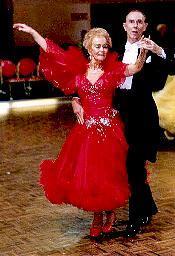
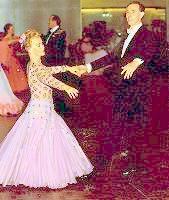
They have many open positions, which makes them attractive
to watch, like the English Old Time,
and unlike Standard Ballroom dancing
in which observers see only the backs of the couples.
The dances also have only the footwork,
alignments and basic holds prescribed,
leaving scope for the dancers to add their own shaping and styling,
which makes them very expressive to dance and to watch.
New Vogue Dancing is now very popular in Australia, being danced at social
dances in clubs and public halls around the country. For example, currently
in Bundaberg, a country town of ~40,000 population,
at the time of writing, there are
New Vogue dances held on
Monday evening (Millbank Hall),
Tuesday morning (Coronation Hall),
Wednesday evening (Coronation Hall),
Thursday evening (Kepnock Hall),
Friday evening (Sharon Hall), and
Sunday evening (Rowers Club).
In the
Dancesport competitions and championships
held around the country, there are usually more entries
in the New Vogue events than in either the Standard Modern Ballroom
or the Latin & American events, and this makes Australian competitions
somewhat different from those overseas,
such as those of North America or Europe.
The Australian New Vogue dances are
sequence dances for couples,
each couple consisting usually of a man and a woman.
In sequence dances, every couple on the dance floor performs
the same steps at the same time, and at the end of the sequence,
the steps are started again. This makes New Vogue dances
relatively easy to learn, as a beginner can easily copy the movements
of adjacent dancers on the floor.
They typically have 8, 16 or 32 bar sequences,
and so need music with a similar
musical phrasing.
New Vogue dances have been choreographed to all the dance rhythms.
In this article, dances are listed for the
Fast Waltz, Slow Waltz, Slow Foxtrot, Quickstep, Tango, March,
Bossa Nova, Samba, Rumba, Cha Cha, and Jive (Swing).
Over the years, many hundreds of New Vogue dances have been choreographed
(Hend, undated; Limon and Butler, undated; Badham, undated)
Many are presented at regular competitions which are held to
provide showcases for such new choreography.
In the end though, only a limited number have actually gained wide popularity.
Over the years, a number geographical variants of many of the dances
evolved, and so in 1967 the Australian Dancing Board of Control
started standardising a subset of the dances for
competitions and dancing championships.
Social New Vogue Dances
Many of the simpler New Vogue dances are sequences of
regular Standard Modern Ballroom or Latin & American 'Steps'.
A 'Step' (also called a 'Figure' or 'Variation') is a standardised
series of movements which has been given a name. The 'Steps' used
in this article are taken from those listed in the syllabuses of the
major dance societies, particularly the
Federal Association of Teachers of Dancing.
Actually, the length of a 'Step' is not fixed, but can vary from
a single step (as in the 'Slip Pivot') to several bars (as in the
'Fregolina').
Nevertheless, these simpler dances can be well described by
a list of the names of the 'Steps' composing them, together with
additional instructions regarding directions and dance holds.
A number of such Scripts are available here in the various
rhythms, each dance being described as above
with simple abbreviations for the directions and dance holds
(described in Appendix A). The names of the dances are listed in
Appendix B.
These dances are more complex than
the simpler social sequence dances described above, and need a more
complex mode of description. A number of books offer tabulations
of the movements for each step of each dance (
Boyd, 1984a; Hesketh, 1989).
For the web pages associated with this project, the dances have been
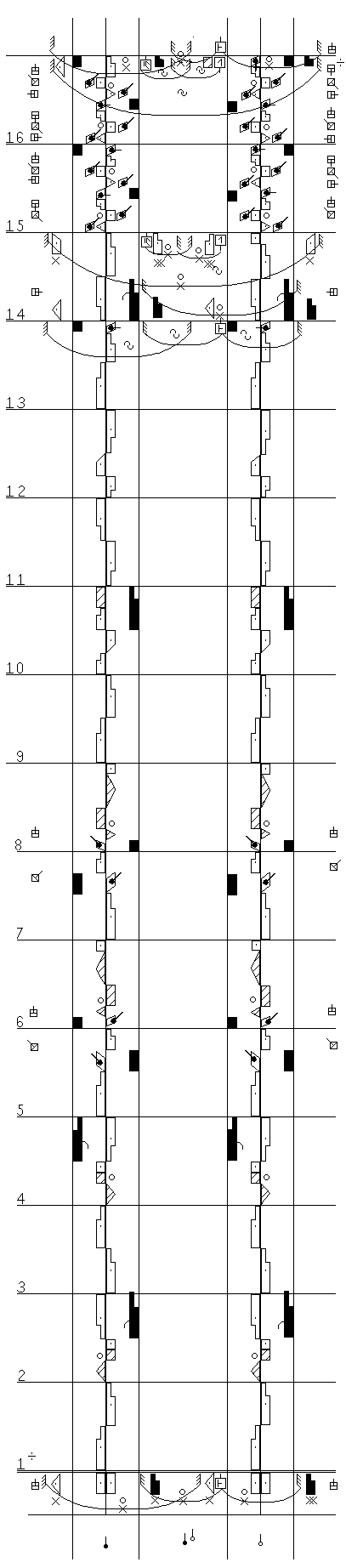
described in Labanotation (Hutchinson, 1954). This is a symbolic graphical
script for describing and/or prescribing general human movement to an
arbitrary degree of accuracy. Most professional dance companies have a
notator on staff who maintains notated scores of the dances in the repertoire
of the company. A number of notations have been internationally standardised
and are used for this purpose. Labanotation is one of these, and it also has
the added advantage that a World-Wide-Web site in Germany has an excellent
tutorial on this notation (Griesbeck, 1996). An example may be seen in
Figure 2, showing the Merrilyn in Labanotation.
As may be seen, the dance is notated on a pair of vertical staffs,
one for the man's movements (on the left) and one for the woman's.
Time advances symbolically upwards, and the dance actually starts at the
double bar line. Symbols below this denote the starting position.
Each staff consists of a central line, with a line each side.
Symbols adjacent to the centre-line refer to weight-supporting
movements of the legs.
Symbols to the left of the centre-line refer to movements of the left
limbs, and to the right of the centre-line: the right limbs. As may be
seen, the initial movement of the man is with the left leg. A symbol with
a nick out of its top signifies a forward movement, so the man may be seen
to step forward onto the left foot and then onto the right foot.
A parallelogram denotes a turn, to the left or to the right depending
on its orientation and by an amount denoted by the pin in its middle.
Thus after his first two steps, the man may be seen to take a quarter
of a turn to the right. The next support symbol for the man is a triangle
denoting a side step, and so on.
The notation is quite easy to learn, but for those who find that
a problem, further assistance has been provided.
In order to understand the Labanotation scores in this project, three special
computer programs called 'LED' (Hunt, 1997), 'LINTER' (Hunt, 1997)
and 'NUDES' (Herbison-Evans, 1997), have been written.
The program 'LED' was written to manipulate Labanotation symbols,
and to create, modify, store, retrieve, and print dance scores written
in Labanotation. It is an editor for Labanotation.
It stores the scores on the computer in files with a simple format.
Each line of the file describes numerically the type, shape,
position, size, level, and orientation of one symbol on a score.
The files for the notation of each dance have also been made available on
the World-Wide-Web, as also has the program source code for the
'LED' ,
'LINTER' and
'NUDES' programs (at no charge, as they were developed using
public finance, so it seems reasonable to make them freely available to the
public).
The program 'LINTER' takes the file of a Labanotation score of a dance
stored by 'LED', and translates it into a set of commands for the
animation program 'NUDES'. From this set of commands, the program 'NUDES'
can produce an animated sequence of a synthetic figure doing the dance.
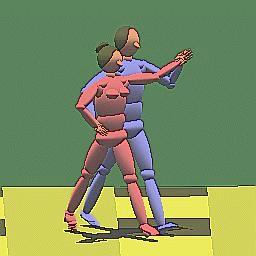
Currently, it will only show either the man (called 'Fred') or the woman
(called 'Ginger') dancing the steps, but
not both, and the viewing frame tracks along with the dancer as he/she
progresses along the dancefloor. The figure dances on a series of
simulated floorboards to allow the eye to appreciate the tracking.
FIGURE 3
Fred and Ginger dancing the Merrilyn together
Various types of output can be requested from the 'NUDES' program.
If a powerful workstation, costing say $30,000, is available to
display the output (e.g. a Silicon Graphics 'Iris'), then a complete
dance can be viewed; and the speed, direction of
view, and degree of zoom can be altered while the figure is dancing.
This makes the 'NUDES' animation far
superior to video as a teaching and learning tool for dancers,
for in a video, the viewing direction and magnification are
fixed.
If only a $2,000 Macintosh or PC is available for viewing the output,
then the viewing direction and degree of zoom have to be fixed
beforehand. If 'Quicktime' or some other similar animation
viewer is available, then the whole of a dance can be viewed.
If only an X-Windows system is available, then only up to 100
frames of animation may be viewed at one time. As most dances are
800 to 1300 frames long at 25 frames per second, this is rather limiting.
The proportion of a dance that may be viewed can be increased at the cost
of poorer quality animation by viewing at say 12 frames per second,
and/or reducing the image size (the default size is 256 pixels square, ie:
about 1/5 of the screen area of a PC)
However, even for these less expensive computer terminals,
the 'NUDES' program can be asked to produce 3-Dimensional output,
and this again makes the computer output superior to video for teaching and
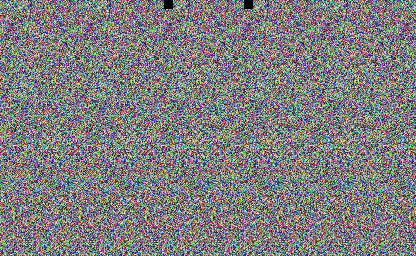
learning dance. There are various options for 3D viewing available from
the 'NUDES' program: freeview or crossview stereo pairs, red/green
superimposed anaglyph pairs, and various forms of autostereograms
such as Wallpaper, Random Dot, and Hybrid.
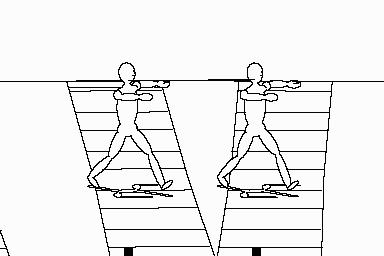
Fred dancing the Dorothea Waltz, in freeview stereo
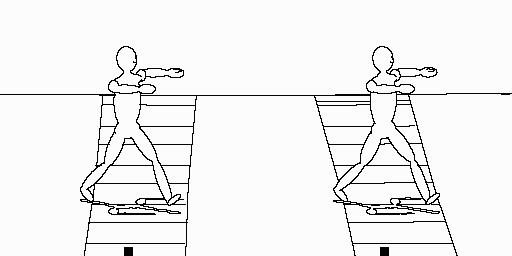
FIGURE 5
Fred dancing the Dorothea Waltz, in crossview stereo
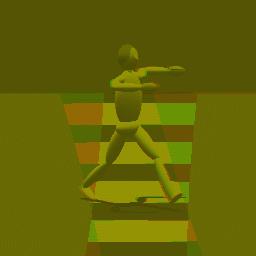
FIGURE 6
Fred dancing the Dorothea Waltz, in anaglyph stereo
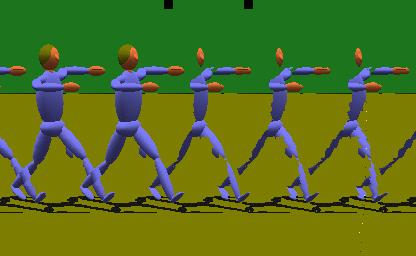
FIGURE 7
Fred dancing the Dorothea Waltz, in wallpaper autostereo
FIGURE 8
Fred dancing the Dorothea Waltz, in random dot autostereo
References
Badham, C. (undated)
Let's Dance Again,
68 High Street, Lismore, NSW, Australia.
Boyd, N. (1984a)
New Vogue Sequence Dancing,
165 Bobbin Head Road, Turramurra, NSW, Australia, Revised Edition.
Boyd, N. (1984b)
English Old Time Sequence Dancing Guide,
165 Bobbin Head Road, Turramurra, NSW, Australia.
Hesketh, R. (1989)
Revised Technique of the Thirteen New Vogue Championship Dances,
Clayton Dance Centre, 296 Spring Road, Dingley, Victoria 3172, Australia.
Hutchinson, A. (1954)
Labanotation,
Theatre Arts Books, 333 Sixth Avenue, New York, USA.
Limon, C. and Butler L. (undated)
Dances for Social Occasions,
PO Box 771, Dubbo, NSW, Australia.
Appendix A: Abbreviations
The Social New Vogue Dance Scripts use the following abbreviations to
describe holds and alignments:
L - left.
R - right.
S - slow (i.e. taking 2 beats of music)
Q - quick (i.e. taking 1 beat of music)
& - and (i.e. taking half a beat of music)
WOW - without weight.
WCW - with change of weight.
LOD - line of dance: anticlockwise around room.
ALOD - against line of dance: clockwise around the room.
C - toward centre of room.
DC - diagonally to centre
DW - diagonally to wall
W - to wall
but both prepared to travel to man's L.
CPP - counter promenade position: facing partner,
but both prepared to travel to man's R.
DH - double hold: facing partner, L hand to R, R hand to L.
OH - open hold: facing partner, man's L to lady's R,
other hands free.
COH - crossed open hold: facing partner, man's R to lady's R,
other hands free.
OEH - open extended hold: both facing same way,
man's L hand to lady's R, other hands free.
COEH - counter open extended hold: both facing same way,
man's R hand to lady's L, other hands free.
SH - shadow hold: both facing same way,
L hand to L, R hand to R.
SSH - semi-shadow hold: both facing same way, man's L hand to lady's L,
man's R hand on lady's R hip, lady's R hand free.
The descriptions in the Scripts are of man's steps:
in SH and SSH: lady's are the same;
in PP, CPP, and OEH: lady's are the opposite foot in the same direction;
in CH, COH and OH: lady's are the opposite foot in the opposite direction.