The Japan Times
March 25, 1995
Through the Doors of Perception
Born from the conceptual advances of Freud, Surrealism came into being as an artistic movement bent on ex-pressing dreams and the subconscious. Though it's the paintings of the Surrealists that have gained the widest recognition, the works that have perhaps best replicated the dream-state have been in film, from Bunuel and Dali, with their "Un Chien Aridalou," down through Deren, Tarkovsky, Brakhage and Jarman.
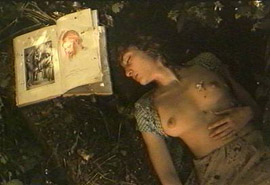
Add the name of Armenian director Don Askar-ian to the ranks of this avant-garde dream team. His latest film, "Avetik," is very much in the tradition of the cinema of dreams - A gorgeous and mesmerizing film, "Avetik" both thrills the eyes but boggles the mind. It takes you on a journey of the mind that leads to heaven or hell - a succulent garden full of bare-breasted goddesses or a frozen steppe of devastation and death.
"Avetik" is, as they say, a ''difficult'' film, a mix of cryptic
metaphor and fantastic symbolism- Just like a dream, not all of it is easily
- or ever - understood. Granted, this drives some people nuts, so if you're
a hard-core left-brain type, consider yourself warned. The director himself
opines that "if a film were perfectly impenetrable, that would be a bad omen,
if not a death sentence for the film… I have tried not to force symbolic meaning
on the film. I very much hope that the film is left open enough for everyone
to draw their own conclusions from it."
If you're still reading this review, then let me suggest two approaches to viewing 'Avetik'. One is the analytical; the imagery comes from the subconscious of both expatriate Askarian and the collective memory of Armenia as a whole. Understand this background, and meaning emerges. The other approach is subjective: Experience the film as an altered state of consciousness, and let your own reactions bubble up from your subconscious.
Such mind games can be as frustrating as they are rewarding, but fortunately Askarian balances the intellectual with the purely sensual: stunning visual images that will haunt your memory and your dreamtime for weeks. Like Jarmati, Askarian is ca-pable of producing images that are unlike anything ever seen before, yet hit you with a primal immediacy.
Try these scenes. A crum-bling and ancient stone cha-pel slowly being reduced to nothing by the vibrations of the military vehicles rum-bling by Anonymous alien soldiers in jumpsuits and gas masks infiltrate through dust and rubble, their flamethrow-er's melting a table full of clocks (warm Camembert to the first person to get this reference). A painted religious mural on a stone wall shakes and the face of the Madonna falls off and shatters on the ground, as columns, of orange and blue smoke shoot into the air. In a ghostly cemetery of hollow-eyed faces carved on tombstones, a woman takes a starving sheep in her arm and proceeds to breast-feed it back to life.
Dreamlike? Definitely, but these images can also be seen as reflecting the realities of ethnic cleansing in the disputed region of Nagorny-Karabakh, where a hot war between Armenia and Azerbaijan has been raging since the late- '80s. Askarian's Avetik is an exiled Armenian, and the film is structured around a number of "chapters," contrasting the bleak angst of his existence in Berlin with his vivid dreams of both idyllic and devastated Armenia.
These include the meditations on Avetik's life in exile. German racism, the genocide of Armenians by the Turks in 1915 (an apocalyptic horror on the scale of the Holocaust) the disastrous earthquake of 1989 (believed by many Armenians to have been caused by Russian seismic weapons), Avetik's memories of the tranquil Armenia of his childhood, and most impressive of all, mysterious imagery based on the erotic medieval poetry of Nahapet Kutchak.
Askarian's most sinking illusion here is to create frames approaching still lifes, where the landscape and, eerily, the humans all remain perfectly frozen in place, while the wind sends random objects spinning in slow motion across the terrain.
If there's one criiticism of this film, it's the lack of a soundtrack. The bulk of the film is without dialogue, and the absence of music as well makes the film more static than it needs to be; the one or two scenes scored with the Armenian duduk flute leave one wishing for more.
Askarian, however, argues his case thusly: "If you think of the words 'sweet sugar,' well, sugar is sweet every time, isn't it? Music in film is like the 'sweet' in the words 'sweet sugar.' If your actors' performances are good enough, you don't need any accompaniment.'
Strong opinions, but Askarian has quite a film to back them up. It's definitely worth a viewing - or two - and if the idea of medieval Armenian poetry seems a little esoteric, well, listen to the director: "There's one big difference between art and Science; for example, if you read an essay on astrophysics, if there's not a set method of instruction it can't be understood. But with art, even without such instruction or other prior knowledge you can learn through feeling it."
by Giovanni Fazio
Other sites:
"Dangerous Light" - The Book by Don Askarian
Don Askarian posters and videos
