Copyright 6/2001. All rights reserved. Please correspond for permission to reproduce.
Our lives are finite, and infinite only by our seemingly endless efforts that exist as we live. For some of us, one quest has been for knowledge, even fancifully for the greatest of knowledge, a grand unifying theory. As my life comes ever closer to an inevitable and abrupt end, the chase becomes more urgent, and less important at the same time. What difference will such a pursuit make? None. For even having accomplished what today must seem like an insurmountable assent into knowledge, still, the personal satisfaction one might expect does not arise. There are always ever more questions, and more answers, and always an ever more grand theory to be gleaned from too short an existence. Theorists want to be correct in the assertions their idle minds provide, however, it is of little consequence if they are entirely wrong, if they have caused other theorists to ask other better questions.
It is not the theory that gives pleasure to the theorist, but the quest. It is not the theory for which he or she wants to be remembered, but the valiant, often quintessentially cavalier, chase. It is not even the theory that is important. It is the measure of the freedom one life bestowed upon one man, the time, the inclination, the books, that personal freedom, the lack of enslavement to other endeavors and other masters, and the overwhelming thrill that it is to share the simpler world so full of wonders with the few companions we are privileged to know, and even more so, those companions, as many are, that shared no interest in common with our pursuit, and instead, just the joy of our company.
I want to express my sincerest thanks and great appreciation for everyone in my life who took the time to share even the simplest of moments with me, especially the simpler moments. Nothing could ever again be so sweet, rewarding or so fulfilling.
Part One - The Theory of Time
Part Two - The Grand Unifying Theory
Part Three - The Fallacy of the Equivalency Principle and Time
Part Four - Wrestling With the Photon
Part Five - The Current Search for Gravity Waves, Gravitons
Part Six - Much Faster Than Your Average Speed of Light
Part Seven - Of the Blackness of Black Holes
Part Eight - Our Terra-Centrist Failings
Part Nine - In Conclusion
Part Ten - Postscript One
Part Eleven - Postscript Two
Part Twelve - The Nature of the Expansion of the Universe
Part Thirteen - Thought Experiments
Part Fourteen - Tackling the Enigma of Inertia
Part Fifteen � Topology at the Planck Length
Part Sixteen � An update, 12/19/03 Frame dragging, and Magnetism, A brief history of Magnetism
Part Seventeen � An update, 10/22/05 Seeking Time Waves, Revisiting the Double Slit Experiment
What is time?
Here, we have a question that answers all, if one can solve the riddle. While during my explorations I have considered many questions concerning the physical nature of the world, the world of physics and more so, cosmology, before seriously tackling the question of time, I always felt a lack of knowledge, an insecurity that somehow there was a blind spot in my perspective on all questions, all theories, and in my understanding. The exploration of the nature of time has provided a surety that has opened up an understanding greater than a vast sea, and, a dead reckoning sense about it, as when viewing for the first time such a sea expanding past the horizon when first glimpsed over a duned beach.
Time, as I shall describe, is everything and the basis for all. Time, and the Universe are both infinite. My instinct now tells me, we may be able to define the process, but never its limits.
To gain a better knowledge of time, one must first consider and cast off parochial beliefs, assumptions, prejudices, and the simpler explanations provided as we began to grasp at knowledge. In the earliest of lessons, we have been given time as a dimension, the fourth dimension, classified as similar to, and following, the X, Y and Z dimensions of the physical universe we inhabit. Nothing could be further from the truth, for time is the first dimension. Without time, the X, Y and Z coordinate system, each a construct of our thought processes, could not, and, would not exist. Neither matter, or energy, could possibly exist without time. Without time the Universe itself would not exist.
Time is misunderstood by theorists, who take it as a constant, even while they know it to be variable. Time is misunderstood because theorists have too quickly given into the idea that it cannot be understood better, and time must therefore, always be approached as a universal constant, even as other theorists know relativity principles have amply proven out and demonstrated that time not only varies, but also, time creates lines of physical demarcation in the world of rock hard substance.
To know time better, the theorist must consider the first law of time. Two rates of time, no matter how diminutively distinct, cannot exist simultaneously in the same place.
This statement, the first law of time, is an inescapable physical law. The first law of time defines an impenetrable confrontation that is created when two different rates of time exist in close proximity. While time is not a physical thing, its passage at different rates gives rise to impenetrable physical barriers at the sub-particle level. The first law of time specifically manifests itself in the subatomic world, by the common occurrence of the confluence that occurs when two time waves converge in a circular pattern, during the regular occurrence of confluence when three time waves converge in a pair* of points, and when the incidental occurrence of confluence for four or more time waves at either a single distinct point or a more rare confluence at two points. Ever more rare events of the confluence of more than four time waves do occur, though mostly under special circumstances. The confluence of two time waves cannot entirely converge until they are exhausted, a theoretical supposition at best. (*Note that the spooky action at a distance of pairs of photons, becomes far less spooky when viewed in this light.)
Time waves are spherical waves emanating from single points in the sub-particle world, creating all we observe as the conventional three dimensional universe. The nature of the time wave is not so much a ripple in space/time as it is the re-creation of it. Despite the ultra-abundance of times waves, which continuously emanate from every previous source of time waves, because time waves are ultra-thin, the convergence of more than four time waves is a rare event, but it none-the-less happens at a regular predictable rate, and in predictable circumstances.
The second law of time is: No single thing can exist in more than one place at the same time, and, conversely, no two things can exist in the same place at the same time.
The second law of time provides a firm basis for understanding space, that which we perceive by the three dimensional universe. The first law gives rise to all things. "All things" are created by the contrast and confrontation of time passing at different rates. The second law of time defines and implies the creation of space as a place for "all things" to exist. "All things" of course, are, all matter, all energy and especially all things in the sub-atomic universe.
In the Twentieth Century we were given the mental exercise of the Big Bang. From the analytical value derived from this purely mental exercise, we can question some of the attributes of time, even if the Big Bang theory is only so much fantasy, a fantasy made by cavalier theorists who thought we might learn of both the beginning and the end of what apparently turns out to be a far more infinite Universe than we might ever grasp.
If we consider the predecessor of the Big Bang, as if it were a good theory, we would find initially a condition of no universe. From this supposed condition of no Universe, we can cognitively and intuitively glimpse the importance of time as the fundamental building block of our very real Universe. What would be the likelihood of a cosmological coincidence occurring in the infinite span of never and nothing, a state of "no universe", that the conventional first, second and third spatial dimensions all would spring into existence simultaneously to the creation of time itself? What a great coincidence it would be that all might all spring forth at one time, if there was no causal relationship between the conventionally termed four dimensions about which we are sure.
Ponderous thought and analysis rules out the first three conventionally termed dimensions, the spatial dimensions, for any one of them being the progenitor of the other two, as well as time itself. Only time itself qualifies as the likely candidate to create the other three as its offspring, and, only time can provide us any logic for the creation of all four of the conventional dimensions simultaneously, as would be required to fulfill the premise of the more than dubious theory of the Big Bang. Time, it is easily deduced, requires at least one dimension, two being more convenient, and three dimensions, like the story of Goldilocks, seems for our abilities to comprehend our surroundings, just right. And again, ponderous thought and analysis rules out any of the spatial dimensions existing without time itself, for they could not be observed.
More succinctly to our theoretical considerations, it turns out the three spatial dimensions are better understood as a mental construct similar to mathematics, and if anything more, then the three spatial dimensions are our evolution-developed mental interpretation of a necessary adjunct to time.
There is no great proof here I can offer. Understanding time as the great progenitor can only be made by conscious cognitive thought by the individual seeking the truth. I can only point the way by providing the first and second law of time. I can only point the way by asking theorists to consider the sub-particle world. This is a pursuit being aggressively taken by string theorists. String theorists however, need cognitive and intuitive direction if they are going to meet with the more serious successes of prediction.
Here, expounding upon a sub-particle world ruled entirely by time, time waves, and time quantum, however loosely it has been framed, we have arrived at a much more impressive universe to contemplate, and, one that can be described by formula, as follows: T=EMC2. That is, all time, T, is equal to, all mass, M, times all energy, E, times the square of the speed of light. Yes, this is a tremendously large product, and, given that time continues to expand as it passes, it is an even larger number than appears upon initial inspection of the formula. It immediately contravenes other physical laws, because we are asked to consider the variables, T, M and E, each continue to increase in value as time passes, and similarly space too continues to expand, demonstrating the inferior descriptive power of the view of the three spatial dimensions, whether in a Cartesian system or the more recent system of curved space/time.
We will not find an end of time, nor, will we find a beginning however some theorists might seek either. From this equation we can however, begin to fathom a universe that is expanding ever faster, and in the process making our three dimensional spatial universe appear ever more odd, contrasting how we conventionally perceive it, even as this Universe based upon time as the progenitor points inextricably towards an infinite balance precluding either a beginning or an end we might be capable of perceiving.
Time, as it turns out, pushes and shoves space ever larger by creating more space. A proof? I offer none conclusive, however, a prediction so outrageous for its distance well outside the understanding offered by other theorists, might foster some appreciation for the likelihood of at least some credibility for the postulate. That prediction is that within the next twenty years, the known universe will expand by our knowledge of it, a trillion-trillion times. That prediction is predicated upon a study of the folly of the history of theorists' scientific endeavors to define the universe, and by honing back the time required to overturn previous conjectures about the universe by our increasing capacity in observational ability. This prediction, incidentally, would have held true throughout the long history of cosmology repeatedly, and it is still a fair wager today, and likely twenty years hence it will still be a fair wager.
It might seem that I am arguing that time is the great creator in the universe, and I am, however, consider also, time is also the great destroyer, utterly destroying and re-making the universe with every sweep of the smallest divisible measure of time, the time quantum.
A time quantum? Yes. Time, because it is variable, it must also be divisible into quantum, for what else could come out of the spigot from which time spews in every direction at once? Could time possibly be infinitely divisible? No. Not if it can be metered, which is what the variability of time implies. That which is infinitely divisible cannot be metered like water running out of a hose. An infinitely divisible time would by definition have to remain constant regardless of conditions. Yes, a time wave is an exquisitely thin brane, but it is not infinitely thin. A time quantum is the single point from which time waves expand into an immediately spherical shape, expanding quite nearly infinitely, but not quite. Light travels upon time waves as an integral part transferable between other time waves.
The time quantum, and its own ultimately indivisible nature, the variability this provides for the passage of time at different rates, is responsible for gravity. The curvature of a time wave creates a statistically attractive force. Bodies of mass, because every particle is ultimately made of time quanta in the sub-particle world, are the greater source of ever more time waves, emanated by time quanta, that is mostly vacant space. Gravity then is explained by the greater curvature of time waves that originate nearby, and subsequently a statistical likelihood that other bodies of mass will be attracted to a body of mass exists simply because there is more local time, and space, and, thus a greater probability the random motion of objects statistically creates attraction. Bodies of mass are made of smaller bodies of mass that are in constant motion, a motion that causes them to drift in the direction of more time and more space, as well as create added momentum as they drift. Gravity is that simple.
The previous statement gives rise to the question of how time waves can create gravity, and yet when man visited the moon, time there seemed to pass at nearly the same rate. Gravity is created by the curvature of the time waves, thus, as time waves expand out and away from their source they lose curvature, providing an ever more flat passage of time as well as less gravity. Thus time waves from the mass just below your feet have curvature we would expect from the circumference of the circle drawn from their source. Time waves that originate at our sun, similarly, have a curvature we would expect from the circumference made when we consider the sun at the center of a spherical time wave made when it reaches us. The sun is 99% of the matter in the solar system, as well as the source of 99% of the time waves that originate from within our solar system. Within our galaxy, our entire solar system makes but a small fraction of a percent of the matter, and a similarly small percentage of the time waves that affect our local time. The maximum distance time waves travel is an open question, one, we can only speculate about knowing that light seems to travel nearly forever.
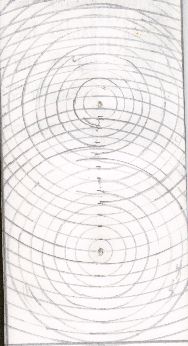
Note in the above drawing how much more interaction there is between the two quanta. This interaction represents how the curvature of time waves is responsible for gravity, e.g., there simply is more time between the two quanta. The difference turns out to be small when we add the complexity of the structures that develop from time quanta interaction, and, because of the super abundance of time waves that exist, compounded many times over by many quanta that make up a body of some mass, gravity does have an effect. The drawing is made in two dimensions only, and, a time wave is actually a spherical wave. Also note the mathematical prediction possible by determining the plot of the difference in interaction between two quanta at varying distances.
Considering the curvature of time waves, the increased time caused and resulting from the close proximity of two quanta, there simply is more time between the two quanta. Here, we have a basis from which to deduce there is a mutual acceleration between the two quanta, even while there is no apparent motion. Because there is more time between, we can assert acceleration, which is a time dependent observation. Time is like an explosion, a constant transformation of the physical world emanating from all sources of time waves, time quanta.
The effect noted above is strong between two adjacent quanta at the sub-particle level. Clusters of quanta exist as groups of overlapping spheres. However, as we step back to the subatomic level, the statistically attractive force diminishes in strength because of the canceling affect of many quanta working one against another. Cumulative rivulets of more time run up in between clusters of quanta. These rivulets ensure spin, which in turn buffers quantum clusters. As we step back again to the macro world in which we exist, the effect of a planet built of time quanta makes gravity a strong force.
We should perhaps consider also, time waves that originate from the most massive of black holes in the universe must dominate the landscape of the passage of time. Time waves have no mass, and therefore easily escape a black hole's gravitational attraction. Here, we find the basis for the fact that our universe is connected by forces that provide the nearly universal surety that a centrifugal force can be created nearly everywhere within it. The exception might be at or above the spinning pole of a black hole where the three dimensional universe is twisted endlessly.
In our era of discovery there are those who are excited about the possibility of time travel. It is an interesting question. According to relativity, theoretically, it is impossible to travel faster than the speed of light, which I have re-defined as the speed of time. It might be possible to travel faster than the speed of light and time, but this does not yield a negative travel in time for we must consider that were we able to travel faster than light or time, time at the place where we originated our trek would still elapse as we traveled, and while we would be able to observe things that happened in the past by looking behind us, we would have to do so from an ever greater distance. The return trip, would negate our ability to view that which happened in the past.
So, if time travel is possible, it might only come from the ability to shield a vessel from time waves, and then, find a way to either propel that vessel forward or backward in time. Time inside such a vessel would pass at an excruciatingly slow pace shielded from the time of the universe, and left to only that time which passed within the vessel. I have also had it suggested to me that it would be impossible to move all the mass and energy in the universe either forward or backward, but what is required to be accomplished really is to move time, for all matter and energy is made of time and its interactions, and nothing more. We therefore can hold out hope, however faint it might be for our meager intelligence and abilities. Shielding time waves is a prospect for which we might find a path, and for which there would be applications other than time travel. I have absolutely no insight into how to then propel such a time-shielded vessel either forward or backward in time, however.
------------------
3/04/03 Addendum:
I apologize for the rambling nature of this text. Scientific discovery can be slow or fast. Theoretical inquiry on the other hand can be just as difficult, while even being more prone to rambling statements that are difficult to comprehend.
I recently was able to better grasp and phrase the nature of gravity. This new description complies with what I previously stated, but adds a new twist as well. I hope you have on your thinking cap.
Gravity, it has been said, is like acceleration. Ah yes. But our conventional view of acceleration doesn't fit well our notion of gravity, so, let's give acceleration a new definition.
Acceleration is conventionally perceived as moving matter through space. Unconventionally, we can perceive of acceleration as moving space past matter. This is the key to gravity I now provide you. The expansion of the Universe is a very real and excitingly dynamic phenomenon.
Gravity can be perceived as the expansion of space and time that emanates from a body of mass flowing past an object that feels the force of its gravity. Here with the unconventional description of acceleration we find gravity to be a simple phenomenon.
The implications of this new view are staggering. It provides a duality to the force of gravity that has previously been observed, but explained away by the chicanery of scientists and theorists for centuries.
The ocean tides of our planet, coming as they do once every twelve (not twenty-four) hours, are an example, as is the so-called solar wind. Both of these phenomenon are due to the previously over-looked dual nature of gravity.
While there is more time and space beneath our feet, something which causes a statistical flow in that direction, and, that holds us to the planet, the space and time created by the matter of the planet also directionally moves up through our feet, up our pant-legs straight out into space dissipating at roughly the square of the distance. This local density of space and time that causes a so-called gravitational attraction moves directionally away from the planet in a constant stream. This directional stream, in a statistical sense, provides a statistical opportunity for free flowing matter, liquids and gas, to move with that flow.
Even more remarkable, the implications of this view for black holes allows for two things. One, eventually a black hole will become so massive, nothing can enter it because space and time fly out of it at a density (again because of local curvature) that from a directional perspective overwhelms all the otherwise dominating influence of the time waves of the rest of the Universe. And two, the newly born time quanta surrounding a black hole will fly away from it instead of being attracted irrevokably into it. There is the birth of a galaxy.
This startling perspective also provides a hint as to where the missing "dark matter" of the Universe may reside. Because so much time and so much space is being created by sufficiently massive black holes, from our vantage point, we cannot view much of what is transpiring near and surrounding such a black whole. Much of the mass that has been created by the confluence and creation of time quanta that is involved in a black hole complex is simply moving away from us at such a high rate of speed, (within that localized region of space), it will not arrive at our telescope's eyepiece for eons, if ever.
Looking at this persepective also reveals something remarkable about the structure and evolution of galaxies. Spiral galaxies in particular might very well be made by two black holes locked in an infinite embrace unable to reach each other because of the continual creation of space between them. Their complex dance of course would be hidden from our view because of all the time and space continually created around their dance floor. The arms of a spiral galaxy could be what has emerged from the edge of the abyss where they embrace.
Best to all!
------------------
------------------
3/06/03 Addendum:
An Open Letter Addressed to All Cosmologists and Physicists Concerning the Nature of Gravity and the Current Search for Dark Energy
It has been my pleasure to be a casual theorist for decades, pondering the immutable and inigmatic Universe. Tackling the most difficult of questions has been my inclination, and, without academic credentials or standing it has been made if not a far easier task, certainly far more enjoyable than it might otherwise have been. With this meager yet truthful introduction, I state my purpose here, to define gravity and shed a light upon the Universe as yet unseen by others.
A. Einstein gave us gravity as similar to acceleration, but failed to provide us with any insight into the phenomenon currently known as dark energy. Mr. Einstein's cosmological constant, I remind all of you, was not meant to provide for a runaway universe, but instead, a steady state Universe, something for which I too have a strong penchant. Were Mr. Einstein alive, he would marvel and rise to the challenge to address these conclusions he apparently missed.
Current scientists and theorists are either wildly myopic or madly hyperopic in their inclinations, couched in irrelevent academic necessity as they are. We should all be thankful for these prideful pursuits, which are better left to those who peer through shaded windows seeking a better view of the Universe.
Acceleration is defined as, the act of increasing velocity. It is a definition that falls short of any description of gravity we can readily comprehend, so A. Einstein's ascertation of the similarity between acceleration and gravity can only provide us with a light brush stroke as to its significance. We therefore need to take a closer look at what is meant by acceleration.
While the conventional definition of acceleration is something meant to describe a phenomenon as it is applied to matter, an unconventional definition of acceleration might lead us to observe that if we had the ability to move space itself past an object, the object would feel acceleration. Consider that for a while while I splash a little tepid water on relativitity theory.
Anyone schooled in relativity theory should not doubt it is possible for space itself to move past matter as I have unconventionally described acceleration. Is this the key to gravity? I think so, but, the implications of this line of reasoning do not stop there. Here, we must consider inertia and by comparison the minor local directional movement of a component of space away from a planet. Gravity can therefore be better understood as deceleration, though it is not a deceleration we would recognize, unless we perceive of deceleration as restraining potential momentum.
Here's an interesting thought experiment that substantiates this new view of acceleration and deceleration. Were we to drill a tunnel through the earth, pump all the air out of it, blindfold an observor and drop him into it, he would not feel acceleration as he fell, any more than he would feel deceleration as he came to rest on the other side of the earth. As we stand upon the earth, what we conventionally view as gravity, is actually better viewed as deceleration, where the potential to fall, potential momentum, is restrained by the earth below our feet.
A Universe of curved space time expanding ever faster where the source of the expansion is matter makes for some challenging problems for physicists. It is the source of great potential for insight.
Space itself is emanating from bodies of mass, depleting as it does at roughly the square of the distance. And "dark energy" has thus had a light shed upon it.
Is there any evidence that readily comes to mind for such a close up experience of the recent and spectacular observation of our Universe expanding ever faster? I believe there is.
The first observation that came to mind for me was that we have high ocean tides twice a day, and not once a day, as conventional gravitational understanding might predict. I remember a specious argument about the attraction of water molecules accounting for the second, moon opposite, high tide from my days in high school Earth Sciences class. Does this too account for the tidal movement of the atmosphere?
The second observation that comes to mind is that our moon is apparently traveling at escape velocity, as is our planet, and likely all the others. It seems the so-called solar wind needs closer study, as does the reason the tails of comets always stream directly away from the sun as they pass by it.
And what of all the stars revolving around all the galaxies too? Need I point out to cosmologists that these too are in escape velocity from the centers of their respective galaxies?
Gravity is acceleration, for space created by the mass of the earth is passing up through us as we stand upon the earth. Space itself is emanated from bodies of mass, and the density of more space and more time beneath our feet pins us to the planet. It is simply statistically more likely the matter that makes our bodies will move in the direction of more space and time.
But how then can this provide us with two high ocean tides? The space and time created by the earth and the moon combine their densities on both sides of the planet, this is how. This is why the tails of comets always trail away from the sun, e.g., relative to the sun, directly behind a comet there is ever so slightly more time and space which corrals the meager scattering of particles that emerge from comets as they warm in their transit.
Theorists and scientists can put these mysteries on shelves in back rooms for only so long before the cumulative effect of the obstinance of their existence consumes the credibility of science itself.
Yes, it is going to be an incredibly difficult task to atone a Universe in which space itself is expanding at every corner and in every nook and cranny of it, but, it is time to reconcile and remedy relativity theory as the static snapshot it is of our far more dynamic Universe.
Don Robertson
I would be utterly and totally remiss were I not to provide the caveat required of my creed, the theorists. Theorists are made of idle minds and mischief, too often far too vain to provide the proper caveat. Theorists are the most dangerous beings on the planet, and at the same time those that hold out for mankind the greatest promise, both from our own perspective of mankind as well as what those who encourage us would hope. But we are prone to pranks, and reticent in the affairs of our failure. So I state it here concisely: I not only could be utterly wrong, I also might be providing mankind the seed of its destruction by my idle pursuit here. I know not the likelihood of either, though I suspect the likelihood of one or the other is better than fifty/fifty. Such are the odds and dangers theorists hold out for mankind.
I should also add, of theorists; theorists know they think not with words so much as with instinct, a gut feeling. A theorist's words, while they may be elegant, they cannot convey that instinct, not the gut feeling they had as they devised their theories trying to avoid contrivance at every level, but always failing there. It has taken many months to write this work, which may be read in a single sitting. It has taken a lifetime to develop the gut feeling of having made, and corrected so many mistakes in the past, so one can think with surety, and still, it is possible only to convey a small part of it to the reader. You will not find my thoughts here, but you might find your own, your own instinct, and a gut feeling that given all your other experiences will allow you to achieve some personal satisfaction more than did I here at this juncture. You will know this feeling, if and when you attempt to write the thoughts down for yourself, and for others to read.
The search for a grand unifying theory has taken hold of theoretical physicists for nearly a hundred years. It has mostly been an ardent but idle pursuit, a mental exercise more designed to provide other answers, as well as other questions, than the pursuit of a grand unifying theory was ever thought by anyone to produce a final result. And this indeed is not what I intend, or, could ever, offer here. My theorem, postulate and supposition is to provide what I believe is the base unit for the universe, the smallest building block, the time quanta, from which all else is created, and ultimately into which all else can be de-constructed.
Physicists at CERN have smashed atoms into ever smaller bits, tiny fragments of the subatomic world, and string theorists have used mathematics applying known physical laws to postulate about the smallest of the small, and indeed each has uncovered many realities that can be interpreted many different ways in the disparate search, each creating yet another field of science. Often theorists have to question if the problem of asking the right question, isn't more a problem of semantics, than it is anything else. We are always ever so close to the next breakthrough, one more nap, another night's sleep, perhaps the inquiry or obvious mistake of a colleague will point us in the right direction. Perhaps it might even be yet another paper that needs to be read? The idle mind is a fertile ground for the theorist's discovery.
I come to you with a most idle mind bent on offering up the time quantum, a source of rapidly expanding spherical time waves, as the single base unit and ultimate building block for the entirety of the universe. I expect few early converts, but I would hope all would be inquisitive enough to ponder the thought, that it is true.
I would hesitate to tread here, were I more inclined to win favor for my work, or, had I a professional standing with which to wrestle. Though alas, I care not, and, indeed have none of this baggage to pin me flat against any tradition, or, the work of mentors. So, I bring to you the worst news available to any theorist, as well the best. Hold these truths close to your innermost interest.
Mathematics, and indeed all scientific pursuit is based upon the equivalency principle, the most fallacious of any argument ever put forth in the annals of our work. The equivalency principle has never been appropriately stated to the best of my knowledge, probably because, to state the equivalency principle as a theorem is counter intuitive to the needs of our limited ability to reason. Indeed, It would be a scientific heresy to state the equivalency principle as if a theorem, and yet still, here I am, with absolutely no predisposition against such heresy.
The equivalency principle states: It is possible for two things to be exactly alike.
Oh! How thankful we all should be that the theorem is not true, for, were it true we would indeed be in a terrible fix.
What anything is, is made only of the relationships it has with all other things, and were the equivalency principle true, we would be caught in an endlessly and forever unpredictable duplicitous Universe. As theorists, we are hopefully adept at seeing similarities, though when we make progress it comes from the concentration of our efforts made seeing relationships, relationships that can truly help define the Universe, instead of cluttering it with unknowns, and questions of duplicity and beyond. It is the relationship principle which declares that no two things can be exactly alike. And, unlike the equivalency principle, the relationship principle is indeed a true theorem.
What the implications of the relationship principle hold for a conscientious study of time helps us define the nature of time best, for time, is the relationship that exists between time quanta, all time quanta, as they alone create the complexity of the Universe. Were there two time quanta alike, in every way, we would find our Universe exactly shadowed in every feature, forever leaving us the question of which Universe we were discussing, experiencing or examining. The dream world of other-worldly dimensions, thankfully, does not exist. Time has mustered this Universe, and, thankfully, time, the time of our Universe, can only exist within the close proximity of our Universe. However strenuously we might struggle to understand this Universe, questioning the existence of parallel Universes is merely a modestly useful mental enterprise, for, were there a relationship of another Universe to ours, it would be within ours, as relationship, the principle of relationship is what makes our Universe.
So, we are left to question, if it is without mass, if it has no dimension beyond a single point, and if it is like every other time quantum, indivisible into anything smaller, what is a time quantum?
Except for the distinction of its unique time, and as a consequence, its place in our Universe, there is no defining difference or description we can give to a single time quantum. The truly defining character of the time quantum is the relationship it has with other time quantum, and how the time waves, which emanate from every time quantum, interact. Any one of all the time quanta in the Universe can be components of, a photon, an electron, a proton, a gluon, an atom of gold, a molecule of water, a school bus or a neutron star. It is the relationship with other time quanta that makes them what they are. And again, this is the relationship principle at work at its finest. Here again however, we must remind ourselves of the fallacy of the equivalency principle. While every time quantum is exactly like every other time quantum in every aspect except one, its unique time and place in the Universe, it is its unique time and place in the Universe that distinguishes every single time quantum from every other. Its unique time and place also defines best what each time quantum will be in the Universe. The fallacy of the equivalency principle is thus held true, and, thankfully, the Universe is saved from any excuse for duplicity.
Still, we will have those theorists who seek solace for their labored perspective of the complexity of the Universe in a multi-dimensional description, but, while it is here where theorists have both made significant advances in our understanding by allowing other theorists to disprove and discredit their view, as well as learn from their experience, it is also just as well where theorists have made ever greater blunders. The Cartesian Universe exists, if we could hold it still for just a moment. The Universe of curved space time exists, if we could view it from a single perspective at a finite distance. Alas though, neither is possible since the Universe in which we exist is entirely made of time, a perspective from which there is apparently no escape, to view it as still for a single moment is ludicrous, just as there is no distance that will ever remain constant for even an instant, because time is an explosion. The peep-hole view we have of the Universe, is a view that only allows us to view the Universe as it was, and whether our view is from atop a mountain and through a grand telescope, or whether we peer through our eyes first opening in the morning before we have found our glasses, when only the end of our nose comes into view, we can only see the Universe, as it was, and never-ever how it is. All our vain efforts made to describe how the Universe will be are forever doomed to approximations of the course of the mesmerizing chaotic explosion of time everywhere in the Universe.
This is the lesson theorists have failed most miserably to learn from the chefs, the observational scientists. Like a really good soup, fate is not defined by the predictability of the Universe, but rather, quite thankfully, by the predictable uncertainty of it. The only thing certain for the theorist, should forever be, our pledge to make ever more grand mistakes as our predictions get only slightly better. It is our crutches, the devices we make, which cause us to stumble and fall so hard upon reality.
Oh! The heresy of it all!
The photon is remarkable. The photon, as it invariably comes to us from out of the past, is the basis for the vast majority of what we know about our Universe, large and small. In classical physics, the physics of the 19th and 20th century, it seems to be both a wave, and a particle. It cannot be both, and more likely it is neither.
What is remarkable about the photon is that it travels at the speed of light, or as I have re-phrased C, the speed of the time waves upon which the photon is carried. The photon is remarkable under the classical description of it, because, according to relativity theory, while a photon travels the maximum possible speed, it also is oddly described as having a mass.
A time quantum, has no mass, though it does have what we might perceive as an attraction in the proximity of a second, or more, time quanta, which is caused by statistical necessity created by more time existing between them, and, as it is affected by random movement. This phenomenon has already been shown in the drawing of a two dimensional representation of the interaction of the time waves of two time quanta, and already discussed. It could be said though, it is possible to perceive of a time quanta as having a mass, even if it would be a serious misnomer, one intrinsic to the semantics of our science. While it is partly true, because, a time quantum is the source of time waves, it is not, at its inception, a wave, and as such, at its creation, it has no perceivable mass, it is not a particle, and it is not a wave, though, it can emanate spherical time waves.
It has also been stated herein that the confluence of more than two time waves under certain conditions, causes a time quanta to be created, in essence from nothing other than the confluence of time waves of other time quanta. This is best understood as the explosion of time in our Universe. Note here, that as of this writing, I do not know how many time waves intersecting at a single point in space it takes to create another time quantum, and though I suspect it happens, and that it happens quite frequently despite how rarely it happens in comparison to the numbers of time waves, and time quanta, that exist. It certainly takes more than two waves intersecting in confluence, which, as already described, meet in a circle. Again, three time waves can intersect at two distinct points, four at one point. Because of the super-abundance of time waves, three time waves intersecting in confluence happens literally many trillions of times every time two time waves intersect in confluence. Two time waves intersecting in a circle is so common, it should be said, this happens trillions upon trillions of times to every time wave. More so to our discussion here, it should be noted, the geometry of intersecting spherical waves traveling at the speed of light is quite interesting, and, it takes a nimble mind to begin to comprehend the complexity of how these waves can intersect and interact to form a confluence at points for three, four, five etc. time waves.
A single time quantum, one brand new to the Universe, and created by the intersection of time waves confluencing at points, and/or a single point, seems then to be a super-abundant thing. And despite how many there are popping into existence permanently all the time, because each is a single point or a pair of points only, at their inception or birth, they do not take up much room in what we perceive as the three dimensional universe. It is by their vast numbers we find them bumping elbows to create, literally, ever more space in the Universe.
Light then must be a single newborn time quantum of no mass, and not yet producing time waves itself, being caught at the instant of its creation upon the wave of another time quantum to be carried at the speed of C with its birth suspended and without time enough to begin to radiate time waves itself as it travels until it is stopped, and captured by other time waves allowing it to sit still, and begin to radiate its own time waves.
I've not yet considered satisfactorily the exact number of intersecting time waves required to permanently create a time quantum, nor, under what conditions a time quantum swept up at its inception by a time wave of another time quantum, might be slowed enough, for a long enough period of time, to begin emanating time waves, but, because at birth a time quantum has no mass, it can travel upon a time wave nearly forever. In fact, a time wave, can carry so many new born time quanta upon its wave crest they provide light for telescopes from a star in all directions for a distance of many billions of light years. We take it all for granted, but it is a marvelous thing.
We must consider the reflective and refractive qualities of light we know exist. We should also consider what we are describing in our minds, knowing that every body of mass emanates what are termed electro-magnetic waves. Consider the Sisyphus misnomer that we know what we mean by the term electro-magnetism, a vestige of the 19th century's fascination with electricity, as if it might explain the complexity of the Universe. Franklin, Edison, Marconi, and Tesla would be proud of their work, but surely not that proud.
What we might consider most important about the photon, is, if a photon has no mass, which I suspect, as we understand it as a time quantum, it is likely to be the building block of the Universe. Having no mass, seems to dictate this assumption.
When I step outside at night and gaze upon the Milky Way, the stars close enough to earth to view well within the Milky Way, and upon Andromeda when I can spot it, ever so much further away, as well as the planets wandering, and the moon, I no longer see bodies suspended in the heavens. I imagine time, and time waves emanating from each of these bodies spreading out, around and past each of them right to me, and through me. It is a marvelous view.
The graviton, I, like everyone else within our small and just barely intelligent species, have never seen, though many have imagined it. I have never understood it well, though well enough to understand that, if it exists, it cannot have a mass. If the graviton had a mass, it could not possibly escape a black hole. And, yet, if it doesn't have a mass, it cannot be what it is that some theorists claim it is.
Gravity waves, on the other hand, seem quite logical, as they might emanate from a collapsing newborn neutron star, or newborn black hole. Whoosh, and something must be detectable from such an event. I grasped it well, once, though still, I had no sense that the graviton could possibly be part of this Universe. Still, how fast a neutron star must collapse inward, what a colossal force it must be, and how could it not be detectable?
As I have stated, I've come to the conclusion that gravity is a statistical phenomenon, more time beneath our feet, and the random movement of all the particles in our bodies, pins us to this vast and massive earth. And, within this understanding, I question how we might detect a wave from the collapse of a neutron star. If such a star collapsed at the speed of light, well, that would be another matter, but a neutron star could not possibly collapse so fast. So we must rely upon the massive temporary statistical shift, but one made from a great distance.
There is currently a test of the theory of gravity waves planned by a NASA program, one that will send two satellites into space to measure the distance between them with minute accuracy, using lasers. I understand the theory, but believe they will not find gravity waves, not this way.
The best test to defuse the prospect of detecting gravity waves might be coupled with a search for the spectacular shift in spectrum that must occur as a neutron star collapses, and then to compare it with the results of the aforementioned experiment. It is rare when an experiment is set up so that it can disprove the theory upon which the premise of the experiment is based, so I expect the search for gravity waves, as well as gravitons, to continue for some period of time yet.
Here, I must interject, I owe a compliment to Brian Greene, and his work The Elegant Universe, and more especially for his description, and illustrations, of the Thomas Young 1880 double slit experiment. I include two of them here.
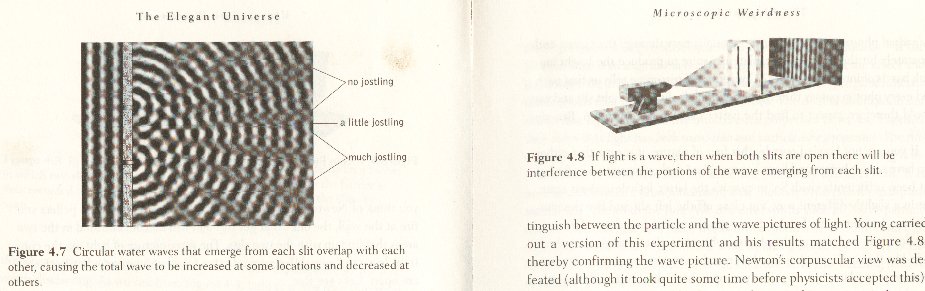
It seems to me there might be a way to detect the effect for which gravity waves are predicted using a variation of the 1880 Thomas Young double slit experiment, especially noting the patterns made in the illustrations, if the collapse of a neutron star causes a sudden stretching then concentration of time waves, and, the collapse brings together much closer time waves than emanated prior to the collapse of such a collapsing neutron star, and, if we could view the pattern as those time waves passed through the pattern we see displayed by the Young experiment. We might detect a minor variation passing through a wide splay of the Young experiment. The effect would be explained, quite surprisingly, as that of deceleration followed by acceleration.
For such an experiment, we would have to consider that time waves travel at the speed of light. The splay of the pattern observable in Thomas Young's double slit experiment would necessarily have to be viewed as wide as is possible. But still, the effect might be made to be observable. Were the experiment to prove out, it would be quite like pulling a rabbit out of a hat. Still, and, none the less, we'd have a real rabbit, quite unlike gravitons.
Thomas Young's double slit experiment is quite often pointed to as proof of the uncertainty principle, perhaps better referred to as the I don't understand principle. I do not however, make light of the great theorists who first propounded this principle. Their contribution has been to leap-frog, and transcend, a misunderstanding forging a greater understanding by there acceptance of their failure to understand. Were any theorist alive today to have the chance, these theorists would prove their meddle in the interchange of ideas, for they come from an era of tinkerers longs since, and, for me, quite remorsefully, gone.
All theorists make a living based upon their heightened understanding of that which they have observed and do not understand, and these men in this era made great strides by far surpassing that which previous theorists thought possible. They did so by questioning the simplest of assumptions. And, even while it infuriated other more staid theorists, they persisted, and persisted, overcoming the uncertainty of their questions, until they arrived at answers that drew the praise and thanks of those same theorists.
Few theorists wish to be remembered for their mistakes, and even fewer are. Most are remembered for the questions they raised, and, here there is no greater homage that can be paid any theorist, than to question their work and their findings, thus adding to the body of knowledge for which they are remembered. Were they alive today, this is how they would wish to be engaged.
How scientists first measured the speed of light, is an account of truly marvelous innovation. And again, it was the tinkerers who shed light upon the subject, and, in a manner fitting the era. In the hundred years since, it is a sad comment about how our cloistered academic and scientific endeavors have failed so, to build on what was then, the true genius of mechanics and tinkerers. I suppose the attitude is, if we've found the speed of light by this method, why then should we continue to perfect it in order to look for anything faster?
The maximum-ness of the speed of light is being challenged, and, defended by the question-test of whether or not "communication" can be accomplished at these greater speeds. A hundred years ago Morse Code would have proven communication, e.g., dot and dash, and I suppose ones and zeros today would suffice, similarly, on and off. But what of the speed of light, the theoretical maximum speed of anything?
Ah... Here we need merely ponder time waves as they grow ever larger eventually enveloping nearly scale less distances.
Time waves travel at the speed of C. They, like many other waves, electromagnetic, and even shock waves under water or in the air, are spherical in shape, traveling in all directions from a focal point.
I ask you to consider two time waves only, two whose origin is separated by a vast thousand-parsec-fold measured distance. Many years will transpire before they meet, each then having become part of a gigantic sphere, and, neither will ever entirely envelope the other. As these two time waves meet, there confluence will begin at a single point, a single point on each of two gigantic nearly flat sheets that from a further perspective, both form perfect spheres, the outer edge of each is quite nearly flat, but not quite. Where they meet, each sheet is traveling at the speed of C toward the other, and after they meet at a single point, their confluence forms a circle, a circle that spreads out so much faster than the speed of C, not twice, not even three times, but at a speed relative to the distance between the two gigantic spheres only. It is a wonderment before the eyes of theorists who can comprehend it.
Can light travel upon the conjunction of such a confluence? We should begin to look for it. And indeed, if we find that it can, what of two disproportionately sized spherical time waves? And, what then might be the trajectories of such precariously placed photons, or as I have asserted, new born time quanta?
It is not merely a wonderment, it is a question.
For all the mathematical calculations, each based upon theoretical models, one holds a tremendous fascination for theorists, black holes, utterly unobservable except through inference, utterly unknowable, except through speculation. Ah. What and how idle minds can spend countless years contemplating the uncontemplatable.
The theory of black holes is based upon the observations and predictions of the bending of light by gravity. As the theory goes, at a certain critical point the gravity of a star becomes strong enough to prevent light from escaping its gravitational pull. The theory of black holes has been conjured to mean the very end of matter itself, a place from which nothing can escape, and all that enters dies a sure death through tortuous annihilation.
I must admit, I spent enough of my own time contemplating the meaning of black holes to have come up with many wrong answers, and just as many meaningless questions. We, theorists, who contemplate black holes, are about as likely to achieve success as a blind man in the stone age might have at contemplating the bottom of the ocean. Still, such is the lot of the theorist, and few who do not tread into these deep waters will make any difference at all, and none will ever have a chance at posing the right question, the one which will provide an advancement in understanding when it is re-thought by better, more nimble, and less polluted minds.
So, let me clutter the obvious shortcomings of our meager annuls.
Is a black hole truly black?
Well. We can only speculate here based upon what we know of the workings of the physical laws in our own locale, which is absent a black hole upon which to gaze. Still though we can question our simple assumptions.
The photon is widely claimed to have a mass. I have questioned its mass based upon the speed at which it travels. It is unlikely the photon could travel at the speed of light, were it to have a mass, and thus traveling at the speed of light, it is unlikely to have a mass. Furthermore, relativity theory states, that if it does have a mass, it must be extremely heavy traveling at the speed of light. This conundrum of relatively seems to undo and undue the prospect of a mass for a photon.
We can work, and re-work these assumptions until there is not room left to argue the mass of a photon, and yet, a photon, when it comes to rest, apparently does have what we perceive as a mass. At the same time, contrary to our suppositions, it can have none when it is traveling at the speed of light, or, when it is suddenly pushed to that speed.
So, if there is no mass in light, how then does gravity bend light and thus form a black hole? It does not. Period. The effect of gravity upon light termed bending is one of refraction, and not attraction at all. If black holes are black, and I doubt they are, it would be due to their opaqueness because of extreme refraction of the light within.
What theorists are saying, when they say, nothing can escape a black hole, is, the escape velocity of such a star exceeds the speed of light. They are talking about the escape velocity required of another body of mass, like a rocket ship.
This supposition is based upon an understanding of gravity as a force of attraction that is unequivocal to any further reduction, as well as, the idea that the photon has a mass that is directly acted upon by gravity. Neither is proven, and, likely, neither is true.
Other theorists have taken the conjecture further and computed the mass required to crush the atomic structure of atoms by gravitational forces. Here, we have seen the bizarre attributed to the unknowable. It should easily suffice to consider, at the center of such a massive celestial body, gravity, here described as the crusher of atoms, would be exactly equal in all directions. Such a place within another place made of crushed atoms would indeed be bizarre and unknowable. Still, we must question does pressure affect the transmission of light?
Other theorists have described how time speeds up as one approaches a black hole, and we can extrapolate from this supposition that it might be impossible to ever reach the surface of a black hole, because there is simply too much time required to traverse the journey, and, I would suggest, perhaps no where near enough idle time to contemplate the implications of such a prediction. I make light of these things, but merely because theorists cannot agree what gravity is, let alone agree about its effects at the extremes.
From my perspective, the attribute of a black hole most interesting, is the creation of space that must be occurring. We can glimpse it by considering what might be the source of an ever increasing expansion of the Universe as a whole. If as I later conjecture, the expansion of space is proportional to the local mass, black holes might become a little less black, and, far more interesting for theorists to waste their idle hours considering.
For time immemorial theorists have held a terra-centrist view of their surroundings. It is a forgivable sin, but not our failure to acknowledge it. Here we are, now, in the Twenty-first Century, a time when the most renowned theorists of our day predict our ready conquest of a Grand Unifying Field Theory, just as if others had already proven such a theory could prove anything, while others still debate whether or not there is life anywhere in the rest of the known Universe. Science demands proof and skepticism. Science also demands we accept things that clearly are untrue, and far too many more other things for which no proof has ever been shown.
According to the best minds, the Universe is but a mere twelve-billion years old. According to other theorists of another discipline, life began on Earth 3.5 billion years ago. Are we to believe the entirety of all can be defined by our meager species as a length of time, for a quarter of which, life has been ongoing on this speck of a planet in the grand scheme everything? What rubbish.
There are plenty of surprises yet to come. There is plenty of room for err and speculation too. There is no reason to feel shame for any of it. Most of what we assume is true is based upon false premise.
So, let us contemplate that life on this planet has existed for a quarter of the age of the Universe. Oh! How lucky we all are! What a lucky coincidence the consequence of our heritage took place when it did. By this measure, it seems almost as if the Universe were made for us. Having begun with the Big Bang, it seems the makings of a universe is remarkable for being nothing more than a more fantastic re-telling of the story of Genesis in the Old Testament. In the beginning... What an ageless human quest.
Such is the pursuit of science, and especially the theorist, who is forever besieged to conform to the expectations of our heritage. For any young aspiring theorist today, men and women with fascination in their minds, I can only wonder how they might manage all their requisite studies, and still remain whole and sane enough to trod on. Life is short, and I can only add encouragement by stating, when a moment of inspiration seizes you, if you let it get away, you may never forgive yourself.
Take your guidance from the edict that we should make everything as simple as possible, but not simpler. That is the real duality principle, for no matter how simple we make our understanding, it is too simple. No matter how complex our understanding might become, it too complex. From both extremities of our knowledge, the theorist forever seeks to refine complexity, and re-define that which is exquisitely simple, but which others have been predispositioned to overlook. Theorists can either play their tunes with marvelously skilled dexterity, or, the utter clarity of a clap of thunder. There is rarely an opportunity more fortuitous than the one offered, today.
I have not come here to prove anything, and neither have I. I have come here with the intention of drawing attention to the deficit of our training. Time needs to be explored, and re-explored by far greater minds than mine. No one will accomplish the task by being shy about it. We will not accomplish the task by accepting, or leaving anything unquestioned that has arisen from the theorists of the past, for their negligence here is tantamount to the great successes that will be achieved. The study of time indeed is nearly wide open, and any theorist might set his idle mind to it to make great progress. Such a discipline, holds great promise.
As you begin to consider time, keep in mind your heritage as a theorist. Yes, Bohr, Einstein, Newton, and Galileo, and even Pythagoras, but even more so, the original theorist, that man who first ventured out from his cave to state, "Today will be a fine day." He made his prediction, set forth his, the first, hypothesis, even though he knew he might very well be wrong. He brought others with him, out into the daylight, to find out how fine a day it might be.
It has occurred to me there is a worth while thread to follow by exploring the nature of time, with no other dimensions. It is a negative argument, one that cannot be held true, though it can be held to prove what might likely be false.
It might be asked how can time exist without spatial dimensions? If time were to exist with no other dimensions by which to measure it, how could we know of its existence, and how could it have meaning, or the substantive value we intuitively know it to have?
It is easy to conceive of time existing with no spatial dimension accompanying it. We can do so by simply assuming our perception of the three spatial dimensions to be an aberration of the limitation of our ability to understand. Thus, while we perceive the three spatial dimensions as they accompany time, if they are an aberration, a convenience to our thought process, we can begin to envision time with no accompanying spatial dimensions.
Second, a comparative analysis of time with only one accompanying spatial dimension, provides yet another glimpse of what might be reality. Similarly with two accompanying spatial dimensions, and again with three, as we intuitively know the Universe to exist. Finally, we must then consider the nature of a universe as it might be with four spatial dimensions accompanying time. This speculative prospect grows increasingly less conceivable having worked through the scenario of a universe with no, one, two and three accompanying spatial dimensions first, as we have.
Time accompanied by no spatial dimension seems unlikely, though it might account for the sameness we perceive everywhere, as in the laws of physics.
Time accompanied by one spatial dimension, a string upon which everything exists, and apparently travels only in one direction too, seems unlikely, but, we do travel the uni-directional advance of time. Can we determine that time carries everything along a single line of our existence?
Time accompanied by two spatial dimensions providing a plane upon which a universe exists equally seems out of place in our understanding of the physical world, however, two dimensions provides us enough depth to fathom some increasing complexity, a flat plane traveling along the uni-directional advance of time.
Time accompanied by three spatial dimensions, our Universe as we intuitively perceive it, is indeed comfortable, but apparently insufficient to describe the outer limits of our experimental observations.
Time accompanied by four spatial dimensions, is an oddity for which we have no intuitive understanding, though many experimentalist want to couch the hypothesis upon the prospect of four and more spatial dimensions.
Finally, placing emphasis upon the negative arguments that can be made against each of these hypothesized universes, we begin to see a similarity, one that, in light of our other knowledge sets, Newtonian, and curved space/time, it becomes apparent that we are readying to rule out all of the spatial dimensions as being particularly meaningful in our reach for an understanding of either time, or, a Grand Unifying Theory. It becomes ever more clear, the more we explore each of these possible scenario-universes, that our study of time alone will yield better, more concrete results, if we can get a better grasp of it.
I know this is a horribly unsatisfactory argument, one made quite askew from the tenets of science, however, familiarity with it yields a mind set better able to cope with the rigorous abandonment of the preconceived notions required in order to overcome the prejudices against a study of time we inherit from past scientific endeavors. On this journey we should consider the unimaginable hurtles we construct, if we were to ask a fourteenth century alchemist, one who had spent a lifetime trying to turn lead into silver, to understand the molecular biology of DNA. Fortunately, our endeavor here can be hoped to not be so complex as molecular biology, and, that we need only the better knowledge not yet found, akin to knowing simply, that, by chemical processes alone lead cannot be turned into silver because of the nature of atomic structure.
It has occurred to me, there is a startling implication here, more startling than the set of ideas I have proposed. It is that, the expansion of space must at some point begin to reflect itself in our observations, and perhaps the density of galaxies is enough to demonstrate this. Galaxies are held together by the force of gravity, however, they also are pushed apart by the expansion of space that is necessary to accommodate ever more time quanta. Thus, we have a push-pull scenario to the explain the structure of galaxies, where, at their center there would be more push, than there would be at their edges, and the pull of gravity, while the dominant architect of these structures, does act not alone.
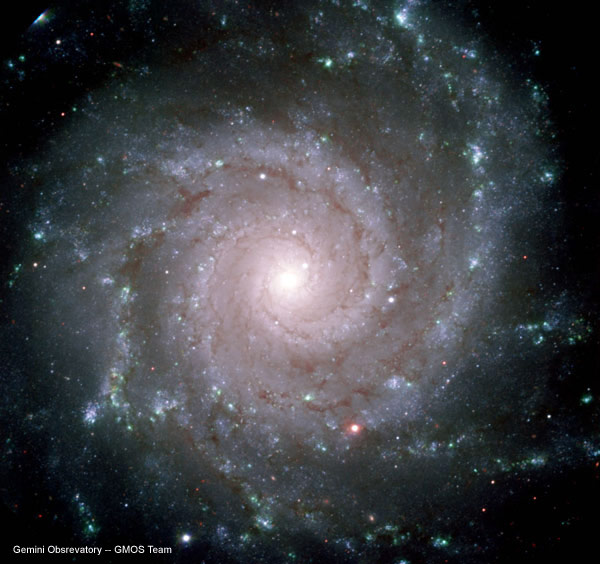
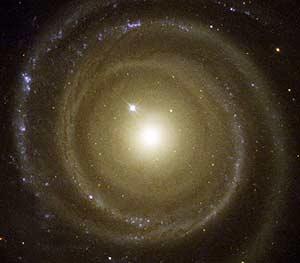
While gravity is a dominant player in the visible structure of galaxies, it is the continual creation of time quanta and space that has created the galaxies we see. Galaxies have not fallen together, they have been spewed forth, and only fallen together in a secondary effect as they have been continued to be created.
Oh! What a tangled web we weave. Looking at pictures of galaxies, it is not too difficult to envision both actions at work.
The current theory of the evolution of the Universe, is essentially a gravitational theory.
It asserts the stars, and galaxies are created out of the gravitational coalescence of diffuse matter, that matter being the remnant of the Big Bang. It's easy to envision the sun and the planets being gravitationally created and precipitated from a cloud of gas, into a disk, and finally into their current formation. It is similarly possible to envision galaxies being formed by the same process. We must however, consider not just the form, but the scale too.
The Big Bang is purported to have occurred a mere 12 billion years ago, a preposterously short period of time for the Universe to have been in existence, but let's accept it for a moment in the current incarnation of cosmological topology.
Hubble Space Telescope was sent aloft in order to look for the beginning, and the creation of the Universe. The results have been an eye-opener, if problematic for Big Bang proponents. The HST has performed as designed and peered back 10-11 billion years finding galaxies already in existence. This has been explained away with conjectures that it took far less time to create galaxies than first thought.
More problematic are the implications of being able to peer back 10-11 billion years, because this implies light traveled a distance of 10-11 billion light years to reach the eye piece of the HST observer, from which we can deduce the known Universe is at least 10-11 billion light years across in one direction, and in two directions we can assume 20-22 billion light years across.
With a known Universe with a span of 20-22 billion light years from one end to the other, it seems a theory predicting a Universe that sprung forth from a single point 12 billion years ago, is something of a stretch, for there is not enough time, no matter how we shave it, for the Universe to have expanded to its current 20-22 billion LY dimension. Worse yet, for the proponents of this theory, the light the HST observer is looking at, is 10-11 billion years old. If expansion of the Universe had already created a Universe that had expanded at roughly twice the speed of light, to reach a dimension of 20-22 billion LY, where must it be now, 10-11 billion years later?
The scale of time and distance simply do not fit the model of a Big Bang Universe shaped by gravitational forces.
The nearest galaxy is Andromeda at 1.5 million LY away. It is easy to mistake that distance as miniscule having just followed a discussion of the scale of the known Universe, but it would be a mistaken view of the scale of the distance dimension. Between here and Andromeda is, we can assume mostly empty space, and if the gravitational view is to be held true, that distance must have been emptied by the gravitational force over a period of 12 billion years. 1.5 million LY is 8,798,544,000,000,000,000 miles. If the Universe is only 12 billion years old, there simply isn't enough time to empty even the small distance between the Milky Way and Andromeda, two closely related galaxies, let alone the far more vast empty voids we know exist within the known Universe.
Furthermore, how can we possibly envision gravity having emptied the vast distances between the galaxies, and yet gravity has not brought everything to the very center of every galaxy?
What then does all this imply? It implies a Universe vastly older, and one where gravitational forces cannot be the progenitor of all the physical properties of the known Universe. It implies a Universe where matter is created where the galaxies are, and not drawn in from the surrounding space.
Here, is where time quanta gives us a better view.
Observation, a measure of reality, will always prove more startling than theory. And I may have been caught up in this quandary myself.
It has been known for some twenty years, the moon is getting further away from the earth, contrary to the idea that it is held permanently by the gravitation of the earth. This observation is so startling it has given rise to a theory propounding the existence of Theia, a planetoid that collided with earth early in its gravitational development. The theory conjectures that Theia tore from the earth some mass that gravitationally coalesced forming the moon in a trajectory that will allow it to eventually escape earth's gravitational pull entirely. (The moon is leaving earth orbit at roughly one inch per year.)
We have no reason to doubt this theory, other than that it is arrived at by the process of the reverse scientific method, and it relies upon the remarkable observation that our moon, the only moon for which we have such a precise measurement, happens to fall into this unlikely class of moon objects that must have been created in this way, if it is to fit our theories.
All the planets, less Mercury and Venus, have moons. And indeed, our sun has all the planets orbiting it. Let us hypothesize, if we could make measurements as precise as the measurement made of the moon's distance to earth, of all these other orbiting bodies, we would find, all moons and all the planets are getting further away from the bodies they orbit. What would it mean? (I can only assume, the observations of our moon came about as a result of the moon landing, and examining data accumulated from radio communications over a long period of time.)
We need only look at an image of Saturn to envision the expansion of the Universe at work. There is clear a point at which expansion has pre-empted the effect of gravitation. Of course, this assumption must be put into relation with the speed of the matter as it orbits Saturn, just as does our moon's escape trajectory. Expansion works in relation to the square of the distance. Still, if we place an object in a permanent orbit according to Newton's laws of gravitation, it will move away with the expansion. Moons and planets are in orbits that allow expansion to affect them with escape trajectories from the bodies they orbit, hence their boundless longevity.
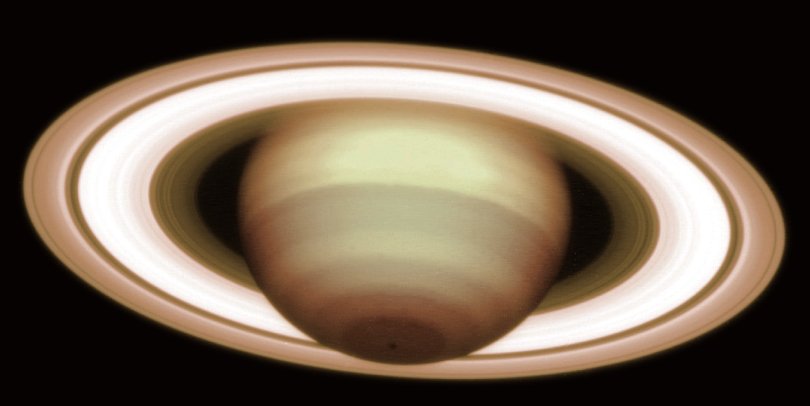
If it turns out to be the case, that all of the orbiting bodies of the solar system are getting further away from the bodies they orbit, we would have a new model of expansion of the Universe, as well as creation of the planets.
I suspect this may be the case. And, if true, it would be as startling an observation as when Galileo first deduced, the planets are in orbit around the sun. It would furthermore be even more startling to find the rate at which these orbiting bodies moved away from the bodies they are orbiting is proportional to both the mass and distance of the bodies, because it would imply an expansion of space proportional to the local mass.
The red shift observable in stars and galaxies is one of our basic measuring tools in cosmological observation. It occurred to me we might refine those measurements by the following experiment.
Envision a satellite traveling towards earth at an increasing and high rate of speed. By shining the reflected light of a star (or galaxy) upon that satellite, if we could see and spectrographically measure the light reflected off the satellite, we could then find at what speed the red shift of the star would be eliminated.
It might even be possible to make these measurements through a clever adaptation of it to a fast moving satellite-mounted telescope equipped with a spectrometer.
Refining spectrographic analysis of stars would greatly increase the accuracy of our observations.
A device that might prove of considerable interest to time scientists might be a differential chronometer.
Such a device I envision being a wand with a digital clock that had two timing crystals, one at each end, and with the capacity to measure time at each end of the wand simultaneously. If we are to explore ways to manipulate time, such a device might prove quite valuable, and other physical parameters to its construct might prove necessary.
I have endlessly queried one of my sons about artificial gravity that can be created inside a spinning space craft, as in 2001 A Space Odyssey.
My incessant primary (and annoying to him) question has been, how does the craft know it is spinning, and that it is not the rest of the Universe spinning about it? Secondarily, I have asked him, if the same craft were NOT spinning in an otherwise empty universe, and then made to spin, would there be artificial gravity?
The answer to the second question (I surmise from my work) is no. No matter how fast the craft is spun in an otherwise empty universe, there would be no artificial gravity created.
So, let us see what it is that leads me to this conclusion.
From much earlier on here, I have surmised the confluence of time waves gives birth to more time quanta from which time waves may emanate. Time quanta are only single points in the vast scale of the three dimensional Universe we perceive. And, time quanta have a statistically attractive force due to the geometric shape of the time waves that emanate from them, and because they are the source of time, which is the cumulative effect of all time waves.
The geometry of spherical time waves moving at the speed of C and intersecting with other time waves at points of confluence, and thus, as previously described, creating more time quanta is a geometric wonder. We must also consider that time waves emanate from a time quantum as closely together, followed by one after another, as is physically possible.
When energy is applied to move an object, the time quanta that make the object are forced out of the space they occupy and through many other positions in space. Thus, more interaction between the time waves of time quanta surrounding the object takes place between the time waves of the object. There is a resistance to acceleration because there are more time quanta created by the changing spatial position of the time waves of the time quanta of the object caused by the movement. Energy is required to create more time quanta, and this energy is observed as resistance to the movement, inertia.
While great numbers of time quanta are being created all the time in even an apparently stationary object, these are generally balanced all around and throughout the object. Greater numbers of time quanta are created by an object that is being made to move, or, is simply moving. As we know, all objects are always moving, and inertia, the resistance to movement, is a constantly affecting all objects, even if it is a varying, phenomenon. Inertia might be better understood as the energy expended that creates time quanta all around and within an object, though it would require a redefinition of the term.
An argument can be made for the redefinition of the scientific term inertia by envisioning what is happening with our own moon whose orbit is only slightly skewed as it orbits our planet, but whose orbit clearly wobbles around the sun. There is inertia at work there, but not an "inertia" in the old sense of the word, that is easily understood in the relationship of our moon to the sun without a modification to the term itself.
Remarkably, under this newly proposed sense and definition of inertia, in the case of orbiting bodies with momentum, there is always a resistive force equal to the resistive force of the orbiting body just as if it were it at rest. Such a definition implies time comes in discrete packets, and that an orbiting body is not actually in constant movement, but that it stops and starts with every tick of the smallest measure of time. With every individual tick of time, the resistive force of inertia is countered (including momentum) by the space newly created by the confluence of time waves of the time quanta of the body and surrounding time waves, each slightly offset and lagging within and behind the otherwise moving object. New time quanta create space, and, as they make room for themselves in the surrounding space, the orbiting body is primed to continue on its orbital path.
Instinct tells me this balance cannot be entirely equal, if it is very nearly so, and better measurements of a two body orbital path would demonstrate some variance from Newtonian gravitational physics. Were our measurements good enough we could probably also detect a variance in a three body orbital path similar to what we would have if the solar system included only the Sun, Earth and Jupiter. In this instance, we would see that as Earth passed between the Sun and Jupiter, it would likely accelerate less quickly as it approached and decelerate less quickly as it went past Jupiter. This would be due to the space constantly created by Jupiter and the sun, (between the two bodies).
The energy required for a stationary body to overcome the resistance of inertia and the energy required for an orbiting body to continue its orbit are the same. Both are equal to the measure of the number of time quanta that are being created over and above those that would be created by the time waves that would have been created by the object when at rest.
The resistive force of inertia then derives from having created minute amounts of matter, which is ultimately made of time quanta.
Generally, even moving large objects, including planets, creates very little matter. Still, the implications of what is described here are important when we consider objects that are moving close to the speed of light, and objects that are extremely massive and move, or rotate, rapidly. Those objects are not just heavier, they are permanently and continually made more massive.
One can consider just how small the amount of matter created is that results from moving a chair across a room by considering E=MC2. The force of the small weight of fissionable matter required to explode a single atom bomb would be enough to move such an object across a room trillions of times. We can glimpse the nearly negligible size and attractive force of a single time quantum here too, by also considering trillions of time quanta are created when moving a chair across the room.
We should however, also consider, were we able to spin a bowling ball fast enough, and without it flying apart!, we would eventually create a black hole in its place. It furthermore indicates that the size and destiny of a star is at least partially determined by its spin.
Note: I was timid as I wrote this section, and I intentionally fudged the description of the relationship between inertia and momentum. After a few days considering it, I will restate the conclusion here.
Momentum is entirely caused by the creation of space, the result of time quanta being created by movement as described above. This is the same whether we're talking about an orbiting planet, within and around which, space is created by its movement, or even a moving freight train. The engine in a freight train pushes against the classical description of inertia. The momentum of an orbiting planet pushes in exactly the same fashion as an engine pushing a freight train. The force that moves the planet against the resistance of inertia is the creation of space made when time waves of the time quanta that make the planet are moved through more time waves that come from outside the planet. The geometry of how the offset and lagging of space created works it wonders can intuitively be grasped by thinking of the minutest tick of time it takes for a time wave to traverse the shortest distance before the next time wave in succession follows.
The momentum movement of a freight train or a planet is due entirely to the creation of space, which is caused by the creation of time quanta, which is ultimately the base unit of all matter. A moving freight train creates matter and space. A moving planet does too. After slicing time to its smallest segments, making a freight train move, as in the classical definition of inertia, is no different from its movement in the classical definition of momentum.
I recognize here, the created space that moves a planet forward, as in momentum, is exactly the same created space (and time) that I have attributed to the causality of gravity. There is no contradiction since these are both statistical phenomenon. The fault in the logical perception of it is in the semantics of science where we perceive gravity to "pull" and momentum to "push". We in fact should perceive each to allow statistical average movement of a body of mass, or bodies of mass in the case of gravity, in space and time to play itself out. In the case of inertia, we are considering how the creation of space statistically affects the movement of a single body in the backdrop of a Universe of time waves. In the case of gravity we are considering how the creation of time and space between two bodies affects their relationship to each other. These are both statistical phenomenon, and not a force in the classical sense.
Considering the Planck length, or realm, I�ve been considering the topology that might exist. Here, we are examining the Universe at the sub-particle, and conventional theorists will inevitably have trouble, and have.
Much has been written of the extra-dimensional notion of the sub-particle world, but it is a hypocrisy of science to believe we can improve our understanding of what we do not know simply by making our assertions ever more complex.
Considering the Planck realm is a troubling question even within our paradigm here. Time quanta are points in space, and they emit spherical time waves, so, can this be fit into our Universe, one we naturally observe as square, cubist, and three dimensional, x, y and z? Of course the question is nearly superficial and almost irrelevant, though not quite. As it turns out it might provide some significant insight into how expansion works its wonders upon the Universe as a whole.
First, yes, we have an infinite multitude of time quanta that make the Universe, points and spherical waves. Viewed thus, we find ourselves in a bit of a bind at the Planck length, until we consider, most time waves are nearly flat planes because they arrive to us from such great distances, and from every direction where there is matter in the Universe. You�re probably saying to yourself, ah ha! Now I�m beginning to see the larger picture of the Planck length topology in this view, but don�t get too excited just yet, because we have yet to fit the points of time quanta and spherical waves into this picture.
By this view we could have an infinite number of time waves converging at every point in the Universe. This is troubling since, I have theorized the confluence of time waves can create new time quanta, but I�ve yet to determine just exactly how many, and under what conditions such a confluence might cause a time quantum to come into existence. The saving grace is apparently the minute distance represented by the Planck length, this, and there is apparently a relationship between the Planck length and the distance between crests of time waves that makes confluence unattainable except under certain circumstances of the timing sequence of arriving waves. The time quantum fits neatly into either package, being simply a point.
Perhaps time quanta emit a time wave with every sweep of another time wave over them. This could be the ultimate timing catalyst for time, how many time quanta are swept over by how many time waves. If it is true, time is variable for another reason other than relative speed.
So here�s what we end up with attempting to envision topology at the Planck length, a fine three dimensional (plane) mesh with no symmetry whatsoever, amongst which there are points, time quanta, emitting spherical time waves into the choppy tangle. Ugly, ugly, ugly, but such is topology at the Planck length.
What is important here, is for theorists get away from the idea of the particle Universe that has been observed with particle accelerators since the turn of the last century. The particle accelerator has its limitations well before we enter into the Planck realm. Learning how to view the sub-particle Universe with time waves will reveal a better view of exactly what is.
I have no doubt, when we do, we will be surprised to learn at, and below, the Planck realm has intricacies that will surprise us even more than the discoveries made by particle physics. Here, we will find our Universe is entirely made of time.
While physicists have proclaimed the unification of magnetism with some of the other forces in a Grand Unifying Field Theory, I would ask them to consider the parallel between Magnetism and the fabled frame dragging of Relativity Theory.
It seems, just as the understanding of Gravity is twofold, so too is Magnetism. Gravity is time/space dependent, where as magnetism is the replendid illustration of Relativity Theory's fabled frame dragging removed one step from the time/space gravitational force.
We were all mystified by magnets as children, but we each failed to see past the attraction and repulsion at the ends of the magnets to consider what is going on inside a magnet. (The explanation we were given was a specious deduction, lining up the magnetic properties of atoms, a definition/explanation dependent upon the subject, magnetism, we desired to be defined.)
We must go back to the origin of Man's discovery of magnets, loadstones, which are naturally occurring magnets. Here we have the perfect example of frame dragging frozen within the structure of an iron ore as it solidified when it was created from molten ore.
The Planck length structures within a loadstone magnet have parallels we can only begin to fathom in relation to superconductivity materials, but it exists. That magnetism can also be affected by electrically affecting iron as it moves from its molten form to a solid form, or by simply applying a coiled current to a piece of iron seems to to have wide implications concerning understanding the Universe.
It seems too apparent, given this view of magnetism, that if magnetism is frame dragging related, propulsion in space relying upon the same model of the expansion of the Universe as I have set forth here, and, the apparent space-density difference within magnets, propulsion might be possible in a way that could provide the necessary acceleration to speeds required to reach the stars.
I envision a magnetic field created and surrounding a spacecraft that would provide a squeezing of a given volume of space into a smaller volume permitting constant acceleration away from sources of the expansion of the Universe, matter, as if like a counterintuitive helium filled balloon, as well as a stretching of a given volume of space into an (internally) larger volume of space providing a constant acceleration towards the sources of the expansion of the Universe, again bodies of matter.
It also may be that by providing two sources of man-created expansion of space, one to play off the other, propulsion might be possible. The problem here is that the expansion of space cannot be encapusulated within a vessel. It should be possible to play two sources of expansion against each other to provide propulsion however. Such a source of expansion might come from forcing to like magnetic poles toward each other repeatedly, a sort of space generation turbine. Two such turbines, one smaller than the other might provide propulsion in space.
Best to all, especially those who have expressed interest with an open and inquisitive mind.
First, let me express my strong appreciation of all those who have embraced even a small part of what I have speculated here, especially those who have found a use however small for something I might have stumbled over in my ignorance.
Thomas Young's Double Slit experiment has befuddled scientists for more than a century, yielding a new scientific endeavor, quantum mechanics, which has been put to great use, if it has led to many unconfirmed hypothesis. Here I propose a solution to removing the uncertainty principle derived there.
Using Young's optical aparatus, if one blocks the path of light to one slit (but not the slit itself) with a pin mounted internally within the mechanism, and accounting for some delay in timing due to the mass of the blocking pin, it might be possible to show the distortion pattern expressed through a single slit of the double slit mechanism.
This would demonstrate that photons move upon some secondary wave, which causes the distortion pattern, unlike what has been proposed, i.e., that a photon travels through both slits at once. I propose these waves to be time waves.
In the history of science, it has been noted by philosophy that when a man is right, he knows it. It's an unfortunate truth that scientists fall into this philosophical trap, for rarely is does this fact of self-reassurance lead to real, undeniable truth. In my own self-reassurance, I go not there, knowing, when scientists are wrong, they are often one-hundred-and-eighty degrees wrong. I could be wrong, and likely I am, wrong about everything I have said here.
It was the Greeks who long ago first posited the idea that from nothing, can come nothing. Unfortunately, to posit any truth, especially such seemingly obvious truths as put forth by the Greeks, one must first know everything that exists before reasoning knowable truth. One scientific derivation of the Greek's nothing from nothing posit is the conservation of matter and energy.
If there are time quanta and time waves that make the universe in its entirety, then the law of the conservation of matter and energy is likely false. For, while on the surface as the Greeks posited for us, nothing can come from nothing, or perhaps better phrased, something cannot come from nothing, we must first know that there can be nothing, a dubious enough proposition by itself. When we think of time, there is always more time following directly on the heels of the time we already have today. It's not much, but it's certainly enough.
I'll close for now with a philosophical note. Enjoy.
Had I a stone upon which to write: Oh! That I might yet sense all the world again, a world through my senses I thought I knew. I reached out here again, before I go, through what is all but impossible to know, guided by a man's frail reason and intuition, and, more for my love of life, I posit here, so you need never doubt it. I too was once alive. This is truth. It is good. And it is even better, if it is as wonderful for you to sense through your senses your world as fine too.
Please report any problems to the webmaster at [email protected]
If you're interested, and have comments, questions or suggestions please feel free to write: [email protected]
The following are some of the correspondence I have had concerning The Grand Unifying Theory, The Theory of Time, as a casual theoretical look at the current trends in cosmology and physics. Your thoughts are of interest, and I am humbled to receive them.
The Grand Unifying Theory, The Theory of Time: Questions, comments, and peer review--------------------------------------------------------------------
Return to original index page.--------------------------------------------------------------------
As of 2/02 I have gone off line, and I will no longer be able to be reached by this or any other email address. Don Robertson Perham, Maine