Musical Theory Part 4
Adding more interest to your music
by Don Stare
There are a number of options to make your
music more interesting which is exciting to study and can add a lot of variety
but can become a little complex. You can continue to write songs with simple
chords but the following may give some ideas that you may want to delve into as
well. Chords will be explained from slightly different angle but is consistent
with what you have learned so far.
1. Chord Inversions
2. Slash Chords
3. Chord Variations
4. Seventh Chords
5. Altered Chords
6. Chord Substitutions
7. Secondary Chords
1. Chord
Inversions
Suppose you are playing a simple C chord on a
keyboard starting at C3 using your thumb and placed it on E3, then the middle
finger on G3 and finally the little finger on C4 instead?" You would still
have a C chord, but it would be a different arrangement of the three notes.
Instead of the 1,3,5 position they could
be 3,5,1(E3 G3 C4) for what is known as the first inversion You could create
a second inversion of the C major chord,
by starting the G3 (position 5) then C4 (position 1), followed by E4(position
3) for a 5,1,3 major chord triad. You would use these different chord positions
in the right hand to keep the melody note as the highest pitch in this right
hand chord position or at least to not allow any of the chord triad notes have
a pitch higher than any other melody notes in the right hand when playing on a
keyboard. As for the left hand chords, you would simply use these chord
Inversions to add interest to the sound unless the melody note descended below
C3 (middle C) on the keyboard and thus the same rule of melody note carrying
the highest pitch. This is not always the case as sometimes other instruments
may carry the melody note.
Try it and see how it sounds, same notes
different places on the keyboard.(C Chord
Inversion). Listen first to the Right hand playing in root, 1st
and 2nd inversions, then the left hand playing in root, 1st
and 2nd position, then both hands playing different positions while
the right hand repeats the root, 1st and 2nd positions.
Note the different sounds generated by simply inverting the chords.
2. Slash Chords
Take the Dm (ii) chord ( D, F, A) which has
been depicted as always having a bass note of D. Playing the A instead as the bass note makes
a big difference in sound.. They way of indicating when it is desirable to play
the bass note is called a slash chord.
The D
chord with D as the lowest note
in the cord, is written D .which
also stands for Dmajor but the major
part is let off. The exception is in the case of designating a major 7th
chord which would be shown as Dma7 to
differentiate it from D7 which is a flatted version of the 7th
tone (1 3 5 7 vs. 1 3 5 -7)
If you want the F(3 note of the chord) in the base,
write D/F and play the F note on the bass part. To designate
the A(5 note of the chord) as the
base, write D/A Besides indicating
the chord inversions it also suggests that you play the slash /A note in the left hand if you are
chording with the right hand .
If you are playing an organ with pedals, you
would also play the /A note with the
pedal. It should also be noted that when the third(3) note of a chord is played
in the bass, it may sound better to leave the third(3) note out of the right.
Using the alternative chord principle to form
the chord, only works when the bottom note of the chord is the same as the name
of the chord itself.
3. Chord
Variations
There are some very common variations musicians
use all the time to keep chords sounding fresh. Here are a few.
The suspended chord – Csus, the
F note (4) replaces E note(3)). 1 +3 5 is the formula used to indicate a ½
step/tone is used.
The major 6 chord - C6. The A (note (6) is added). Sometimes known as a blues chord... 1 3 5 6
formula is used to build this chord.
The major 7 chord - CM7(Bb
note(7) is added. used to jazz up chords)
The major 9 chord - CM9 (D note
(2) replaces the C note (1) which can be played in the bass with left hand or
on an organ pedal). 1 2 3 5 is the formula designation with the 1 usually
played at least another octave higher or lower.
Charts of these and the 7th
Chords to follow are included separately (for all keys) in the files folder and
should be downloaded
4. Seventh
Chords
Minor chords will often add a 7th to them. Cm7
would have the formula 1 -3 5 -7 ( C Eb G Bb)
V major chords from progression maps often have a 7 note
added as well. In the key of D, the V chord is A, so you would see A7 appearing
in the music. V chords for the key of C would have the B note added. Using the
alternate note principle just take the major chord, skip a tone from the G to
the B.
5. Altered
Chords
Altered chords are derived from switching a
note in the chord to a non-scale note. These are depicted in a the chord
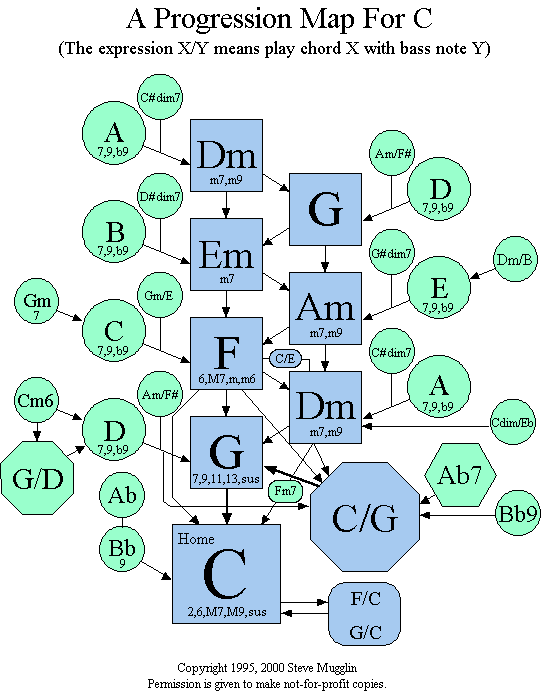
progression maps such as (mapC.gif) and can be found in
the files section as well and should be printed for reference. They are colored
in green on the maps.
The iv
chord ((we switched from IV(major
chord) to iv(minor chord)) uses the
flatted 3 note which is not in the scale
is a very useful altered chord making an F chord into a Fm chord. (I.e. Fm is F, Ab, C
instead of F, A, C ).
Another useful altered chord employed is the
iim7b5(called the "two minor seven flat five").
The iim7b5 would have notes D ,F, A ,C representing the Dm7 chord(2) with the A (5
note) flatted (lowered 1/2 step).
As a test, try playing a C chord with the bass
C note up 1 octave(C/E with E being the base note), then the Fm chord and then
the Dm7b5(you just have to add the D base note to the Fm chord) , then back to
C chord (C base note indicated this time). This could replace an un-interesting
C bar ending sequence.
6. Chord
Substitutions
There are a whole group of
chords with wild names like nines, elevens, thirteen’s, nine sharp fives, nine
flat fives, and the list goes on. These chords have very interesting sounds. A
good player will use these chords when that particular sound is needed.
Often the player
"substitutes" one of these complex chords for a simpler one in the music.
Suppose the music calls for an A7(A,C#,E,F#).
An A7b9 might sound even better(Bb
((note 2 the same as a ninth)) ,C#,E,F#
((drop the A note or play it with
the other hand)) ). They are called chord substitutions because you may use them
in place of simpler chords .
Here are some substitutes for A7.
The A7b9
looks like this
A,C#, E, G would represent the A7 chord
then take the 2 note in the A scale
(which is B) and lower it 1/2 step
dropping the A note or moving it to
the left hand or pedal and it would then have Bb, C#, E, G as a substitute.
Another substitute for A7 is G/A. which is
simply the G major chord with the A note replacing the bass G note of the chord.
7 Secondary
Chords
These are chords that can take the place of the
primary chords
.Review:
The number of chords available increased
dramatically..
Even simple chords can be played in several ways
called inversions.
Slash chords added to keep track of bass notes
when the bass is playing something other than the root.
Scale notes to get chords like 2, 6, M7, sus and
non-scale notes to get iv and iim7b5.
Chord substitutions like nines, elevens, and
thirteen’s came along to replace sevens when needed.
Chord maps like the ones created
by Steve Mugglin in 1995 show the natural flow of these chords and the
substitute chords that can be used .(available in the Music Theory File folder
as Cords 12 Maj keys.zip)
The maps can
be interpreted as containing stepping stones representing each chord
that can be used to move from one place another before returning to the jumping
off point which is the root or I chord
Do you remember the rules?
You may jump anywhere from I, which in this case
is the C chord.
If a chord appears at more than one place (like
Dm or G), there is a "secret tunnel" connecting them, so being at one
spot is the same as being at the other.
Using the generic key chart or the C key
chart from part 3 we can create a lot of
chord options for our song writing in
any of the keys by replacing the generic
I, IV etc with the notes from any scale from our table of chords for the that
key. There is however a zip file containing each of the 12 major keys located
in the Files folder as well.
You may want to spend some time making music
from these maps in more than one key before moving on especially if you didn’t
complete the exercise using the C key map.
There is still
some details in these charts that needs to be pointed out.
Looking at the C chord progression (mapC.gif) again.:
* Notice the blue boxes and the chord variations
included inside each box. For instance, C
lists the 2 chord, the 6 chord, major 7, major 9, and suspended as possible
options. These chords can be used in place of the major chords from our chord.
* The blue
octagon with C/G (slash chords) inside
indicates that this chord quite often follows Dm or F, and then heads for G
before going home to C.
* The box labeled F/C and G/C shows that the
right hand chord can change while the bass note (C) stays right where it is.
As discussed previously, this technique of
holding a bass note while varying the chord above it, yields many surprising
and useful sounds. Finally, the little box labeled C/E is often found between F
and Dm. It can be used going either way.
* The chords with a green background don't belong to the key of C;
they come from other keys.
They are useful when we want to "step
further out." You can put a green chord almost anywhere, but when you do, you'll
probably want to follow the arrows back toward the blue ones. Your audience
will feel good when the chords that seem "far from home" step back to
more familiar ground.
Note
about names - Some of the green chords are
written as slash chords, like Am/F#. This chord could also be written F#m7b5.
In general, whenever you take a simple minor chord and move the bass from the
root down three half steps, you get m7b5 on the new bass note. Sometimes
calling it Am/F# is easier.)
As you should have done previously, see how
many short progressions you can create and try out some of the non key related
chords. Start anywhere. Then follow the arrows. You can input these into a
keyboard or software program with styles and listen to the results and even go
back and modify your example B
section from a song created earlier.
These simple exercises will give you a greater
understanding of the chords available to you, show how they move naturally from
one to another and provide insight into how some of your favorite music was
constructed.
You should also be aware of how these might
create a feeling or mood you want to convey thru your music.
You should try to stay with a single Key
signature until you become familiar with it and later expand to others. It is
usually easier to think of adding harmony to your melody notes from the C major
scale.
In the case of the midi file you created
earlier, you can select from the Chord
Progression map of the key you selected and work from that map to hear how some
of the substitute chords and other possible combinations sound.
Don't be concerned it some of them don't quite
fit. You may have to rethink and modify
your melody to incorporate some of the new chords or start over as before and
try to adapt the melody idea you had with the new chords as the basis.
A
diverging step from here could be to use the knowledge of the chords and
subsequent notes that go together to embellish your music via the midi
sequencing route.
Going forward
on the Theory series will incorporate a look at other related Scales and how the
melodic minor and harmonic minor scales contribute to harmonizing your music.
Progressions based on types of music such as blues will be discussed along with
the blues scale and others.
Improvisation comes into the picture as well for those who are
interested in how that might be accomplished.
Key relationships and an
explanation of the infamous Circle of 5th may be included and perhaps more
depending on the interest generated so far and questions posed. The idea of
styles is also a possible topic.