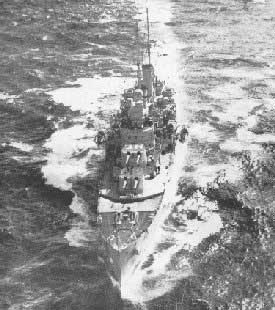
We left Brisbane on the 14th July ostensibly to join up with an American task force - on second day out we received information, - following day these arrangements were cancelled and our task force was detailed to proceed direct to Wellington.
HMAS Hobart (1)
We anchored in Wellington harbour for the 19th, 20th and sailed on the 21st July. On leaving Wellington we - TF44, Australia, Canberra, Hobart, Chicago, Salt Lake City and attendant destroyers took over escort of 12 special troopships which were fitted out in A1 condition for an invasion. Their cargo consisted of over 30000 marines of the amphibious force - (1st Mardiv) and necessary equipment and supplies. Three days later we joined forces with further US naval units; consisting of heavy and light cruisers and destroyers. We also had as a covering force 2 carrier task forces. About a week later we arrived off Koro Island in the Fiji group; where we were to carry out rehearsals of a landing on an enemy occupied island. The first rehearsal was marred by reefs encountered near the beach; the second however was a success so after collecting marines and materials back into troopships we set sail for Tulagi, Guadalcanal, Florida, Gavutu and Mocambo Islands in the Solomon Group. For the whole of this trip our luck was phenomenal in so far as we steamed between Tulagi and Guadalcanal at 0530/7 without having once been sighted by the enemy.
At this time time Vincennes commenced her bombardment of Guadalcanal; and shortly after which destroyers opened on the only vessel in the bay - a Japanese junk which was evidently loaded with ammunition. They failed to sink her by gunfire, but when cannoned by dive bomber, she exploded. We bombarded different islands for about thirty minutes, destroyers bombarding the beaches.
At 0810 disembarkment of marines commenced and at 0900 landing was in full swing. Apart from isolated guns bombarding landing barges no opposition was encountered.
The troops after landing reported that the Japanese had evidently fled in panic at commencement of bombardment leaving everything behind them even to rifles and ammunition. Later in the day the airmen had great sport hunting the Japs. The bombers hunting them into the open by bombing the woods, and the fighters machine gunning them as they broke cover. On another occasion when Quincey was bombarding Japanese held positions, spotting aircraft were giving them spots even to dimensions of buildings sometimes even mentioning number of windows and doors. On still another occasion Quincey was told to hold for two seconds as motor convoy was approaching a bridge. Quincey failed to receive message in time and bridge was blown up before convoy reached it. Yank airmen evidently wished to shake hands with a Jap truck driver . It was a picnic party for the airmen, they had a great time.
One pilot was almost crying for a target and threatened to jettison his bombs if not given something to drop them on. My guess is that he had picked out a tempting bunch of Japanese on which he wished to drop them.
At 14.45 a large formation of Japanese twin engined bombers attempted to bomb the ships - I don't know whether it was just our usual luck or not but they just fell astern of us. They were not extra large bombs but there must have been about 80 - 90 of them and all landed within about 30 seconds or so. Talk about machine gun fire, these bombs landing had it beat to a fair-thee-well, and I don't mind admitting I said my prayers and so did everyone else.
We had many another air raid scare but apart from a raid by dive bombers on a destroyer these 27 planes made our only real scare.
Following day August 8th we received a warning that 40 odd twin engined bombers were on their way. They arrived at noon. The original group must have split in two for one lot of 20 odd torpedo bombers attacked our forces off Guadalcanal. We (Hobart) shot down 10-12 of these. Another force attacked our ships off Tulagi to which "Canberra" was attached. They also claimed 12 planes. These attacks would have proved dismal failures had it not been for a piece of very bad luck in so far as one of the planes hit, in falling, crashed on the deck of a transport, setting her on fire. When the torpedo bomber crashed on the transport's deck her torpedo was still in the planes racks. This naturally did not assist the now doomed transport in any way. A large percentage of stores was however removed from the transport before she was finally abandoned. She burned for about 30 hours until in the end she blew up.
As at dusk on the previous night we - a force of light cruisers - patrolled the western end of the bay which has been fashioned by nature with a large crescent shaped island in its centre the tips of the crescent face towards the bay thus making two entrances the eastern end being patrolled by the Canberra, Chicago, Astoria, Quincey, Vincennes and a force of destroyers. At approx 0200 on the 9th there was an explosion in the proximity of the eastern entrance. Then a battle royal ensued. We later heard that a Japanese force tried to enter the bay for the purpose of sinking the transports but on sighting Canberra and Chicago evidently lost their nerve and fired torpedoes thus giving their presence away. The Canberra receiving a hit had all her power and fire fighting apparatus thrown out of action so that when fires were started by shells, she was unable to extinguish them. She was abandoned about dawn, with a loss of approx 92 lives and 190 seriously injured. The captain (Capt Gettings) died on way to Noumea as did 9 others.
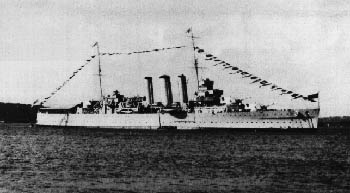
HMAS Canberra - County class 8 " heavy cruiser
The Chicago also stopped a fish but luckily was only hit in the bows and was able to carry on under her own power, without reducing speed. The Vincennes was set on fire and beached on the shores of an island in the bay. At daylight there was still no news of the Quincey, Astoria and several destroyers, but we later heard, that the Quincey had been sunk whilst she and others had been giving chase to remnants of the Japanese force.The Astoria was also set on fire, and finally sunk by her own destroyers. One destroyer was also sunk. Aircraft reconnaisance during the day failed to locate any of the enemy so it is surmised that they were entirely destroyed. The Canberra was sunk by our own gunfire during the forenoon when all attempted to extinguish fires were of no avail.
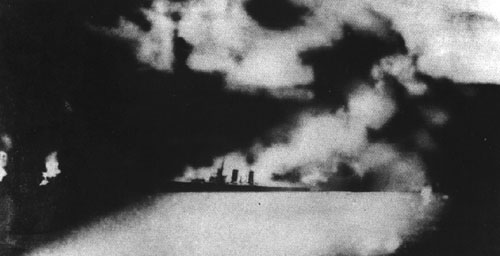
Vincennes in a Jap searchlight
On Sunday evening we sailed from Tulagi escorting the eleven remaining transports. Apart from a few air raid alarms and submarine scares our trip to Noumea was uneventful. We arrived at Noumea on the 12th August sailed again on the 18th. We joined forces with two large carrier task forces, one of one carrier, cruisers and destroyers, the other of two carriers, one battleship, cruisers and destroyers. Our force now consisted of three carriers, one battleship, eleven cruisers and twenty destroyers. From then on until the 23rd we had a quiet time. At 0200 on the 23rd 4 enemy destroyers landed 700 Japanese troops on Guadalcanal. The enemy attempted to attack our forces by crossing the Lunga River, but the marines made a flanking movement, which drove the Japanese down to the beach where they were annihilated, 30 only being taken prisoner. Our forces sustained 47 casualities.
At noon a small Japanese convoy escorted by two cruisers was sighted 300 miles to northward steaming towards Tulagi. At 1430 Saratoga flew off a striking force but about the same time enemy altered course to northward - this alteration and rain squalls was the cause of the failure of the striking force to locate the enemy. Later in the day a force from Guadalcanal 'drome sighted and attacked this force, - one large transport was hit, set on fire and left blazing fiercely.
On the same day our own forces landed troops and material at Guadalcanal and Tulagi, - from one large transport and four destroyers.
Early on the 24th we landed still further troops and materials from two large transports at Tulagi and Guadalcanal. The transport at Guadalcanal was reported just before dawn as an enemy cruiser but only damage done was that the air force were put on their toes. Our dawn reconnaisance located six small to large transports escorted by two heavy cruisers, 240 miles north west and steaming towards Guadalcanal.
Land based aircraft were sent off to attack and later claimed to have hit and set on fire one heavy cruiser and one large transport, both were last seen blazing fiercely.
Saratoga's aircraft which had been flown off to attack the previous day and had spent the night at Guadalcanal returned to carrier at 11.30.
A small carrier force was sighted consisting of one carrier, two cruisers and attendant destroyers. The catalina flying boat which sighted them was driven off by three zeros. Saratoga then sent off 4 scout planes to locate and shadow the enemy until our air striking force could arrive. The catalina subsequently made a forced landing at Stuart Island; the crew were rescued on the 26th.
In the meantime, Japanese reconnaisance and bombing forces had been busy - and a heavy raid was made on Guadalcanal, by a large group of fighter and bombing planes. Only damage done was some tree felling, - no material damage was accomplished. However partial success was accomplished by their reconaissance. One Japanese twin engined land plane sighted our force and managed to report us before being shot down in flames only 8 miles off our starboard beam by one of our carrier borne fighters at 1400. Later two 4 engined patrol planes were also shot down by our fighters. Of the bomber force attacking Guadalcanal 11 zeros and 10 bombers were shot down. We lost 3 fighters.
At 14.15 Saratoga flew off a striking force which attacked the aircraft carrier group. This force obtained first results mentioned below in results for 24th.
At 17.50 the large carrier force was located by B17 land based bombers, who attacked scoring hits with 4/500 lb bombs on one carrier a 1000lb bomb hit on the battleship and 5 / 300lb bomb hits on the second carrier, as well as shooting down 5 of 7 zeros which attempted to intercept.
Estimated results of action on 24th August.
An enemy of two carrier task forces:
Saratoga air group attacked a small carrier obtaining hits and left it smoking - she was later sighted stationary in the water. Same force also scored one destroyer sunk and one cruiser hit by torpedo. In a second attack one cruiser was hit and a 1000lb bomb hit a battleship - the information of the presence of two large carriers was not obtained early enough for our aircraft to attack.
An enemy air attack group consisting of eighty planes attacked our force scoring three hits on USS Enterprise (A/C) but fires were extinguished and she was able to carry on. We lost 8 pilots. Japanese losses were 47 planes shot down by our fighters and 24 planes shot down by our ack ack gunnery. Earlier in the day one of our seaborne fighters shot down a Japanese twin engined land plane. Other fighters later shot down two four engined patrol planes and one single engined twin - float sea plane. Marines at Guadalcanal - Solomon Islands - shot down 11 zeros and 10 bombers, in a raid on the island. Eight bombs were dropped doing no damage.
On the 25th USS Grayson probably sank a submarine. Submarine was last seen trailing a thick tail of oil. Later a scout bomber from the Enterprise scored a direct hit with a 1000lb bomb on another submarine.
A small Japanese transport landed 60 telegraphists and equipment on Guadalcanal, whilst 2 Jap destroyers bombarded the Island for 5 minutes. Land based aircraft claimed one direct hit on one destroyer and a near miss on the other. Of the 60 Japs landed 58 are now good Japanese the other two are prisoners. We lost one plane. Another group of three heavy cruisers escorting an enemy convoy were sighted 180 miles to the nor'west of Tulagi steaming at 10 knots in that direction. These were attacked by planes from Guadalcanal and also by planes from Enterprise. The bag was one cruiser burst into flames although no hits were observed, another was hit by three bombs and was seen to break in two, and one large transport was hit by a 1000lb bomb and left burning fiercely. Two type 25 seaplanes were also shot down.
At 11.50 21 twin engined Jap bombers raided Guadalcanal flying at 27000 feet; a bit of bush clearing was accomplished but no material damage.
At 17.20 a Hudson bomber - land based - sighted momentarily through a rift in the heavy clouds 9 Japanese ships. These apparently later split up and a small force attacked and landed on the northern end of Milne Bay - (Eastern New Guinea) - an AIF reception committee awaited them.
This landing was 0700/26. At 0810 one transport two cruisers and one minesweeper were sighted steaming towards the southern end of Milne Bay. They were attacked by planes of the RAAF and one cruiser was probably sunk. Further reports of this action were not obtained on board, until the announcement on the 31st August that Japanese had been driven out of Milne Bay with heavy losses including all stores and material of which tanks were in eminence. Shortly after Noon of the 26th our force was probably reported by a Japanese sub. We oiled under way from a US tanker. Later in the day RAAF claimed sinking of one gunboat and hits on two transports.
From 26th - 31st the trip was uneventful - At 1800 on the 31st we parted company with the US forces and it was announced that we expected to arrive at Moreton Bay PM Thursday
Finish
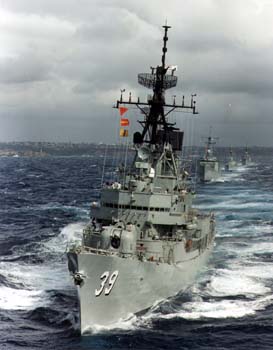
HMAS Hobart (2)
When I found this account of my father's experiences, during the Guadalcanal campaign I was quite excited as I know so little of his war service. This sparked an interest in me that has grown into this production. During the course of my research I have studied a number of books on the Solomons and found the book "The Lost Ships of Guadalcanal" by Robert Ballard very detailed. This book covers an underwater search for the many sunken naval ships in the waters just north of Guadalcanal Island during 1992 as well as detailed accounts of all the conflicts. The book "The Shame of Savo" by Bruce Loxton is a extremely detailed and well researched investigation into all possible causes of the Battle of Savo Island. It really demonstrates that there were many complex issues and factors which lead to the defeat. Bruce was a midshipman on the bridge of the Canberra at the time of the attack.
The battles both land and sea that occured between August and November 1942 were some of the fiercest of WWII and were effective in changing the course of the War. More Allied servicemen died in the waters surrounding the Islands than died on land. During the Battle of Savo Island 1077 Allied seamen were lost with 700 wounded. The night time naval battles would have been a terrifying experience. Not only was there the danger from enemy shelling or torpedoes but if you weren't trapped in the vessel when it went down then there was always the chance that the sharks would get you while waiting to be picked up when daylight came.
On studying the subject you can be amazed by the number of blunders made by the Allied commanders. Fortunately the Japanese made the occasional blunder which tended to even things up. In many cases the Americans had the advantage with superior numbers, more modern ships and radar. With the Battle of Savo Island an inferior Japanese force crept up on a far greater Allied force and virtually wiped them out. Quincy being the only ship to return effective gunfire before being sunk. My father's account of this battle is inaccurate in a couple of places.
The Japanese were experienced at night battles and certainly did not "lose their nerve" on making contact with the Allied fleet. Quincy was sunk but not while in pursuit of the Japanese fleet as her wreck has been discovered close to her patrol route. Vincennes was sunk and not beached on the shores of an island as George believed.
This Battle of Savo Island came to be known as the greatest blue water defeat of the US Navy. Some of the contributing factors to this defeat were:
As a result of all these blunders most of the Allied ships began taking hits before they could get their own guns operational. It was a shooting gallery.
Fortunately in this and the future battles that the Allies fought around the Guadalcanal waters the US learnt many valuable lessons that would eventually help to turn the tide against the Japanese.
Although the Battle of Savo Island was a defeat if combined with all the naval and land battles in the area it became a victory for the Allies and the eventual turning point in the War. By the Allies keeping control of Henderson Field on Guadalcanal the Japanese were prevented from taking New Guinea and eventually Australia. The land fighting to defend Guadalcanal was the first land defeat of the Japanese army. Previously both the Allied and Japanese soldiers believed the Jap soldiers were invincible. It was a great boost to the moral of the American Marines and a severe blow to the Japs.
In the account of the Battle of the Eastern Solomons of the 23rd and 24th August 1942 George's claims on the enemy losses are incorrect. The Japanese lost the aircraft carrier the Ryujo and 75 planes whereas the Allied forces lost 25 planes and the carrier USS Enterprise was damaged.The lobsided airplane loss in favour of the US marked a trend that would lead to Japan's undoing. In a war of attrition the US had the advantage of having its enormous industrial might behind it. This lead to the gradual defeat of the Japanese.
This account although exhibiting some inaccuracies was to a large extent as correct as the information supplied to Allied personnel would allow. It is only with the advantage of time that we discover all the details. Although my comments may appear to be a critiscism of the Allied naval performance it is not intended so. It must be remembered that although the sailors were well trained they were not battle hardened like the Japanese. In addition the Allied commanders did not have the battle experience to provide proper leadership during the conflict. Those that survived certainly gained that experience which helped in the ultimate defeat of the Japanese.
Greg Donald December 1996
BIBLIOGRAPHY
The Lost Ships of Guadalcanal - Robert D Ballard ISBN: 1 86373 533 X
Great Campaigns of World War II - J B Davies ISBN: 0-7481-0151-9
War Maps - S Goodenough ISBN: 356 075680
War in the Pacific - Bernard C Nalty CN 2658
The Shame of Savo - Bruce Loxton