 |
|
|
|
|
|
|
|
|
|
|
|
|
|
|
|
|
|
|
|
|
|
|
|
|
|
|
|
|
|
|
|
|
|
|
|
|
|
|
|
|
|
|
|
|
|
|
|
|
|
|
|
|
|
|
|
|
|
|
|
|
|
|
|
|
|
|
|
|
|
|
|
|
|
|
|
|
|
|
|
|
|
|
|
|
|
|
|
|
|
Surveying Stonehenge |
|
|
|
In 1964 Gerald.S.Hawkins discovered that Stonehenge was aligned a little more than to just the midsummer sun.
He discovered that it was possible to work out the day of the vernal equinox to a high degree of accuracy. The vernal Equinox is based on a lunar calendar so it changes each year by 24-72 hours.
So while impossible to build a tri-lithium to capture the moon at this point it is quite easy to work out the exact date from the other stones, which as it turned out were placed there, for exactly that purpose.
The vernal Equinox seems to have been a very important date in the ancient world. It was regarded as the first day of the new year and most civilisations celebrated this event with traditions and ceremonies designed to welcome the new and see out the old. In Sumeria at this time the king was taking the hand of Utu the sun god and reaffirming by not bursting into flames that he was a good king and so deserved another year.
In India they celebrate Holi at this time, while Christians are celebrating Easter and Hebrews Passover..
In the ancient world the lunar calendar was used more often than the solar one because it was essential to know which day to plant crops.
So it would be fair to say that if it wasn�t for this astronomical event we wouldn�t have been as well fed as we were for all those millennia.
Stonehenge has recently been dated to 3200bce. This fits with the supposed construction date for three other sites of wonder in the same geographical area .Those sites are
1. Silbury hill
2. Avebury
3. Uffington |
|
|
|
 |
|
|
|
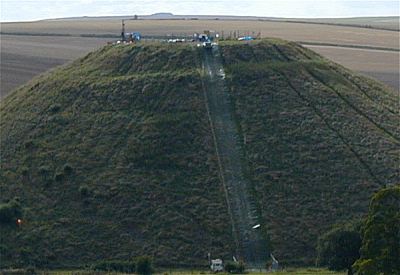
Silbury hill is located just outside of Avebury, between Marlborough and Beckhampton in Wiltshire. It is the largest man made earth mound in Europe and stands 130 feet high. The base covers an area of 5 acres and the flat top of the hill is 100feet across. From the top you can view the three other sites quite clearly and its possible to take an accurate bearing on all of them.
|
|
|
|
Avebury |
|
|
|
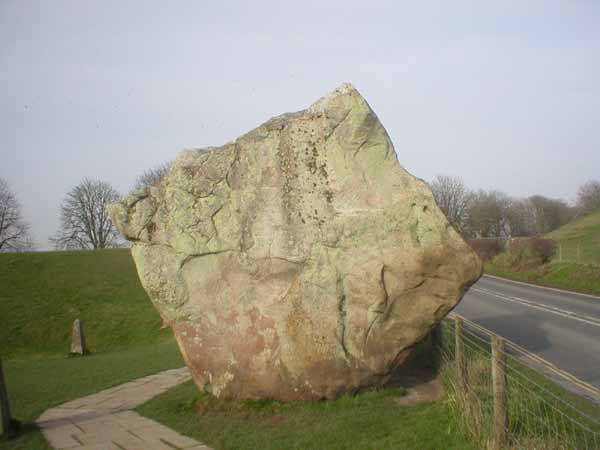
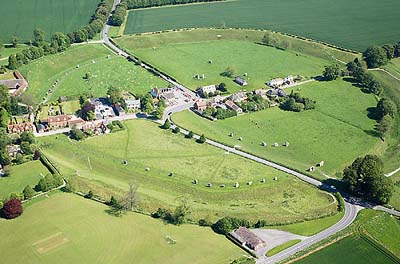
The stone circle at Avebury is the largest stone circle on Earth. It�s a touch over 1400 feet in diameter and covers an area of 28 acres. This stone is the largest in the circle and is called the Swindon stone. It weighs in excess of 60 tonnes. |
|
|
|
 |
|
|
|
Avebury is also linked to the vernal Equinox but because it is larger it is possible to work out the degrees of arc of this alignment whereas at Stonehenge you can discover the minutes. |
|
|
|
 |
|
|
|
Uffington |
|
|
|
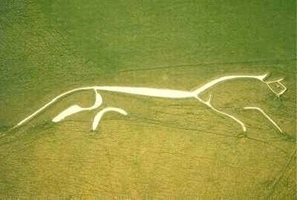
Uffington is unlike Stonehenge and Avebury in that it isn�t aligned to any astronomical features consists of quite a few ancient features. The most well known, of which is the Uffington white horse. |
|
|
|
 |
|
|
|
The name horse however is a recent addition, it used to be known as a dragon and the small man made mount to the north is known as dragon hill. It is reputedly the mythical spot where St George fought and vanquished the dragon making him patron saint of England. The horse is orientated so that people can only see it from the north. It�s a mystery as to why it was cut in the hillside and by whom, but the local villagers of Uffington used to engage in a pastime called �the scouring� when on mid-summers day the whole village would turn out and brush the lines of the horse to keep it pristine. This practice kept the horse in position for 5000 years until the local council had white concrete poured on the lines making it far more permanent and killing off one of the oldest traditions on earth.
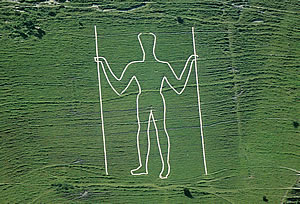
Not connected to any of these sites on the east Sussex downs is another Neolithic chalk figure with an unknown origin. This figure is known as the long man of Wilmington. It also has a construction date set well in the past as the Romans wrote about it when they came here. Rev A.A Evans who said �The Giant keeps his secret and from his hillside flings out a perpetual challenge.� The challenge of course �Who am I and why am I here.� Most experts agree with Rev Evans in expressing a belief that we will never know
. |
|
|
|
 |
|
|
|
 |
|
|
|
|
|
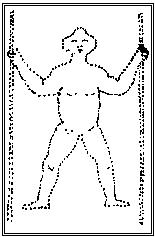
The long man is 226 feet high. The staves are 230 feet and 235 feet respectively, and the distance between the top of the staves is approximately half that again.The image on the right is the long man after it was painted by the local council whereas the image on the left is the earliest representation known |
|
|
|
The Jigsaw |
|
|
|
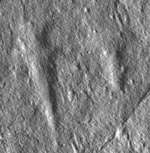
So all four sites have a few things in common. They are all unexplained and nobody knows who built them, or why. No written record exists. There have been a few times over the years when people have claimed to have found strange shapes in the Stonehenge Sarsen stones but in most cases its later turned out to be a naturally formed simulacra. Then in 2001 a new set of carvings were discovered using laser scanning |
|
|
|
 |
|
|
|
They have been described as pictures of Bronze Age axe heads. Of course no one has explained why someone would spend a great deal of time and effort to display his or her current weapons technology but there it is all the same. Incidentally the Bronze Age began in Neolithic England in about 2000bce. Elsewhere on earth it started earlier and the first bronze was in production in Sumeria, Mesopotamia 1500 years before. It seems that being an isolated island is not helpful when upgrading technology and in Europe the Bronze Age started anything up to 500 years earlier. How can it be that we were so primitive in some areas yet capable of moving huge stones up to 45 tonnes across 200 miles of open country at a time that Ancient Egypt was still unfounded. And how did we gain such fantastic astronomical knowledge and then forget all about it. Maybe we didn�t
Sir Frederick Hoyle wrote a book three decades ago where he claimed that the knowledge of astronomy displayed by the builders of Stonehenge could only have come from navigating the world�s oceans. Sir Frederick Hoyle is about the most qualified astronomer to have speculated on this subject. His claims were dismissed as far out at the time and generally glossed over in favour of his less remarkable statements on the subject. |
|
|
|
 |
|
|
|
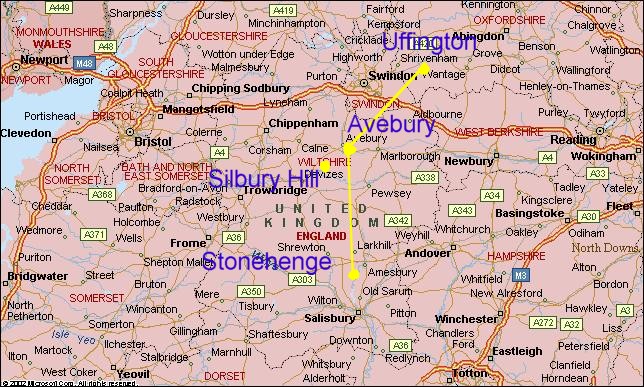
Here they are all laid out on a map. You can clearly see from this perspective that the three sites are suspiciously equidistant and not in a pattern you would expect from a random placement. Silbury hill sits a little to the southeast of Avebury in a position that allows it to overlook both Avebury and Stonehenge. It also sits along a north south axis |
|
|
|
The Nebra sky disc |
|
|
|
 |
|
|
|
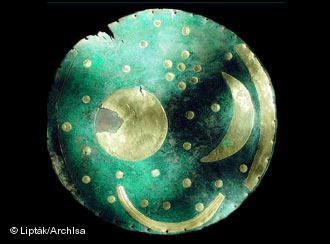
Found in Germany in 1999 the Nebra sky disc is regarded as both a priceless treasure and an enigma. Because it has a rainbow on it its believed to represent a forgotten myth which features a rainbow and to some corroborates the biblical story of Noah. But a rainbow is a very well known symbol no matter which culture you are from. Up til now the consensus has been that the dots that appear on it are constellations but doing a dot to dot on constellations is impossible. There are simply too many combinations that would appear correct for anyone to ever be that lucky. So without a guide it will never be solved. Now in Germany the Bronze Age started in approximately 2300bce as was already mentioned. So if it is of German origin its construction cannot possibly preceed that date because it has Bronze in its construction. It was found in close proximity to the German Goseck circle, another Neolithic stone circle almost identical to Stonehenge in many ways. Which is also believed to be an astronomical observatory which also can be used to predict the vernal equinox. |
|
|
|
Answers |
|
|
|
So what is the connection between all these places. The answer is surprising. There is none. According to conventional orthodox wisdom these sites are unconnected. Drawing that to its logical conclusion its like saying that there were at least five separate teams of Neolithic builders with a masonry technology and knowledge of astronomy greater than any civilisation in recorded history. Sounds a little far fetched but there you have it. So there it ends I�m afraid. All the apparent similarities are coincidences and that�s the end of the matter. Except for one little thing. There was a race on earth at the time that these were built who had the skill in masonry and the advanced astronomical knowledge to have built all of them. But alas they are just too far away.
The race in question is the Sumerians. One of the most widely recognised and celebrated archaeologists in the history of the science showed quite clearly that the Sumerians had already been in existence for 2000 years before Egypt was founded. He entirely exploded the idea that Egypt was the earliest civilisation on earth. After he had exhumed several burials at the royal cemetery at Ur and noticed how advanced the value of the grave goods were in a technological sense. The Sumerians had needed approximately 2000 years to get to the level displayed and they obviously had done it all on their own without any help from a more advanced culture because there weren�t any in 5000bce.
However just like Frederick Hoyle his comments were ignored in favour of his less �out there� theories. The Sumerians legends are just full of sailors. They are the race that originated the Noah myth that appears in the bible. They called their Noah, Upnapishtim. He was also known as Atrahasis, which means extra wise. There is another famous Sumerian sailor this time a fisherman called Adapa. He was a fisherman at Eridu one of the earliest cities on earth. He got lost in a storm one day so the legend goes and found the underworld. The Sumerian kings also used the trident for this very reason. You have the guilt by association of being wise by holding the symbol of a fisherman. Seems to have worked, as the Sumerian kings were very popular with their peoples up until a point. That point came in approximately 3500bce when Enlil the head of the Sumerian pantheon was blamed for sending a flood, which caused widespread suffering and a collapse of their extended empire. This is the way that the name Enlil was written prior to 3200bce. |
|
|
|
 |
|
|
|
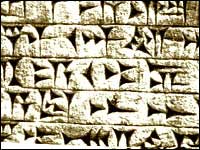
After 3200bce a new form of writing came into existence called Sumerian cuneiform. Here�s an example of what it looks like |
|
|
|
 |
|
|
|
Cuneiform is the oldest language of its kind recorded. It developed from a pictographic form of writing as is common with most forms of writing currently in existence. I�m sure he didn�t mean it to look like a horse. But there it is all the same on a hilltop in the town of Uffington, Oxfordshire |
|
|
|
 |
|
|
|
|
|
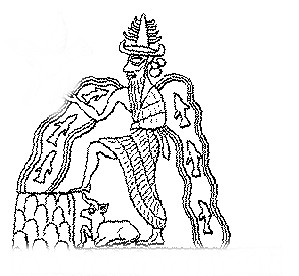
Here�s a picture Of the God Enlil�s brother. His name was Enki. In this picture he is crossing a body of water into a land of sheep. The two streams of water indicate he is halfway across. |
|
|
|
 |
|
|
|
|
|
|
|
|
|
He was top dog in Sumeria after Enlil was deposed for sending a flood. Enki was favoured as he had warned mankind that the flood was coming and had sent Upnapishtim off in a boat. The other time that you see Enki depicted he is always holding two staffs and indeed the sign of Enki is two staffs. Just like the long man of Wilmington. |
|
|
|
|
|
|
|
|
|
|
|
|
|
Remember the axe heads and the Sumerian Cuneiform. Looks kind of samey doesn�t it. If the Axe heads were found carved in Sumeria there wouldn�t be any discussion as to what they represented.
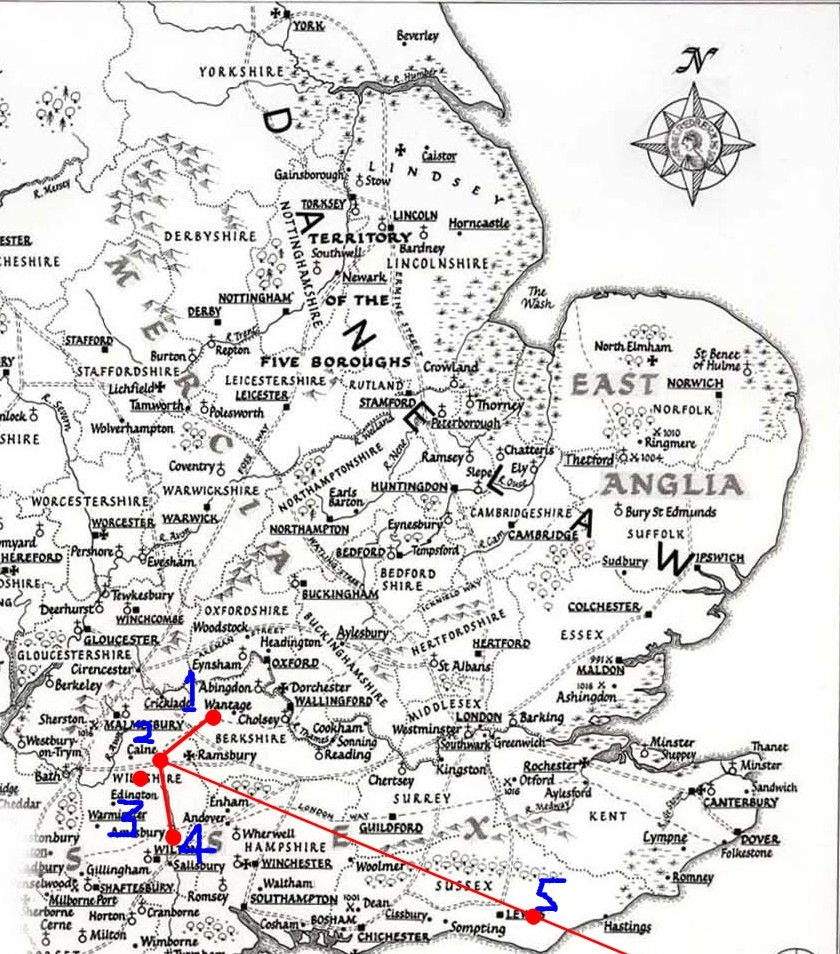
Here�s those four points connected to make it all clear. |
|
|
|
 |
|
|
|
1. Uffington
2. Avebury
3. Silbury
4. Stonehenge
5. Long man of Wilmington |
|
|
|
Another coincidence means of course that this doesn�t mean anything either. Aren�t the tricks that nature plays on us incredible. But the Nebra sky disc is very unnatural. Would it help if we looked at it with the dots joined up as the constellations would appear above Sumeria |
|
|
|
 |
|
|
|
As it appears on the Vernal equinox. Of course it helps if you realise that it isn�t a boat but in fact a rainbow. Which is why it appears in the sky that way up. It allows the holder of the disc to align the disc to the right direction north south. Like the line from Stonehenge to Avebury. |
|
|
|
|
|
|
|
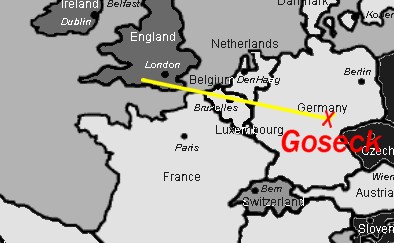
Then quite simply all you�d have to do was stand at Stonehenge during the Vernal equinox and you�d be able to see which direction to head to get back to the centre of the disc, which of course was in the general direction of home |
|
|
|
 |
|
|
|
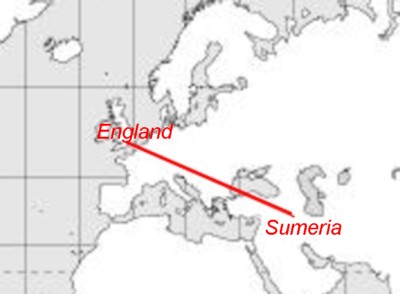
It would direct you towards the southeast, through Germany where the sky disc was found and on towards home and Sumeria, Mesopotamia |
|
|
|
 |
|
|
|
But you remember Sir Frederick Hoyle saying that the knowledge to build Stonehenge must only have come from a race that had learnt astronomy prior to 3200bce through navigating night time seas which is an essential skill to know may have possibly been a bit radical but was he also possibly correct.
And Gerald S. Hawkins had an idea that the whole thing was designed to predict the Vernal equinox and nothing more may also have been onto something.
And Sir Leonard Woolley when he said that �the Sumerians knew what they were doing civilisation wise a long time before Egypt and that it was a little obvious how the other cultures that followed showed signs of being given a hand up, so to speak� .....was he entirely wrong
What do you think. |
|