VTEC is one of Honda's greatest invention. Though an undisputed expert in turbocharging as evidenced by years of Formula-1 domination while Honda was active in the sport, Honda's engineers feels that turbocharging has disadvantages, primarily bad fuel economy, that made it not totally suitable for street use. At the same time, the advantages of working with smaller engines meant that smaller capacity engines with as high power output as possible (ie very high specific-output engines) are desirable for street engines.
Thus Honda invented VTEC which allows it to extract turbo level specific output from its engines without having to suffer from the disadvantages of turbocharging (though VTEC introduces disadvantages of its own).
The Temple of VTEC is specifically created by Jeff Palmer as a dedication to this great technology and the Temple of VTEC Asia is dedicated to the home of VTEC -and of Honda, Japan and the region of Asia.
In this permanent feature, we will examine the basic mechanism that make up
the VTEC technology as well as the various implementations of VTEC.
The Basic VTEC Mechanism
|
The basic mechanism used by the VTEC technology is a simple hydraulically actuated pin. This pin is hydraulically pushed horizontally to link up adjacent rocker arms. A spring mechanism is used to return the pin back to its original position. | 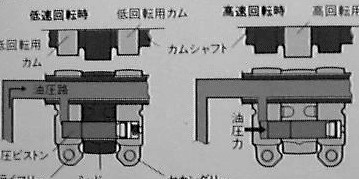 |
The VTEC mechanism is covered in great detail elsewhere so it is redundant to go through the entire mechanism here. Instead we will look at the basic operating principles which can be used in later sectionse to explain the various implementations VTEC by Honda.
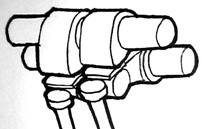
To start on the basic principle, examine the simple diagram below. It comprises a camshaft with two cam-lobes side-by-side. These lobes drives two side-by-side valve rocker arms.
|
The two cam/rocker pairs operates independently of each other. One of the two cam-lobes are intentionally drawn to be different. The one on the left has a "wilder" profile, it will open its valve earlier, open it more, and close it later, compared to the one on the right. Under normal operation, each pair of cam-lobe/rocker-arm assembly will work independently of each other. |
 |
|
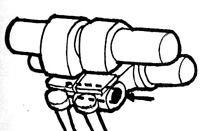
VTEC uses the pin actuation mechanism to link the mild-cam rocker arm to the wild-cam rocker arm. This effectively makes the two rocker arms operate as one. This "composite" rocker arm(s) now clearly follows the wild-cam profile of the left rocker arm. This in essence is the basic working principle of all of Honda's VTEC engines. |
 |