Has it been done elsewhere?
What is wrong with the proposal?
Will it affect my local park?
What is the alternative?

In its draft policy on �People, Dogs and Parks,� the City proposes to introduce a new system for off-leash areas in City parks.
Under the proposed system, local dog owners would need to form a group to apply for a leash-free area. Following consideration by the City and a public meeting, the City may decide to grant a collective permit to the group.
Under the permit, the group would be responsible for ensuring that all users of the leash-free area comply with the park rules, failing which the permit could be revoked.
Existing off-leash areas would not be �grandfathered.� The City plans to �re-evaluate� all existing off-leash areas, bringing them under the new system.

The system appears to be closely modeled on Chicago. Mississauga and Markham have something similar, too.
In considering whether adopting these cities' system would be a positive move for Toronto, you should know that the City of Chicago has a population five times that of the City of Toronto, but just twelve (yes, 12) leash-free areas. See the list here. Mississauga has just five off-leash areas for 600,000 people. Markham has a population of 250,000 people and one (yes, just one) leash-free area.
The scarcity of off-leash areas in these cities (even compared to Toronto) should come as no surprise, given the drawn-out application process and the onerous legal and organizational responsibilities imposed upon local dog owners by the collective permit systems in place there. Follow these links to see how it works in Chicago and Mississauga.
3-million people,
12 off-leash areas.
A model for Toronto?
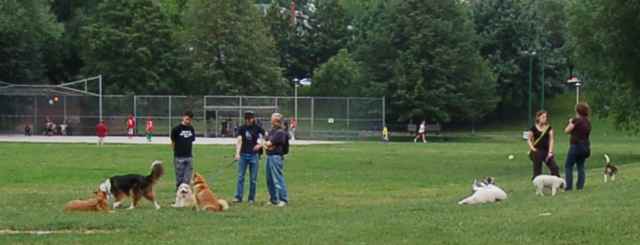
The proposal treats off-leash dog exercise as an abnormal park use warranting the imposition of special onerous conditions not applied to other users. In fact, responsible off-leash recreation is a legitimate park use that enhances the quality of life in the park and in the surrounding neighbourhood. It should not be a mere �privilege� to throw a ball or frisbee to one�s dog, or to let one�s dog play with other dogs, in a neighbourhood park.
The City�s proposed solution to the problem of the 1% of dog owners who are irresponsible is to force the other 99% to deal with them, as the price of exercising their own dogs off-leash. Dog owners should be responsible for their own conduct, not for enforcing park rules against others.
Read our petition, here.
Not from the City. Although dog owners are taxpayers, the draft policy states that there is no money for any �operating requirements� or �amenities� that might be needed in order for a particular site to be, in the City�s estimation, appropriate for an off-leash area (p. 10). Presumably local dog owners would need to choose a site where such �requirements� or �amenities� exist already, or raise the money for them on their own.
Mississauga's rules, which resemble the draft Toronto policy, entailed dog owners having to raise $24,000 initially, plus another $20,000 subsequently, in connection with Mississauga's five off-leash areas. That's almost $9,000 per off-leash area. Where will the dog owners in your park find $9,000 for your off-leash area?
Existing off-leash areas would not be �grandfathered.� The City plans to �re-evaluate� all existing off-leash areas, bringing them under the new system rather than relying on �outdated or historic practices� (p. 13).
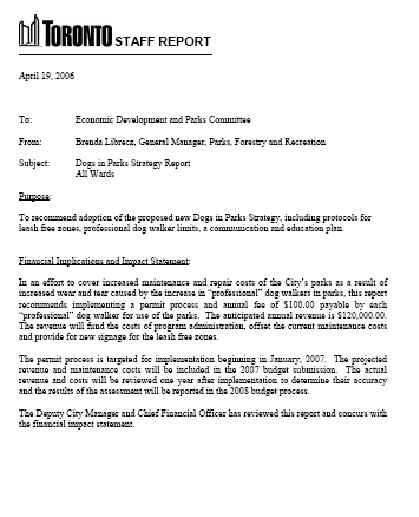
In 2006, the City of Toronto Parks Committee issued a �Dogs in Parks� strategy that recognized that Toronto needs more off-leash areas. The 2006 strategy provided for, among other things:
� Proposals by residents for the establishment of new off-leash areas;
� Suitability criteria for proposed new off-leash areas; and
� Community involvement in encouraging responsible use of the parks by dog owners, and consultation about any ongoing issues.
The Parks Committee agreed to revise its 2006 document, following lobbying by groups that viewed it as too accommodating of the interests of dog owners. The current draft policy is the result of that effort.
Many dog owners, and others who believe that dogs belong in parks, will feel that the 2006 strategy is preferable by far.
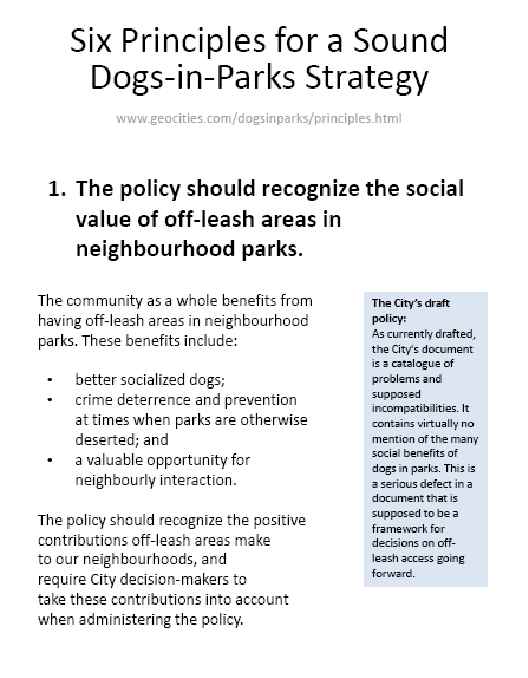
We urge you, in thinking about what a policy for dogs in parks should look like, to consider these six principles for a sound dogs-in-parks strategy: click here to see the principles.