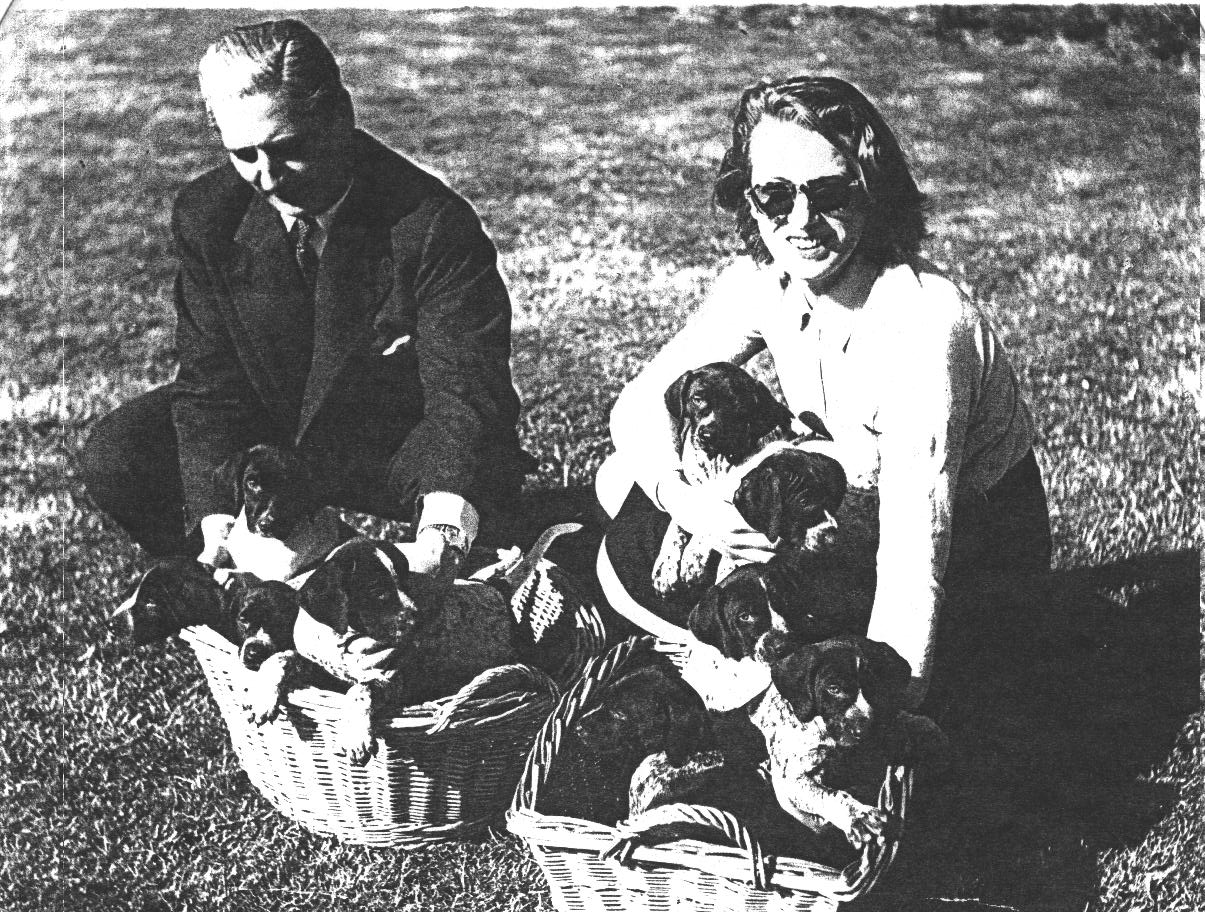
The German Shorthaired Pointer, or Jagdhund, is a breed of dog that has been established on the Continent of Europe for generations, with more or less the same conformation.
They come from the same ancestors as all the other pointing dogs to be found in Europe: the English Pointer, the Weimaraner, the Hungarian Vizsla, the French and Italian Pointers, and the various "Braques".
The hunting instinct is a mixture of good breeding, good instinct, and good training. Upon the return home from World War II, the organization of the GSP Club in England was created and very active by 1951. It became the most popular shooting dog club with the versatile German Shorthair.
Sportsmen soon realized the great possibilities and advantages of a pointer-retriever. At the same time, the GSP also became very popular in America where it could easily travel over rough terrain as the sound of guns burst and quail or other game were retrieved and found for its master.
Tell me, how long does it take for a dog to become a Champion?
It can be as little as 3 shows, as some pretty amazing dogs have done or it can take many, many shows.
The dog needs to earn 15 points in the AKC system to become a champion.
Two of these wins must be "majors" - 3 or more points at one time. The
15 points must be from at least 3 different judges. And, you can't earn
more than 5 points at one show. The number of points is determined by
the number of dogs defeated. The point system changes by region across
the USA.
http://www.akc.org/dic/ptschedule/index.cfm
I mean, do you have to win so many like best in breeds or best in shows? How does this all work?
To put it more simply than it is, the dogs who are not already champions
compete in classes arranged by age and sex. The best male dog is
eventually chosen from the dogs who won their age class and he is called
the Winners' Dog - he gets points based on how many dogs he defeated.
Then, the same thing is done for the females. The Winners' Bitch also
gets points based on how many dogs she defeated.
After that, the dogs who are already champions enter the ring along with
the Winners' Dog and the Winners' Bitch. The judge chooses a Best of
Breed, Best of Opposite Sex (the dog which is the best of the sex that
didn't win Best of Breed) and the judge chooses the Best of Winners from
between only the Winners' Dog and the Winners' Bitch. However, there can
be some overlap - for instance, the Winners' Dog could become the Best of
Breed and automatically be the Best of Winners, too.
The dog who goes Best of Winners *may* pick up more points because they
just defeated more dogs.
But, lets say I get a GSP someday, and I show it, not big on traveling, but compete mostly in shows around my area. What
would make my dog a champion?
Great conformation, few faults, solid temperament, hard work,
preparation, teamwork, great grooming, style, money, etc.
Now, say that I may consider it being a therapy dog as well, what
would that take? At an early start, what socialization does it need
and how do you go about doing it?
Before socialization can even begin, the puppy needs to be born of
parents and ancestry that have good temperaments. You may not be able
to socialize a puppy that isn't of proper temperament to begin with.
It's both. You then need to ensure you are dealing with a breeder that
begins proper socialization right from the beginning to set the stage
for the work you are going to do later.
Some interesting information regarding inbreeding.
Some interesting information I've found regarding inbreeding. It takes a lot of experience, a lot of study, and the right amount of the right genes in order to produce the right dog. Here is something to consider:
It is very important that a breeder knows which ancestor's genes are being concentrated in a dog.
(The percentage of genes which come from a specific ancestor is called
the relationship coefficient (rc).)
One person commented that when she was breeding English Setters, she
found that the most successful pedigrees were about 3-10% inbred and
as high as possible RC on certain ancestors. When going below 3% IC, she
found that consistency of type was gone, as was consistency of health
problems (or the lack thereof). The whole thing became a crap shoot -
not knowing what would be produced. Going above 10%, then also produced more health problems... but they were more predictable.
So, when considering the right dog with the right genes, do lots of research and hope your findings are correct. The way to know? Check the progeny! How have they done? Are they stable in temperment and have no health problems which may be characterized in the breed? Just because a breed is known for various health issues, it doesn't necessarily mean that your dog will develop those issues--especially if the breeding has been carefully made.