

This terrible sounding phrase simply means that the heart cannot keep up with the pumping demands placed upon it. It does not mean a heart attack or that the heart will stop beating. "Congestive" refers to the fluid that accumulates in the lungs or other organs because of the ineffective pumping of the heart. It is seen commonly in dogs of middle or old age.
There are many causes of congestive heart failure: too much blood flowing into a heart chamber, an obstruction keeping the heart from emptying, or the heart muscle is weakened or contracts inefficiently. It may also have a higher incidence in certain families, so it is a good idea to record the incidence for comparison and correlation to avoid breeding potential sufferers.
Large holes between heart chambers, or heart valves that leak, can volume overload the heart making it very difficult for the heart to pump all the blood out. The excess volume causes fluid to leak out of the blood vessels entering the heart resulting in congestion of the lungs or other organs.
Valves, are structures made of flaps of tissue that act as gates, and create two sounds as the heart pumps blood.
If there is a severe obstruction to the flow of blood from the heart, the pumping chamber has to develop excess pressure to overcome the obstruction. This increases the work the heart must do which may exceed the strength of the heart muscle. Similarly, if the heart muscle is weakened because of an infection or some inherent abnormality, the heart cannot effectively pump even at normal volumes and pressures.
There are several drugs that can help the heart to pump. These include: drugs which increase the force of the heart muscle contraction, drugs which help the body get rid of excess fluid that has accumulated in organs, and drugs which relax the circulation making it easier for the heart to empty. The best drug to use depends on the cause of the heart failure.
The right atrium receives blood from the veins and then pumps it into the right ventricle of the heart. The right ventricle of the heart then pushes the blood into the lungs where it exchanges carbon dioxide for oxygen before returning to the left atrium. This gas exchange provides oxygen and rids the body of waste products, the two main goals of the heart and circulatory system. Blood then flows into the left ventricle of the heart where it is pumped to the rest of the body. The atria and ventricles contract alternately, which forces blood through the heart in a smooth, continuous pattern.
The blood vessels act as the body's internal "highway". They transport blood to the various body organs and are the site of nutrient/waste exchange in the body. Arteries carry blood away from the heart, veins carry blood to the heart, and the capillaries are the actual sites of the exchanges.
Murmurs
The sounds that the heart produces are actually the sound of the valves of the heart closing. If these valves do not close properly, because of a disease or a congenital (present from birth) condition, a murmur might be heard. Most murmurs are harmless, and may be outgrown. Some murmurs persist for a lifetime without causing serious harm. Some are warning signs that there is a greater defect, which may cause debility later in life. A vet will diagnose Heart murmurs and grade them according to their severity, management and treatment will be advised at this time. If treatment and veterinarian advice is followed, the animal can have good quality of life.
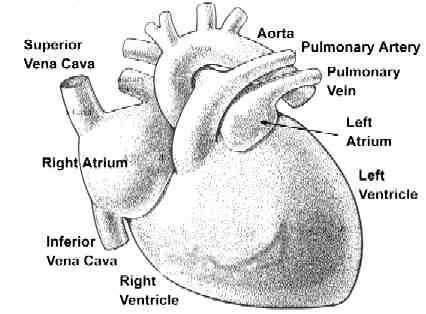
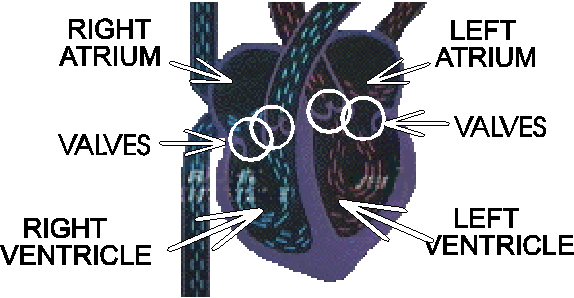
HEART DEFECTS IN THE DOG.
From studies of congenital (present at birth) heart disease in 35,280 dogs over eight years in the School of Veterinary Medicine at the University of Pennsylvania, It was shown that ...Excerpts Genetics for Dog Breeders - Hutt 1979 p.143....Genetics of the Dog - Willis p.234.
The most common abnormality of the heart in dogs is called
patent
ductus arteriosus. In normal development of the foetus, the ductus
arteriosus is a channel from the pulmonary artery to the aorta, but
it should become closed before or shortly after birth. When it fails to
do so and remains patent (open), circulation of the blood is abnormal.
It was found that about half the pups with the duct fully open developed
heart failure and another 15 percent had other abnormalities of circulation.
According to research patent ductus arteriosus
accounts for
25 to 30 percent of all congenital heart disease in dogs.
Breeders were persuaded to donate puppies found to have congenital heart disease for study, and during a period of six years these dogs were used in experimental matings in which both parents were of the same Breed and had the same defect.
When parents of the same Breed both having patentductus
arteriosus were mated together, the incidence of that one defect in
their progeny was 829 per 1,000.
Furthermore, the high degree of concordance between pups and parents with respect to each of the five malformations studied shows that there are specific genes inducing specific defects.
None of the latter, however is a simple recessive trait.
If it were a simple recessive the incidence in pups from parents both affected
should have been 100 percent. It is concluded that polygenetic inheritance
is responsible. Polygenetic characters like these heart defects, which
are not manifested at all by some individuals and are expressed in different
degrees by others of the same population are sometimes called "Threshold"
characters. This term implies that in the interaction of genes trying to
induce the trait and those genes trying to suppress it (ie. to maintain
normal development) there is a threshold beyond which the former (inducers)
overpower the latter (suppressors).
The incidence where one parent is normal is about 21%, which is too low for it to be a simple dominant factor; this would result in a 50% affected puppy result.
A good rule is that if you are sure that an animal carries one of these polygenetic traits that can be lethal or semi-lethal do not use that animal or any close relative to it in a breeding program.
Heart Disease
A heart murmur is not a disease. It is simply the sound produced by blood swirling around, usually because of some defect in anatomy. Murmurs are graded I through VI, but the grading is based on loudness, not on the seriousness of the defect that's causing the murmur.
If your vet diagnoses a murmur in your puppy and she is otherwise healthy, stay calm. Many puppy murmurs are "innocent" and will go away as her heart continues to develop. However, if she has stunted growth, pale or blue gums, or an abnormal pulse, you would want your vet to look further.
In middle-aged dogs, the most common heart defects seem
to be pulmonic stenosis (narrowing of the arteries), valve disorders and
congestive
heart failure.

Animations are created in-house and are copyright please email us if
you want one and we will send a copy for your use. Thankyou.