Experience with dogs, horses, human athletes, cattle, hogs and chickens indicates that for everything that lives and breathes there is an army of experts to tell you how that particular thing should look. A lot of these experts seem to lack the ability to quantitatively distinguish one physical attribute from another. Most start with an animal they love and build a standard to fit, but some few are really awesome in their knowledge of which physical dimensions work best.
Those persons whose opinions on conformation have borne the test
of years have without exception, come from the ranks of the professionals
who use the animals to make money. Now, money doesn't give you good
judgement, but it takes good judgement to hang on to it. You can bet that
anyone dealing with Pit Bulls for a long period of time professionally
has been exercising good judgment.
Professionals look for an animal that can get the job done. Amateurs,
because they have no way to test their theories, wind up feeding their
imaginations. So lets get to the point of establishing a conformation standard
for the American Pit Bull Terrier. Due to todays laws and social standards,
breeding practices are dictated to breeding a dog for looks (AST) rather
than performance. In the interest of preserving the most extraordinary
animal that man has ever created, let's take a good look at what the American
Pit Bull Terrier was suppose to do.
His existence today was not because he was bred only for .
He was not bred only for .
He sure as hell was not bred only for his intelligence, loyalty, boldness,
round eye, rose ear, red nose or his inclination for dragging children
from the paths of speeding trains. He was bred to .
That's right he was developed for sporting competition.
The professional dogfighters have made him what he is. The professional dogfighters improved him, and now, when the professional dog fighters are gone, the real Pit Bull Terrier will gradually fade away. What we will have is something the amateurs will have preserved that reminds us of the gladiators of old. Thank God for the amateurs. Professional dogfighting is a fast dying occupation. Preservation of this grand athlete that was bred to go to war is going to be in the hands of the amateurs. So, lets look to the profession of the dog in establishing our standard, so that our grandchildren will at least see an authentic physical reproduction of a fighting dog.
If we start with the premise that conformation should reflect the
ideal for the dogs usage and that this particular animal was suppose to
win a dogfight, we come naturally to the question, what did it take to
win?
Most of those who have backed their judgment with hard-earned money
would agree on the following to some degree or another.
1. Gameness
2. Attitude
3. Stamina
4. Wrestling ability
5. Biting ability
Note that only one of these qualities; wrestling ability,
is directly related to conformation. One other, stamina may be partly due
to conformation, but is probably as much reliant on inherited efficiency
of the heart and circulatory system. Some people seem to feel that the
shape of the head determines hard bite, but in practice, it seems there
are a lot of other factors involved. Earl Tudor said that the great "Black
Jack", who killed 4 opponents in 7 big wins in big money fights, bit hard
"because he wanted to bite hard". That about sums it up. Good biters seem
to be where you find them regardless of the shapes of their heads.
Any old-time dogfighter would have told you, "If you've got a game dog with good air, he's worth a bet." I might add, "if he can also bite, put a second mortgage on the house and take him to a convention." In other words, never mind what he looks like. However, wiser men than I have said, "The only dead game dogs are dead ones." Also, "Under certain conditions most dogs will quit." I believe there's a lot of truth to that, and to reinforce the fact that conformation is important, remember that conformation and wrestling ability are very closely related and it's usually the bottom dog in the fight that quits. It's hard to stop even the rankest cur if he can stay on top. The dog whose muscle and bone structure doesn't permit him to wrestle on even terms, needs more of everything else to win. He's always coming from behind. His career is short because each "go" takes so much out of him. So I believe that wrestling ability (and therefore conformation) is a very important ingredient in a fighting dog.
The Standard of Conformation can not be based on what someone
who never saw a dogfight thinks a fighting dog should look like, but should
be based on those physical attributes displayed by winning pit dogs of
yesteryear.
Height to weight ratio is critical.
Since dogs were fought at nearly identical weights, the bigger the dog
you have at the weight, the better your chances. Hence, stocky dogs with
long bodies, heavy shoulders and thick legs usually lose to taller, rangier
opponents.
Nature usually blesses a tall rangy dog with a fairly long
neck which is a tremendous advantage in that, it enables him
to reach a stifle when his opponent may have his front leg, take an ear
to hold off a shorter necked opponent, or to reach the chest himself when
the other dog is trying to hold him off. The neck should be heavily muscled
right up to the base of the skull.
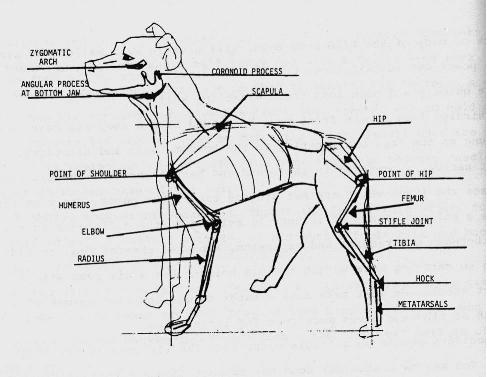
Secondly, look at his back end. That's the drive train of any four legged animal. A Bulldog does 80% of his work off his hips and back legs. A long sloping hip is most important. By its very length, it gives leverage to the femur or thigh bone. A long hip will give the dog a slightly roached backed appearance. Hence the "low set" tail so often spoke of. The hip should be broad. A broad hip will carry with it a broad loin and permits a large surface for the attachments of the gluteal and the biceps femoris muscles, the biggest drivers in the power train. The femur or thigh bone should be shorter than the tibia, or lower leg bone. This means that the stifle joint will be in the upper one third of the hind leg. A short femur and long tibia usually means a well bent stifle, which in turn leads to a well bent hock. This last is a really critical aspect of wrestling ability. When a dog finds himself being driven backward, he must rely on the natural springiness of the well bent hock and stifle to control his movement.
Always look at the front end.
He should have a deep rib cage, well sprung at the top but tapering to
the bottom. Deep and elliptical, almost narrow is preferred to the round
or barrel chest. The rib cage houses the lungs which are not storage tanks,
but pumps. The ribs are like a bellows. Their efficiency is related to
the difference in volume between contraction and expansion.
Depth of rib cage gives more room for large lungs. Shoulders should
be a little wider than the rib cage at the eight rib. Too narrow a shoulder
does not support adequate musculature but too wide a shoulder makes a dog
slow and adds unnecessary weight. The scapula (shoulder blade) should be
at a 45 degree or less slope to the ground and broad and flat. The humerus
should be at an equal angle in the opposite direction and long enough that
the elbow comes below the bottom of the rib cage. The elbows should lie
flat, the humerus running almost parallel to the spine; not out at the
elbows which gives a wide "English Bulldog" stance. The forearm should
be only slightly longer than the humerus and heavy and solid-nearly twice
the thickness of the metatarsal bones at the hock. The front legs and shoulders
must be capable of sustaining tremendous punishment and heaviness can be
an asset here. The relationship between front and back legs should be,
at first appearance, of a heavy front and a delicate back. This is because
in an athletic dog, the metatarsal bones, hock and lower part of the tibia
will be light, fine and springy. The front legs will be heavy and solid
looking. The experienced bulldog man however, will note the wide hip, loin
and powerful thigh, which makes the back end the most muscular.
The head varies more in the present day pit bull. More than any other part of the body, probably because its conformation has the least to do with whether he wins or loses. However, there are certain attributes which appear to be of advantage. First it's overall size. In an otherwise well proportioned dog, the head will appear to be about two thirds the width of the shoulders and about 25% wider at the cheeks than the neck at the base of the skull. From the back of the head to the stop, should be about the same distance as from the stop to the tip of the nose. The bridge of the nose should be well developed which will make the area directly under the eyes considerably wider than the head at the base of the ears. Depth from the top of the head to the bottom of the jaw is important. The jaw is closed by the Temporal Fossa muscle exerting pressure on the Coronoid process. The deeper the head at this point, (that is, between the zygomatic arch and the angular process of the bottom of the jaw) the more likely the dog is to have leverage advantage both in closing the jaw and in keeping it closed. A straight, box-like muzzle and well developed mandible will not have much to do with the biting power but will endure more punishment. "Lippy" dogs are continually fanging themselves in a fight, which works greatly to their disadvantage. Teeth should meet in the front, but more importantly, the canines or fangs should slip tightly together, the upper behind the lower when the mouth is closed. Fangs should be wide at gum line and taper to the end. Soundness and healthy with none missing. The eye elliptical when viewed from the front, triangular when viewed from the side, small and deep set. In general, such a head will be wedge shaped when viewed either from the top or side, round when viewed from the front.
Skin should be thick and loose, but not in folds. It should appear to fit the dog tightly except around the neck and chest. Here the skin should be loose enough to show vertical folds even in a well conditioned dog.
The set of the tail is most important. It should be low. The length should come just above the point of the hock, thick at the base and tapering to a point at the end and should hang down like a pump handle when relaxed.
The feet should be small and set high on the pasterns. The gait of the dog should be light and springy. Most of the above relates to the skeletal features of the dog. When we look at muscles, from the breeders standpoint, it is much more important to look at the genetic features of musculature than those features due to conditioning. A genetically powerful dog can be a winner in the hands of even an inept owner, but a genetically weak dog needs a good matchmaker to win. Conditioning won't do much for him. Think of bones as levers with the joints as the fulcrum and the muscles being applied to the power source. The power being applied to the lever is more effective the farther away from the fulcrum it is applied. Muscles should be long, with attachments deep down on the bone, well past the joint. Short muscled dogs are impressive looking but not athletic. A muscle's power value lies in it's ability to contract. The greater the difference between its relaxed state and it's contracted state, the greater the power.
The coat of the dog can be any color or any combination of colors. It should be short and bristled. The gloss of the coat usually reflects the health of the dog and is important to an athletic American Pit Bull Terrier.
