Because the catheter is introduced
directly into the venous system, it must be placed in an aseptic
(very clean) manner. Comfort is also important when placing the
catheter you don't no the duration the catheter might stay in the vein.
After 3 days I usually replace the catheter
in order to minimize the chance of the catheter causing an infection.
I.V. catheters.
I.V. catheters are usually placed
in one of three veins:
1. Cephalic Vein
This is by far the most common
vein to use. It runs along the top of the foreleg of dogs and
cats. The illustration below shows the placement of this catheter
in a large dog.
2. Jugular vein
This vein is in the neck. A catheter placed
in this vein allows longer term use and the ability to give larger volumes
of medication with different viscosity's.
3. Saphenous
This vein is on one of the back
legs. It is mostly used when the cephalic vein is unusable, but
can be used at any time.
Catheter
Placement
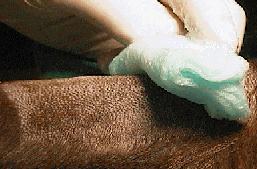
The first step in catheter placement is proper preparation
of the leg. After the hair is clipped it is cleaned with betadine disinfectant
that is used to prepare pets for surgery. If the leg is not prepped properly
an infection can be introduced into the venous system.
This is the cephalic vein coursing from
the foot on the right to the elbow on the left (the arrows
mark the vein and direction of blood flow). It is bulging
(this one is bulging much more than usual, which is why I
picked it for this picture because I gentley tied a leather shoe string occluding the flow of blood to the vein at
the elbow.
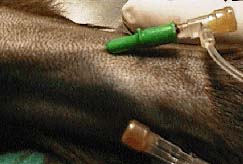
A special Teflon coated catheter is precisely inserted
into the vein and threaded all the way in. I use different sized catheters
depending on the size of the vein, this one is an 18 gauge. As you can
imagine, this takes a lil skill (not all veins are this large).
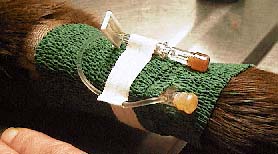
After I am sure of proper placement I carefully
wrap the catheter to the leg with several layers of tape. Most dog's leave
the catheter alone, but due to the fact that there are a limited number
of veins to use, I commonly place a collar on a dog if he acts shakie about the line so that it does
not try to chew it off.
Fluids
I use several different types of fluids depending
on the specifics of the situation. They can be given by many
routes, usually intravenously through a catheter when the dog has been hit hard, or subcutaneously (SQ) under the skin at the scruff of the
neck. When given SQ the fluids will slowly absorb into the body. The
amount I give depends on the dog's age, size, state of
dehydration, and condition. Of all the procedures I
perform on dog's, the administration of fluids is the most
important.
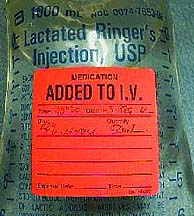
One of the more common fluids,
called Lactated Ringer's Solution (L.R.S.)
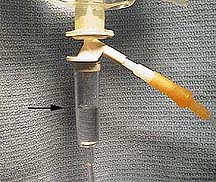
This is a close-up view of the
proper fluid level in the receptacle and the proper storage of the
tip of the IV line. The fluid level in the receptacle should be at
the halfway point . There is a line to mark the spot.
It is not critical to remove all air bubbles since they will cause
no harm when administered this way.