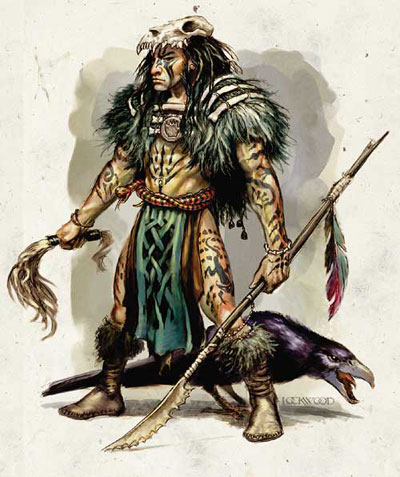
THE SHAMAN
Spirits, say shamans, are all around us: In the wind, the grave, and every drop
of rain and spark of fire. Through magical chants and dances, shamans implore
and even coerce spirits to do their bidding, whether in their healing allies,
revealing the future, or destroying their enemies. Hailing from the same tribal
societies as barbarians, shamans are often revered as witch doctors, medicine
men, and mystics, serving their communities in ways that clerics, and even druids
and wizards, serve their more civilized counterparts. But some shamans are
menacing, powerful figures to be feared, the wicked masters of voodoo, death,
and the walking dead.
Shamans are common among tribal human, wild elf, and monstrous humanoid societies.
Shamans need not worship a deity to receive their magic, but it is not
uncommon, especially among orcs, for shamans to work in the name of a god,
often one of death, war, nature, or fire.
GAME RULE INFORMATION
Shamans (Shm) have the following game statistics.
Abilities: Charisma and Wisdom are key abilities for a shaman. Together,
Charisma and Wisdom influence most of the shaman’s class skills and class
features, from Heal to Perform to Spirit Touch and Spiritbinding, and each
plays an important role in spellcasting, with Charisma determining maximum
spell level and the Difficulty class of shaman spells and Wisdom determining
bonus spells. A high Intelligence provides bonus skill points that can be used
in Crafting Totems, Tribal Dancing, and overcoming the shaman’s Primitive
nature. And high Dexterity and Constitution scores are valuable assets,
allowing the shaman to avoid and withstand attacks and damage.
Base Attack Bonus: Low (as a sorcerer)
Hit Die: d6
Saves: High Will
Alignment: Any
Starting Age: As a wizard
Starting Gold: 4d4 x 10gp
Favored Class: Shaman is a favored class for Humans, and an additional
favored class for Half-Orcs (at the DM’s discretion).
CLASS SKILLS
The shaman’s class skills are Autohypnosis (Wis), Concentration (Con), Craft
(Int), Diplomacy (Cha), Handle Animal (Cha), Heal (Wis), Intimidate (Cha),
Lucid Dreaming (Wis), Perform (Cha), Scry (Int), Sense Motive (Wis), Spellcraft
(Int), and Survival [Intuit Direction/Wilderness Lore] (Wis).
Skill Points at 1st Level: (4 + Intelligence modifier) x 4
Skill Points at Each Additional Level: 4 + Intelligence modifier
The shaman uses Craft (Alchemy) in place of the Alchemy skill.
CLASS FEATURES
All of the following are class features of the shaman.
Weapons and Armor Proficiency: Shamans are proficient with the blowgun,
club, dagger, dart, halfspear, handaxe, javelin, quarterstaff, shortbow,
shortspear, and sling. They are proficient with wooden shields but with no
other form of armor. (Also see Primitive.)
Shamans cannot cast their spells when wearing metal armor or using metal
shields. Their divine magic only works while wearing no armor or armor composed
of leather, bone, hide, wood, or similar organic materials. Spiritbinding and
their other class features are unaffected by armor.
1 Omens, Primitive, Spellcasting, Spirit Guide
(1/day)
2 Craft Totem, Spirit Sight
3 Spiritbinding
4 Tribal Dance (1/day)
5
6 Spirit Touch
7
8 Spiritbinding, Tribal Dance (2/day)
9
10 Spirit Guide (2/day)
11
12 Tribal Dance (3/day)
13 Spiritbinding
14
15 Spiritwalk
16 Tribal Dance (4/day)
17
18 Spiritbinding
19 Dreamwalk
20 Spirit Guide (3/day), Spiritwrack, Tribal Dance (5/day)
Omens: In the patterns of tossed bones, the flight of birds, the
entrails of animals, and the positions of stars: The shaman is skilled at
recognizing and interpreting omens in the world around him, the cosmic clues
and hidden signposts to the future. Once per day, he may perform an augury
as a spell-like ability.
Primitive: Like the barbarian, the shaman hails from a primitive tribal
culture, often one without a written language. As such, he does not
automatically know how to read and write, nor can he read scrolls. The shaman
must spend 2 skill points to gain the ability to read and write all languages
he is able to speak and to cast divine spells from scrolls normally.
More sophisticated magic items are somewhat foreign to the shaman, whose
culture may have had little or no exposure to the likes of magic chainmail,
magic rings, and magic rods. His caster level is considered -1 when meeting the
pre-requisite for any Item Creation feat except Brew Potion and Craft Staff. In
addition, the shaman must be able to read scrolls (as above) to qualify for the
Scribe Scroll feat.
Characters that multiclass in to 1st-level shaman with levels in any other
class except barbarian are not bound by the Primitive class feature, a
by-product of a tribal upbringing. However, such characters do not receive any
of the shaman’s weapon or armor proficiencies (but are still bound by shamanic
armor restrictions). In addition, if a shaman reaches 2nd level with levels in any
class other than barbarian or shaman, he does not automatically gain Craft
Totem and can only acquire that ability as a feat.
Spellcasting: The shaman casts divine spells without preparation, using
his Charisma score to determine maximum spell level and the Difficulty Class of
his spells and his Wisdom score to determine bonus spells. Each day, he selects
his spells from the shaman class spell list, using the bard’s Spells Known
progression. He can then cast the spells selected for the day without preparation,
using the bard’s Spells Per Day progression. The shaman uses the following
spell list, often called Shamanism:
- 0 Level: create water, cure minor wounds, dancing
lights, daze, detect magic, detect poison, foraging charm, ghost sound,
guidance, mending, purify food and drink, ram’s might, resistance, spirit
voice (phantasmal whisperer), unnerving gaze, yell
- 1st Level: bane, bless, burial blessing, burning
hands, cause fear, cure light wounds, detect animals and plants, detect
evil, doom, endure elements, goodberry, hawkeye, hypnotism, magic stone,
magic weapon, nature spirit (wood wose), obscuring mist, preserve organ,
protection from evil, rankletaste, remove fear, sacrificial skill, see invisibility,
sleep, smell of fear, spirit worm, summon spirit I (summon nature’s ally
I), suspend disease, towering oak, weather eye
- 2nd Level: animal trance, blindness/deafness, blood
frenzy, breath of the jungle, bull’s strength, cat’s grace, circle dance, cloudburst,
continual flame, cure moderate wounds, death knell, delay disease, delay
poison, dissonant chant, eagle’s splendor, elephant’s stamina (endurance),
enthrall, fox’s cunning, hold person, lesser restoration, owl’s wisdom,
produce flame, protection from arrows, pyrotechnics, resist elements,
scare, sonorous hum, speak with animals, spectral hand, spirit warriors
(phantasmal assailants), suggestion, summon swarm, summon spirit II
(summon nature’s ally II), wolf’s nose (scent)
- 3rd Level: bestow curse, bladebane, call lightning,
contagion, contagion ward, cure serious wounds, dispel magic, eagle eyes,
embrace the wild, evil eye, fear, feign death, flame arrow, greater magic
weapon, gust of wind, identify with flame, lesser geas, magic circle
against evil, nature’s form (polymorph self), neutralize poison, phantom
steed, plant growth, poison, prayer, protection from elements, rage,
remove blindness/deafness, remove curse, remove disease, scrying, speak
with dead, speak with plants, spiritjaws, spirit torch (corpse candle),
summon spirit III (summon nature’s ally III)
- 4th Level: animate dead, bear’s heart, claws of the
savage, discern lies, dominate person, hallucinatory terrain, jaws of the
wolf, junglerazor, minor creation, phantasmal killer, quench, reincarnate,
restoration, ritual of the red egg (Theller’s argauneau), shelter
(Leomund’s secure shelter), skull of secrets, summon spirit IV (summon
nature’s ally IV), vine mine, wall of fire, war cry
- 5th Level: animate dread warrior, big sky, break
enchantment, control winds, cure critical wounds, dispel evil, dream,
empower venom, fabricate, hasten recovery, imprison possessor, insect
plague, jungle’s rapture, magic jar, mass contagion, nightmare, owl’s
insight, revenance, soul scour, spirit guard (Mordenkainen’s faithful
hound), spiritwall, stone tell, summon spirit V (summon nature’s ally V),
true seeing, watchware
- 6th Level: bestow greater curse, control weather,
dream casting, eyebite, finger of death, fire seeds, forbiddance,
geas/quest, greater dispelling, great thunderclap, green oath, heal,
heighten venom, heroes’ feast, impotent possessor, imprison soul,
insanity, juju magic (create undead: juju zombie), mandragora, project
image, raise dead, snare astral traveler, spirit thief (phantasmal thief),
summon spirit VI (summon nature’s ally VI), vision
Spell Notes: When casting any spell with the Dragon
Magic component, the shaman can instead substitute a small handful or reptilian
bones; such spells have a minimum casting time of 1 full round. Spells simply
renamed, such as spirit torch and shelter, operate as the root
spells noted (corpse candle and Leomund’s secure shelter, in
these cases), with the following exceptions: Spirit guard (Mordenkainen’s
faithful hound) allows the shaman to designate the guardian’s appearance
(howling wolf, roaring lion, hissing snake, etc.); Nature’s form (polymorph
self) only allows the shaman to take the form of Animals; and the summon
spirit (summon nature’s ally) spells can only summon creatures the
shaman can Spiritbind. If he can only Spiritbind Animal Spirits and River
Spirits, for example, he can only summon animals and water elementals (no
satyrs, fire elementals, etc.); if he can only bind Spirits of the Dead,
however, he cannot utilize summon spirit spells at all. A list of each
spell’s source is at the end of this post.
Spirit Guide (1st/10th/20th level): The shaman may call upon his spirit
guide for advice and guidance. A spirit guide is a visual personification of
Nature that only the shaman can see. It always appears to him in the same form,
that of a speaking, intelligent animal such as a fox, bear, raven, or snake.
The spirit guide has no material existence other than its image; it is not
affected by magic or antimagic and cannot be attacked or attack, although true
seeing and stronger divinations can make it visible to others. The shaman
can call on his spirit guide once per day, then twice per day at 10th level and
three times at 20th level. Summoning the spirit guide is a spell-like ritual
requiring the shaman meditate for 1d4 minutes; when he opens his eyes, his
spirit guide is before him. In most cases, the spirit guide remains only long
enough to perform the task requested, which takes a full round unless otherwise
noted, and then disappears. Once it arrives, the shaman may request one of the
following, depending on his level:
- Identify: The spirit guide identifies a single
object within 5 feet of the shaman, as if the shaman had cast a variation
of the wizard spell.
- Whisper (2nd level): The spirit guide whispers into the
shaman’s ear a translation of any language the shaman is currently
listening to or reading, as if the shaman had cast the comprehend
languages spell.
- Sense Traps (4th level): The spirit guide walks ahead of the
shaman and points out concealed peril, as if the shaman had cast find
traps. The spirit guide searches as if it has ranks in Search equal to
the shaman’s Search score or to the shaman’s level (whichever is higher).
It also receives a +10 insight bonus to checks when detecting threats also
identified by the detect snares and pits spell. The spirit guide
never triggers a trap itself, even those it fails to detect, although the
shaman (or his party) can trigger any trap normally.
- Legend (6th level): The spirit guide provides information
about an important person, place, or thing, as if the shaman had cast legend
lore.
- Nature’s Voice (8th level): The spirit guide communes with
nature, granting the shaman detailed information about the local
terrain.
- Revelation (10th level): The spirit guide answers a single
question, as if the shaman had cast a form of divination. An
inconclusive response means the spirit guide does not know or, more
likely, won’t answer for its own mysterious reasons.
- Hidden Path (12th level): The spirit guide leads the shaman out
of an area, as if the shaman had cast find the path. If this trek
lasts more than two hours, the spirit guide imparts to the shaman the
knowledge necessary to complete the journey and then disappears.
- Find (18th level): The spirit guide locates a creature
or object, as if the shaman had cast discern location. This
detection requires the spirit guide concentrate for 10 minutes; all other
restrictions of the spell apply to the shaman.
Spirit guides have
also been known to occasionally appear to shamans in their dreams with cryptic
warnings, philosophical questions, or words of advice. These appearances are at
the DM’s discretion and do not count against the shaman’s daily limit.
The shaman can enhance his Spirit Guide ability with the Ancestral Spirit and
Extra Spirit Guide feats.
Craft Totem (2nd level): The shaman enjoys his own cultural form of
magic item creation, allowing him to fashion a small group of rustic magic
objects without many of the costs normally associated with Item Creation.
Crafting a totem requires only skill, experience, and time, and most totems
hold their magic for a short time, function only under certain conditions, or
function only for the shaman or those he designates. Totems (detailed further
below) include animal tokens, burial ground markers, cave paintings,
dreamcatchers, headdresses, medicine pouches, monkey paws, peace pipes,
shrunken heads, spirit masks, totem poles, and voodoo dolls. (Also see
Primitive.)
The shaman can enhance his Craft Totem ability with the Epic Totem Crafter
feat.
Spirit Sight (2nd level): The shaman’s vision extends into the spirit
realm. Beginning at 2nd level, he can see ethereal creatures as a supernatural
ability. In addition, the shaman can see any creature that he can Spiritbind if
it is cloaked by natural invisibility, as if he were able to see
invisibility against those creatures. For example, a shaman who binds Wind
Spirits can see invisible stalkers, a Nature Spiritbinder can see pixies, a
binder of Fiends (via the Greater Spiritbinding feat below) can see hellcats,
etc.
Spiritbinding (3rd/8th/13th/18th level): By force of personality, the
shaman can bind spirits to his will or make them tremble in his wake. He gains
the supernatural ability to rebuke and command certain creatures as an evil
cleric two levels lower affects undead, up to a number of times per day equal
to his Charisma modifier. At 3rd level and every five levels thereafter, he
selects one of the following spirit types to affect:
- Animal Spirits (Animals)
- Fire Spirits (Fire Elementals)
- Mountain Spirits (Earth Elementals)
- Nature Spirits (Fey, Spirit Folk, and Wood Woses)
- River Spirits (Water Elementals and Nixies)
- Spirits of the Dead (Undead)
- Tree Spirits (Plants and Dryads)
- Wind Spirits (Air Elementals)
A good shaman can
only rebuke (but not command) Spirits of the Dead; a nongood shaman can only
rebuke (but not command) good-aligned Nature Spirits. A shaman often refers to
spirits in terms more specific to his culture; A desert-raised shaman, for
example, may command Dune Spirits (Mountain) and Spirits of the Desert
(Nature), while an islander may refer to Volcano Spirits (Fire) and Spirits of
the Sea (River). Unlike clerical turning, Spiritbinding is unrelated to
positive and negative energy and not subject to feats or effects that target
clerical turning.
The shaman can enhance his Spiritbinding ability with the Destroy Spirits,
Empower Spiritbinding, Epic Spiritbinder, Extra Spiritbinding, Extra Spirit
Type feats, Greater Spiritbinding, Heighten Spiritbinding feats, and Quicken
Spiritbinding feats.
Tribal Dance (4th/8th/12th/16th/20th level): Beginning at 4th level, the
shaman may learn tribal dances that have a supernatural effect on spellcasting.
To learn his first dance, the shaman must have 4 ranks in Perform (Dance); each
subsequent dance requires an additional 2 ranks in Perform (Dance), up to 12
ranks to learn all five dances. At the indicated levels (or as soon as he
qualifies thereafter), the shaman learns one dance. He can perform a number of dances
per day equal to the number of dances that he knows.
Each dance can be performed as either a full-round performance, granting one of
two Metamagic or related effects, or as a 10-minute performance, granting one
of two more powerful effects. Upon completing a dance, the shaman selects one
of the available effects and then, on his next turn, casts any spell listed for
that dance that he has prepared: This spell is enhanced by the chosen effect
without taking up a higher level spell slot. If attacked while dancing, the
shaman must make a Concentration check (DC 13 + damage dealt) or have the dance
spoiled and that daily use lost. He can voluntarily end a dance after one round
but short of the 10-minute mark and still receive the benefit of the full-round
dance. The tribal dances are:
- Bone Dance: The shaman can perform the bone dance, a menacing, frightening
series of juts and screeches, accompanied by the violent shaking of bones,
a skull on a stick, or the carcass of a freshly killed animal. The spell cast
is affected by either the Extend Spell or Spell Focus feat (full-round
dance) or the Heighten Spell +3 or Greater Spell Focus feat (10-minute
dance): animate dead, cause fear, death knell, finger of death, ghost
sound, speak with dead, or spiritwall.
- Fire Dance: The shaman can perform the fire dance, a vigorous gallop and
chant either around an open fire or while holding a flame (such as a
torch). The spell cast is affected by either the Heighten Spell +1 or
Spell Focus feat (full-round dance) or the Maximize Spell or Greater Spell
Focus feat (10-minute dance): burning hands, dancing lights, fire
seeds, flame arrow, pyrotechnics, summon nature’s ally V (fire elemental),
or wall of fire.
- Medicine Dance: The shaman can perform the medicine dance, a
rhythmic, circular shuffle and soft, sorrowful chant. The spell cast is
affected by either the Heighten Spell +1 or Reach Spell feat (full-round
dance) or the Heighten Spell +3 or Maximize Spell feat (10-minute dance): break
enchantment, cure light wounds, elephant’s stamina (endurance), heal,
purify food and drink, remove disease, or restoration.
- Rain Dance: The shaman can perform the rain dance, a pleading, murmured trot,
palms and face raised to the sky. The spell cast is affected by either the
Enlarge Spell or Extend Spell feat (full-round dance) or the Maximize
Spell or Widen Spell feat (10-minute dance): call lightning,
cloudburst, control weather, control winds, create water, obscuring mist,
or quench.
- War Dance: The shaman can perform the war dance, a howling, spinning, and
hooting display of intimidation, prowess, and weaponry, often performed
around an open fire or before a group of warriors. The spell cast is
affected by either the Extend Spell or Heighten Spell +1 feat (full-round
dance) or the Heighten Spell +3 or Maximize Spell feat (10-minute dance): bless,
blood frenzy, greater magic weapon, heroes’ feast, resistance, revenance,
or war cry.
For the purposes
of meeting pre-requisites and prestige class requirements, knowing a tribal
dance does not constitute knowing or having any of the feats listed for that
dance.
The shaman can enhance his Tribal Dance ability with the Spirit Dance feat.
Spirit Touch (6th level): Once per day, the shaman can affect ethereal
creatures as if they were material. This manifests in one of two ways, chosen
when Spirit Touch is employed: Any weapon in the shaman’s hands or the missiles
it fires (if applicable) carry the Ghost Touch effect for a number of rounds
equal to 3 + the shaman’s Wisdom modifier (if positive); or the shaman can cast
one spell, of a spell level equal to 1 + the shaman’s Wisdom modifier (if
positive), that only affects ethereal creatures, as if the shaman had cast the
spell while on the Ethereal Plane. Initiating this supernatural ability is a
move-equivalent action.
Spiritwalk (15th level): The shaman can assume a visible ethereal state
as a standard action, as if he had cast the ghostform spell. This
spell-like ability can be used a number of times per day equal to 1 plus the
shaman’s Wisdom modifier (if positive) for a number of total minutes per day
equal to the shaman’s level.
Dreamwalk (18th level): The shaman can enter a meditative state for 10
minutes and free his body from its fleshy cage, as if he had cast astral
projection. This spell-like ability can be used once per day.
Spiritwrack (20th level): As a full round action, the shaman can rouse
the spirits of nightmares and madness, evoking a weird as if he had cast
the spell. This spell-like ability can be used once per day.
Epic Shaman: The epic-level shaman continues his Hit Die, skill point,
and Spiritbinding progressions. In addition, he receives bonus epic feats at
23rd level and every three levels thereafter (23rd, 26th, 29th, 32nd, etc.)
from the following list: Automatic Quicken Spell, Automatic Silent Spell,
Automatic Still Spell, Enhance Spell, Epic Counterspell, Epic Elemental Focus,
Epic Leadership, Epic Poison Crafter, Epic Spell Focus, Epic Spell Penetration,
Epic Spellcasting, Epic Spiritbinder, Epic Totem Crafter, Epic Will, Ignore
Material Components, Improved Combat Casting, Improved Heighten Spell, Improved
Metamagic, Improved Spell Capacity, Intensify Spell, Master Staff, Multispell,
Perfect Health, Permanent Emanation, Spectral Strike, Spell Stowaway, Spell
Opportunist, Spirit Dance, Spontaneous Spell, Staff Specialization, Tenacious
Magic, Undead Mastery, and Zone of Animation. The shaman can
substitute his Spiritbinding class feature for the ability to rebuke undead
when qualifying for the Spectral Strike feat.
TOTEMS
Totems are rustic magic items that shamans can create through their Craft Totem
class feature. Crafting a totem requires the shaman be of the specified level,
have ranks in certain Craft skills, and sacrifice time and experience. Unlike
other magic items, totems do not require spells or gold to create. However,
most totems can only be used under certain conditions or by certain individuals
or retain their magic for only a short time before becoming mundane objects
again.
All level-based effects of totems, such as Difficulty Class and number of
times, are based on the shaman’s level at the time of the totem’s creation.
Totems fall into three categories: Personal totems, such as spirit masks, which
can only be used by the shaman who crafted them; communal totems, like
dreamcatchers, which can only be used by the shaman and those he designates
during creation; and territorial totems, such as cave paintings, which only
function in a fixed location. In the hands of others, personal and communal
totems simply radiate faint magic (until their magic fades entirely) but do not
function – shrunken heads are simply gruesome ornaments and medicine pouches
are bags of twigs – while territorial totems lose their magic if moved from
their fixed location.
Totems cannot be crafted for monetary gain; if the shaman creates a totem in
exchange for gold or material profit, the totem loses its enchantment the first
time the designee attempts to use it. As such, totems do not have Market Prices
or material value to others – except as cultural curiosities or examples of
folk art. Shamans can, however, craft totems in exchange for the recipient
performing a geas for the shaman.
ANIMAL TOKEN (Personal Totem) Requirements: Level: 2
(badger), 4 (eagle), or 6 (others); Craft: Sculpting or Woodcarving 4
and Painting 2; Time: One day (Woodcarving) or Three days (Sculpting); XP:
20xp/level. Description: The shaman sculpts a small, fist-sized wooden
or stone figurine of one of the following animals: ape, badger, black bear,
boar, eagle, leopard, or wolf (or regional equivalents). After creation, the
shaman can throw this token on the ground before him as a standard action and
verbally command it to come to life, and it does, as if the shaman had cast the
appropriate summon nature’s ally spell. The animal fights and acts as
the shaman commands for 1 round per level at the time of creation. If the
animal is killed, if the duration ends, or if the shaman so commands, the
animal reverts to its token form.
The shaman may possess up to three different tokens at a time but can only have
one activated at any given moment. Each token can be activated once per day for
a total number of days equal to the shaman’s level at the time of creation. To
those other than the shaman, an animal token radiates faint magic but cannot be
activated. It loses its magic entirely after one month (carved tokens), three
months (sculpted tokens), or after having been activated its maximum number of
times.
BURIAL GROUND MARKER (Territorial Totem) Requirements: Level:
9; Craft: Woodcarving 3; Time: Three days; XP: 327xp. Description:
A burial ground marker is a staff-like object of crossed sticks adorned with
feathers and animals skins and topped with the skull of a Small or larger
Animal or a Humanoid. Within 12 hours of completion, the marker must be driven
into ground where, within 20 feet of the marker, there are three or more
humanoids corpses buried. The shaman must personally know, be related to, or be
from the same tribe as at least one of the corpses.
Twenty-four hours after being planted, the marker begins warding the area as a
sacred burial ground. This protection lasts as long as the marker remains
standing, protecting any corpses buried or subsequently buried in the affected
area. In most outdoor environments, unless physically knocked down, burial
ground markers persevere weather and animals for 2d6 years before needing to be
replaced. In deep caves or other sheltered environments, however, burial ground
markers can last centuries. When the marker falls or ceases to provide its
protections, the shaman who crafted it feels a mental ping. A shaman can only
have up to two burial ground markers in place at any one time. Replacing one of
his own damaged or worn markers costs the shaman only one-third the normal XP cost.
Within 20 feet of a marker, the following effects occur:
- Any creature who views the marker for the very
first time must make a Will save (DC 13 + shaman’s level) or be shaken
while in the protected area and for 1d4 rounds after leaving the area. The
shaman is immune to this effect.
- All saves against Fear effects in the area are
made at a -2 penalty. The shaman is immune to this effect, and it has
already been figured into the save against being shaken.
- As if in hallowed ground, corpses
buried in the protected area cannot be turned into undead creatures –
except by the shaman who crafted the marker.
- Any speak with dead spell cast on a
corpse buried in the protected area lasts up to 1 hour and allows the
caster to ask three questions per level.
- Any reincarnation spell cast on a
corpse buried in the protected area functions as true reincarnation,
granting its caster greater control over the type of creature that
results.
- Any raise dead spell cast on remains
buried in the protected area functions as resurrection, allowing
its caster to raise the corpse no matter how long it has been dead.
- Any intelligent creature except the shaman who
created it that knocks over or destroys a burial ground marker must make a
Will save (DC 13 + shaman’s level) or suffer a curse as if the shaman had
cast bestow curse upon the victim. The shaman designates the nature
of this curse during the totem’s creation.
CAVE PAINTING (Territorial Totem) Requirements: Level:
6; Craft: Painting 6 and Herbalism 6; Time: One day; XP:
180xp. Description: The shaman paints one of the following animals on a
natural, unworked stone wall: brown bear, giant constrictor, giant crocodile,
rhinoceros, or tiger (or regional equivalents). The wall used must be adjacent
to an area, generally a 15 foot radius gap from the wall, that can physically
accommodate the animal in question. During the painting, the shaman designates
those individuals who will not trigger the cave painting, a list that can be as
specific as just the shaman himself or a list of names or as general as “my
tribe” or “all who dwell here.” The enchanted painting, which radiates faint
magic, may be placed among other mundane or magical paintings on the same wall.
For the purposes of magical removal or relocation, cave paintings are treated
as glyphs.
Twenty-four hours after being painted, the painting begins to ward the area
from intruders. Any creature passing within 15 feet of the wall triggers the
painting, causing it to spring to life as if it were greater glyph of
warding holding a summon nature’s ally V spell. The painting
disappears and a living version of the animal takes form within 10ft of the
wall and attacks the intruder; once that intruder is slain or flees, the animal
attacks the next closest intruder. The animated animal cannot stray more than
30 feet from its wall location but defends the area for up to one hour before
returning to its painting form. The animal will also revert to its painting
form 5 minutes after the intruders have left the area or been slain or at the
shaman’s verbal command. Once activated, a cave painting can’t be triggered
again for 24 hours. The painting loses all its magic after being activated
three times.
DREAMCATCHER (Communal Totem) Requirements: Level: 5; Craft:
Weaving 4; Time: Two days; XP: 202xp. Description: A
dreamcatcher is a web-like pattern of netting within a small wooden or bone
hoop adorned with feathers, beads, and often small animal bones. The
dreamcatcher snares nightmares in its netting while pleasant dreams are allowed
through a gap at the center of the pattern. Often used in homes or at
campsights, the dreamcatcher must be positioned a few feet above the ground (to
a wall, to a tree, above the bed, etc.) and left stationary to have any effect.
An hour after being so positioned, the dreamcatcher begins to ward all within a
15ft radius from bad dreams. Phantasm spells or effects such as illusory
pit, nightmare, phantasmal assailants, phantasmal killer, weird and the
shaman’s own Spiritwrack ability have no effect on creatures in the protected
area. In addition, those protected receive a +2 sacred bonus to saves against
hostile illusions. Finally, those who sleep under the dreamcatcher’s protection
recover double the hit points they otherwise would for a full-night’s rest.
An area can only be warded by one dreamcatcher at a time. If the dreamcatcher
is moved, its protections against phantasms and hostile illusions end until it
has been properly repositioned and remains motionless again for 1 hour; if
moved while protected creatures are sleeping, its benefit to rest is lost for
that day, even if repositioned. While only the shaman or those he designates
can position the dreamcatcher, it benefits all within the protected area. After
three months, a dreamcatcher’s magic completely fades.
HEADDRESS (Personal Totem) Requirements: Level: 8; Craft:
Weaving 8; Time: One week; XP: 88xp/level. Description: A
headdress is a woven cap or headband threaded and adorned with a colorful and
elaborate train of feathers. Each headdress is crafted for a specific Tribal
Dance, often reflected in the colors of its feathers (red and yellow feathers
for Fire Dance, white and blue feathers for Medicine Dance, etc.) Donning a
headdress (which weighs 15 pounds) is a move-equivalent action that provokes an
attack of opportunity. A shaman wearing a headdress can perform the related
Tribal Dance for a full round and enjoy its benefits as if he had danced for 10
full minutes. A headdress can only augment one dance per day (and only the
specific Tribal Dance it was crafted for) and can augment a total number of
dances equal to the shaman’s level. After three months or after having been
used the maximum number of times, the headdress loses its magic.
MEDICINE POUCH (Personal Totem) Requirements: Level: 4; Craft:
Herbalism 7 and Leatherworking or Weaving 2; Time: Two Days; XP:
7xp/level. Description: A medicine pouch appears to be a simple leather
or hemp pouch containing herbs and various roots; it is unremarkable to the eye
in every way. To the shaman, however, the medicine pouch has several mystical
qualities. As long as he wears his medicine pouch, he receives +2 to all Heal
checks (as if using a Healer’s Kit) and can once per day, up to a number of
times per day equal to his level, effect one of the following spells as a full
round action: cure light wounds, delay poison, or purify food
and drink. After 30 days, the medicine pouch loses its magic.
MONKEY PAW (Personal Totem) Requirements: Level: 20; Craft:
Herbalism 18; Time: One week (see description); XP: 2959xp (see
description). Description: The monkey paw is the severed hand of an ape
(the creature used by the first shaman to craft this totem) or any Large or
smaller humanoid creature that has been soaked in a mystical brew until it is
shriveled and blackened. The shaman spends one day of the creation time
preparing this magical broth. He must then, within 24 hours of preparing the
brew, personally sever a hand from the living victim and place it into the
brew. (This up-to-24-hours period does not count as part of the creation time.)
The shaman must actively tend and stew for the remainder of creation, stirring
and chanting. Once finished, the monkey paw is often worn around the neck as a
gruesome petrified medallion. The paw allows the shaman to make a single wish
as a standard action by holding the paw and stating his desire. This incurs the
normal experience point cost of the spell (generally 5,000xp, in addition to
the paw’s creation cost). After the wish has been made, the paw becomes
nonmagical. The paw can endure for centuries if unused, long after the shaman’s
death.
Unlike other personal totems, a monkey paw will function for other creatures –
but as a cursed item. When used by a creature other than the shaman, the wish
takes effect as a perversion of the intent, regardless of how carefully worded
or minor the request, and drains the normal experience points from the wisher
(generally 5,000xp) as well as 1 point of Wisdom permanently. In addition, the
monkey paw will attempt to perversely grant the most mundane, casual desire the
owner vocalizes, even if not phrased or intended as a wish and even if the
owner is unaware of the paw’s power to grant a wish. If the owner says aloud
that she wants something to eat, for example, the monkey paw will grant that
desire in a horrible way (a bowl of maggots appears, the owner’s mount cooks
alive, etc.), with the costs described above. While in possession of the paw,
there’s a 5% chance per day that the owner will accidentally voice some mundane
desire that the paw will make perverted reality.
PEACE PIPE (Communal Totem) Requirements: Level: 5; Craft:
Herbalism 6, Woodcarving 6, and Painting 2; Time: Three Days; XP:
10xp/level. Description: A peace pipe is often used in communal
settings, during negotiations, or at celebrations. A wooden pipe ranging in
length from 8 inches to 4 feet, peace pipes are intricately carved and painted
and often adorned with feathers. Regardless of the type of herb placed in its
bowl, all those who smoke from the peace pipe and all within 10ft who can smell
the smoke are affected as if in a zone of truth or calm emotions
if they fail Will saves (DC 12 + shaman’s level); creatures with the Scent
special quality suffer a -3 to these saves. The effect is chosen by the first
person who activates the pipe’s magical qualities, which must be the shaman or
one he designated during creation. The duration of the effect is 5 minutes,
although continued usage of the pipe by those already affected can extend the
duration in 5 minute intervals up to one hour. A peace pipe can be used once
per day and takes a full minute to load, light, and take the first puff.
Although the shaman or one designated must be the first to smoke from the pipe
for its magic to work, the pipe influences all in the area. After one year or
after having been used a number of times equal to twice the shaman’s level, it
loses its magic.
SHRUNKEN HEAD (Personal Totem) Requirements: Level: 7; Craft:
Herbalism 10; Time: One week; XP: 33xp/level. Description:
The shrunken head is as it sounds: the disembodied head of some humanoid that
has been soaked in a mystical brew until it resembles a shriveled, apple-sized
version of its former self. The shaman spends one day of the creation time
preparing this magical broth. He must then, within 24 hours of preparing the
brew, place the head in the brew. The shaman need not have personally killed
the head’s hapless owner, but the head must be placed in the brew within 24
hours of the creature’s death, whether due to the decapitation or not. (This
up-to-24-hours period does not count as part of the creation time.) The shaman
must actively tend and stew for the remainder of creation, stirring and
chanting. Once finished, shrunken heads are often hung from leather straps on
belts, worn as gruesome medallions, or tied dangling to staffs. When held in
front of the shaman as a standard action, a shrunken head’s withered eye
sockets glow with an infernal red light as it unleashes a cone of fear
(DC 13 + shaman’s level). The shrunken head can cause fear a total
number of times equal to the shaman’s level at the time of creation, and up to
three times in a single day. After three months or after it has been used the
maximum number of times, the shrunken head becomes a grotesque nonmagical
bauble.
The shaman can prepare up to four additional heads in the same brewing and use
the group as a single head bundle. Each additional head increases the base
experience point cost to create by 15%, the total number of times the shaman
can cause fear by 2, and the DC of the saves by +1. A five-headed
bouquet created by a 10th-level shaman, for example, costs 528xp to create
(330xp + 60%), can be used up to 18 times (10 + 8), and has a DC of 27 (DC 13 +
4 + 10).
SPIRIT MASK (Personal Totem) Requirements: Level: 4; Craft:
Woodcarving 7 and Painting 5; Time: 3 days; XP: 5xp/level. Description:
Large (around 30 pounds) and ornately carved, painted, and adorn with feathers,
spirit masks bear the horrible face of an evil spirit, a visage so horrible
that it frightens those who view it. The shaman can don and activate the mask
(a full-round action that provokes an attack of opportunity) to cause a scare
effect (DC 12 + shaman’s level) as the face on the mask animates, scowling,
screaming, and hissing at the targets. The shaman can initiate this effect once
per day, and it lasts for a number of rounds equal to the shaman’s level as
long as he keeps the mask on. While wearing a spirit mask, the shaman suffers a
–3 penalty to Spot checks, all Charisma-based skill checks (except Intimidate),
and any skill checks reliant on vision.
If the shaman also has 8 ranks in Craft (Weaponsmithing), he can carve his
spirit mask onto his wooden shield for an addition +50% experience points,
enabling him to initiate the scare effect without needing to physically
don the mask and without the resulting penalties to skill checks. After three
months, the spirit mask (or the shield) loses its ability to scare.
TOTEM POLE (Territorial Totem) Requirements: Level: 15; Craft:
Woodcarving 15 and Painting 8; Time: One month; XP: 2500xp (see
below). Description: Totem poles are markers most often used to protect
villages from rival tribes, marauding goblins, wild wolf packs, and other
threatening creatures. A totem pole is an intricately carved and painted log at
least 1 foot in diameter and ranging in length from 10 feet to 18 feet. The
pole is carved with the faces of the shaman’s ancestors, legendary barbarian
warriors, ferocious animals, protective spirits, and often the shaman’s own
Spirit Guide. During creation, the shaman designates one alignment, creature
type, or enemy tribe that is affected by the totem pole. For an additional
1000xp cost, he may designate one additional alignment, type, or tribe.
Once the pole is completed, it must be set into the ground, usually placed in a
hole at least two feet deep, firmly packed in, and surrounded by a mound of
piled stones to keep it erect. The pole must be placed “in the earth and
beneath the sky.” After 24 hours in the ground, the pole begins radiating an antipathy
effect in a 300 foot radius (DC 15 + shaman’s level), repelling the designated
creatures. Any designated creature within 300 feet of the totem pole when it
begins radiating its protection is immune to its effects until it leaves and
then attempts to reenter the warded area. If a totem pole is ever set afire,
destroyed (it has hardness 5 and 40 hit points), moved, or knocked over
(Strength check DC 28), its protection ends and the totem pole becomes mundane
wood. The shaman who created the totem pole, if still alive, feels a mental
ping when the pole is disabled. In typical environments, an unmolested totem
pole can endure for centuries.
VOODOO DOLL (Personal Totem) Requirements: Level: 15; Craft:
Sculpting or Weaving 2 and Herbalism 5; Time: One day; XP: 933xp.
Description: The shaman must have a corporeal sample of the intended
victim of a voodoo doll – a lock of hair, toenail clippings, a severed finger,
etc – and must have met the victim at least once. The shaman incorporates this
component into the construction of a small doll, sewn from fabric and stuffed
with hair and herbs, or carved from wax, that need only very crudely resemble
the victim. Once completed, the shaman can use the doll to make a single attack
on the victim. The victim must be on the same plane as the shaman at the time
of the attack, and the attack must take place within 24 hours of the doll’s
creation, or the effort is wasted. When the voodoo doll is used, the shaman
selects the attack he wishes to make from the following:
- Curse: The shaman can inflict a curse upon the
victim as if he had cast bestow curse. This is usually accomplished
by binding or impairing the doll in some way – tying its legs together to
affect Dexterity, strapping its arms down to affect Strength, removing
some stuffing to affect Constitution, etc. The victim is entitled to a
Will save (DC 13 + shaman level) to shrug off the effect. The curse lasts
until the shaman restores the doll, the doll is destroyed, or the victim
has the curse removed by the appropriate magic.
- Blind: By removing the doll’s eyes or covering its
head in cloth, the shaman can inflict permanent blindness as if he had
cast blindness/deafness on the victim. The victim is entitled to a
Will save (DC 12 + shaman level) to shrug off the effect. The blindness
lasts until the shaman frees the doll, the doll is destroyed, or the
victim has the blindness removed by the appropriate magic.
- Disease: By stuffing the doll with dead flies or
burying it with a diseased corpse, for example, the shaman can infect the
victim with a malady as if he had cast contagion on her. The victim
is entitled to a Fortitude save (DC 13 + shaman’s level) to shrug off the
effect. The disease lasts until the shaman frees the doll, the doll is
destroyed, or the victim has the disease removed by the appropriate magic.
- Kill: By maliciously damaging or destroying the
doll, such as by piercing it with pins or throwing it into a fire, the
shaman can inflict similar damage, even fatal damage, upon the victim. By
damaging the doll in a corresponding manner, the shaman can attempt to
inflict one of the following types of damage on the victim: acid,
bludgeoning, electricity, fire, piercing, or slashing. The victim is
entitled to both a Will and Fortitude save (DC 10 + shaman’s level).
Succeeding at both saves allows the victim ignore the effect entirely,
except for experiencing a sudden sense of alarm. Failing one of the saves
inflicts subdual damage upon the victim equal to her current hit points
+1, leaving her unconscious. Failing both saves inflicts actual damage of
the type inflicted upon the doll equal to 10% of the target’s current hit
point total multiplied by 4d4; creatures that suffer damage equal to 110%
or more of their hit points are slain instantly. (Note: If the shaman
chooses another form of attack with the doll, such as blind, then
destroying the doll merely ends that attack. Destroying the doll only
inflicts damage if the shaman specifically chose the kill attack.)
- Summon: By keeping the doll in his physical possession
at all times, the shaman can summon the victim to him as if he had sent
the victim a demand to come to the shaman. This demand can
include no information other than the shaman’s location and, if he wishes,
his identity. The victim sees an image of the shaman summoning him and, if
she fails Will save (DC 15 + shaman’s level), immediately begins to trek
toward the shaman by foot, sea, or spell – by whatever means she has
access to. The summons persists until the shaman sets down the doll, until
the doll is destroyed, until the victim reaches the shaman, or until the
duration of the demand expires. If the shaman casts a lesser
geas or geas spell upon the victim within 10 minutes of her
arrival, she suffers -3 penalty to her Will save to resist.
NEW FEATS:
ANCESTRAL SPIRIT [General]
You can summon the spirit of one of your ancestors for advice and guidance.
Prerequisite: Charisma 18, Wisdom 16, Spirit Guide (Revelation) class
feature, Extra Spirit Guide feat.
Benefit: Once per day, you can use your Spirit Guide ability to call
upon the spirit of one of your ancestors. You voice your specific request,
chosen from the list below, and enter your meditation to make the summons. The
ancestor that answers your call is always determined randomly, based on its
ability to answer the voiced request. You can request from your ancestral
spirit one of the following:
- Insight: Your ancestral spirit imparts upon you
insight into life and death. For 1 hour, you enjoy a +1d4+1 insight bonus
to either your Charisma, Intelligence, or Wisdom score.
- Lore: Your ancestral spirit imparts upon you its
knowledge. It will answer a number of questions posed to it equal to half
of your level, otherwise acting as if under the effects of the speak
with dead spell. Questions that can be answered are limited to those
topics your ancestors might know, limited to their experiences and
environments at the time of their lives. If you ask a question that only
one specific ancestor can answer, and that ancestor is unwilling, it may
refuse.
- Prowess: Your ancestral spirit imparts upon you its
prowess in combat. For 1 hour, you enjoy the benefit of any single fighter
feat for which you meet the pre-requisites. If you have a Wisdom modifier
of +4 or higher, you can ignore a single pre-requisite of the chosen feat
if it is another fighter feat; with a +6 Wisdom modifier or higher, you
can ignore two such pre-requisites for the feat requested.
- Skill: Your ancestral spirit imparts upon you its
skill. For 1 hour, you enjoy one of two effects: You can take 10 under any
circumstance when making checks with three chosen non-exclusive skills, or
you are imbued with a number of ranks equal to half of your level in any
single exclusive skill, such as Animal Empathy or Read Lips. Either of
these benefits apply to an additional skill for every 4 points of your
Wisdom bonus, rounded down.
CRAFT TOTEM [Item Creation]
You can create rustic magic items without the costs normally associated with
Item Creation.
Prerequisite: Wisdom 12, Spirit Sight class feature.
Benefit: You gain the ability to construct a small group of rustic magic
items without some of the costs normally associated with Item Creation.
Crafting totems requires only raw materials, skill, time, and experience.
Common totems include animal tokens, shrunken heads, totem poles, and voodoo
dolls. See the individual totem descriptions for exact instructions and
requirements for creation.
Special: Shamans with only class levels in shaman or barbarian receive
this feat for free at 2nd level.
DEADLY [General]
Your spells with the Death descriptor are more potent than normal.
Prerequisites: Greater Spell Focus (Necromancy), Able to cast three
spells with the Death descriptor, such as circle of death, finger of
death, and power word, kill.
Benefits: Add a +2 to the Difficulty Class of all saving throws against
your spells and spell-like abilities with the Death descriptor. This stacks
with the effects of all Spell Focus feats. In addition, for the purposes of
range, area of effect, and duration, your caster level is considered +1 when
casting these spells.
DESTROY SPIRITS [Special]
You can destroy some of the spirits that you can bind.
Prerequisite: Charisma 20, Wisdom 15, Heighten Spiritbinding feat,
Ability to Spiritbind three spirit types.
Benefit: Select two of the following spirit types that you can currently
spiritbind: Angels, Animal Spirits, Fiends, Fire Spirits, Mountain Spirits,
Nature Spirits, River Spirits, Spirits of the Dead, Tree Spirits, or Wind
Spirits; or one of the following spirits types that you can currently
spiritbind: Evil Spirits or Good Spirits. When you successfully spiritbind the
selected creatures, you can choose to destroy them, as a good cleric destroys
undead, instead of command them. If you can normally only rebuke (and not
command) the chosen creature, such as a good shaman who can spiritbind Evil
Spirits or Spirits of the Dead, you can now rebuke and destroy the chosen
creature with a +2 bonus to turning check and damage rolls.
Special: Outsiders enjoy a resistance to spiritbinding attempts equal to
half of their magic resistance. A good shaman cannot destroy Angels, Animals
Spirits, or Good Spirits. You can take this feat twice; each time, it applies
to additional spirit types.
DIVINE VERSATILITY [General]
You can learn additional divine spells but can cast fewer per day.
Prerequisite: Ability to cast divine spells without preparation.
Benefit: Select a class that can cast divine spells without preparation.
The number of spells that you can learn at each spell level in this class is
increased by 1. The number of times per day you can cast spells of each spell
level in this class is decreased by 1.
Special: You must select this feat before or at the level you gain the
ability to cast divine spells without preparation in the selected class,
typically at 1st-level.
DREAMWEAVING [General]
Your Illusion (Phantasm) spells and sleep spells are more potent than
normal.
Prerequisites: Greater Spell Focus (Illusion) or Spell Focus (Illusion)
and Spell Focus (Enchantment), Able to cast sleep, dream, and nightmare.
Benefits: Add a +2 to the Difficulty Class of all saving throws against
your Phantasm and sleep spells and spell-like abilities, including
sleep-inducing effects of spells such as eyebite and binding.
This stacks with effects of all Spell Focus (Enchantment) and Spell Focus
(Illusion) feats. In addition, for the purposes of range, area of effect, and
duration, your caster level is considered +1 when casting these spells.
ELEMENTAL FOCUS [General]
Your spells with the chosen energy descriptor are more potent than normal.
Prerequisites: Spell Focus (Evocation or Conjuration) feat, Able to cast
three spells with the chosen energy descriptor.
Benefits: Choose one of the following energy types: Acid, Cold,
Electricity, Fire, or Sonic. Add a +2 to the Difficulty Class for all saving
throws against your spells and spell-like abilities with this descriptor. This
stacks with the effects of all Spell Focus feats and the Elemental Focus and
similar class features.
EMPATHIC [General]
You have greater emotional understanding of others.
Benefit: You get a +2 bonus on all Heal and Sense Motive checks.
EMPOWER SPELLBINDING [Special]
You can affect more creatures with a single spiritbinding attempt.
Prerequisite: Charisma 13, Spiritbinding class feature, Extra
Spiritbinding feat.
Benefit: You can affect more creatures than usual with your
Spiritbinding, but you have a harder time affecting creatures with a larger
number of Hit Dice. If you take a -2 penalty on your turning check roll to
spiritbind, you can add +2d6 to your turning damage roll.
EPIC ELEMENTAL FOCUS [Epic]
Your spells with the chosen energy descriptor are even more potent than normal.
Prerequisites: Elemental Focus (Chosen energy type) feat, Greater Spell
Focus (Evocation or Conjuration) feat, Able to cast one 9th-level spell with
the chosen energy descriptor.
Benefits: Add a +4 to the Difficulty Class for all saving throws against
your spells with this descriptor. This stacks with the effects of all Spell
Focus feats and with the Elemental Focus class feature but does not stack with
the Elemental Focus feat.
EPIC SPIRITBINDER [Epic]
You can spiritbind outsiders.
Prerequisite: Charisma 25, Wisdom 18, Greater Spiritbinding feat,
Heighten Spiritbinding feat, Ability to Spiritbind Fire Spirits, Mountain
Spirits, River Spirits, Wind Spirits and either Angels or Fiends.
Benefit: You can spiritbind Evil Spirits (evil outsiders) or Good
Spirits (good outsiders).
Special: Outsiders enjoy a resistance to spiritbinding attempts equal to
half of their magic resistance. A good shaman can only rebuke (but not command)
Evil Spirits; a nongood shaman can only rebuke (but not command) Good Spirits.
A shaman can take this feat up to two times, gaining the ability to spiritbind
both Evils Spirits and Good Spirits.
EPIC TOTEM CRAFTER [Epic]
You can craft totems with amazing speed.
Prerequisite: Craft Totem feat, Skill Focus (Craft) feat, Able to craft
a Monkey Paw.
Benefit: By paying twice the normal experience point cost, you can a
Craft Totem in a number of rounds equal to the number of days normally required
for that Totem. For example, you can craft a Medicine Pouch in two rounds
(instead of two days). You must still have the required raw materials and ranks
in the appropriate skills and prepare any materials ahead of time as normal,
such as the stews for Monkey Paws and Shrunken Heads.
EQUESTRIAN [General]
You are skilled at riding horses.
Benefit: You get a +2 bonus on all Handle Animal and Ride (Horse)
checks.
EXTRA SPIRITBINDING [Special]
You can use spiritbind more frequently than normal.
Prerequisite: Spiritbinding class feature.
Benefit: You can spiritbind three additional times per day.
Special: You can take this feat multiple times, gaining three extra daily
Spiritbinding attempts each time.
EXTRA SPIRIT GUIDE [General]
You can call on your spirit guide more frequently than normal.
Prerequisite: Wisdom 16, Spirit Guide class feature.
Benefit: You can call upon your spirit guide two additional times per
day.
Special: You can take this feat multiple times, gaining the ability to
summon your Spirit Guide two additional times each time.
EXTRA SPIRIT TYPE [Special]
You can affect an additional spirit type with your Spiritbinding class feature.
Prerequisite: Charisma 13, Spiritbinding class feature.
Benefit: Select one of the following spirit types: Animal Spirits, Fire
Spirits, Mountain Spirits, Nature Spirits, River Spirits, Spirits of the Dead,
Tree Spirits, or Wind Spirits. You can now spiritbind these creatures in
addition to the other spirits you already bind.
Special: A good shaman can only rebuke (but not command) Spirits of the
Dead; a nongood shaman can only rebuke (but not command) good-aligned Nature
Spirits. Your can take this feat multiple times, selecting an additional spirit
type each time.
FAST HEALER [General]
Your wounds heal rapidly.
Prerequisite: Constitution 13.
Benefit: You naturally heal a number of hit points per day of rest equal
to the standard healing rate + your Constitution bonus.
FAVORED SKILL [General]
You have a knack for a particular skill.
Benefit: Select any non-exclusive skill or any class skill. This skill
is always considered a class skill for you, and the maximum number of ranks you
may have in it is equal to your character level +4.
FEARLESS [General]
You are fearless in the face of doom.
Prerequisite: Intrepid feat.
Benefit: You are immune to fear spells and effects.
FIERY TEMPER [General]
You are prone to anger and acting on impulse.
Benefit: You get a +2 bonus on all Intimidate checks and Initiative
rolls.
FLORA/FAUNA [General]
You have studied plants and animals.
Prerequisite: Knowledge (Nature) 10 ranks.
Benefit: You may identify animals and plants as if you possessed the
Nature Sense class feature. Flora/Fauna does not, however, allow you to
identify pure water.
FOCUSED CASTING [General]
Your sound mind allows you to ignore distractions when casting defensively.
Prerequisite: Combat Casting feat, Wisdom 14+, Concentration ranks.
Benefit: You add your Wisdom modifier to all Concentration checks made
when casting defensively.
GREATER SPIRITBINDING [Special]
You can spiritbind certain outsiders.
Prerequisite: Charisma 15, Wisdom 12, Heighten Spiritbinding feat,
Ability to Spiritbind three of the following: Fire Spirits, Mountain Spirits,
River Spirits, Spirits of the Dead, or Wind Spirits.
Benefit: You can spiritbind Angels (celestials) or Fiends (demons and
devils).
Special: Outsiders enjoy a resistance to spiritbinding attempts equal to
half of their magic resistance. A good shaman can only rebuke (but not command)
Fiends; a nongood shaman can only rebuke (but not command) Angels. You can take
this feat twice, gaining the ability to spiritbind both Angels and Fiends.
HEIGHTEN SPIRITBINDING [Special]
You can affect more powerful creatures with your Spiritbinding attempts.
Prerequisite: Charisma 13, Spiritbinding class feature, Extra
Spiritbinding feat.
Benefit: When you spiritbind, you may choose a number no higher than
your shaman level or to your effective level for Spiritbinding. Add that number
to your turning check to spiritbind, while subtracting it from your turning
damage roll.
INTREPID [General]
You are brave in the face of doom.
Benefit: You received a +4 bonus to all Will saves against all fear
spells and effects.
METABOLIC CONTROL [General]
Your wounds heal rapidly.
Prerequisite: Wisdom 13.
Benefit: You naturally heal a number of hit points per day of rest equal
to the standard healing rate + your Wisdom bonus.
METAPHYSICAL [General]
You can apply your Wisdom modifier to your Hit Die.
Prerequisite: Wisdom 13.
Benefit: You use your Wisdom modifier instead of your Constitution
modifier when determining your bonus hit points at 1st level. At higher levels,
your bonus hit points are determined by your Constitution, as normal. However,
you now gain +1 hit point every time your Wisdom is permanently increased 1
point.
Special: Metaphysical can only be taken as a 1st-level character.
MORADIN’S EYE [General]
You have uncanny accuracy when throwing either axes or hammers.
Prerequisites: Dwarf, Weapon Proficiency with any axe or hammer.
Benefits: You get a +2 to attack and damage rolls when throwing either
axes or hammers (designated when the feat is taken) at any target within 30
feet.
Special: You can take this feat twice, choosing either axes or hammers
the second time.
NONMAGICAL [General]
Like many of dwarven blood, you have an inherent resistance to arcane magic.
Prerequisites: Dwarf.
Benefits: You enjoy spell resistance against arcane magic equal to your
character level plus your Constitution modifier (if positive). Your inherently
nonmagical nature has a cost: You suffer arcane spell failure equal to
100&, which stacks with any arcane spell failure imposed by armor, and you
always fail Use Magic Device checks.
Special: Nonmagical can only be taken as a 1st-level character.
POISON PROFICIENCY [General]
You are skilled at handling and crafting poisons.
Prerequisite: Intelligence 13.
Benefit: You never risk accidentally poisoning yourself when handling
toxins. In addition, you receive a +2 bonus to all Craft (Poisonmaking) checks
and to Craft (Alchemy) checks to identify poisons.
QUICKEN SPIRITBINDING [Special]
You can spiritbind creatures with a moment’s thought.
Prerequisite: Charisma 13, Spiritbinding class feature, Extra
Spiritbinding feat.
Benefit: You can spiritbind creatures as a free action but with a -4
penalty on both your turn check and turning damage roll to spiritbind. You may
still only make one spiritbinding attempt per round.
SKEPTICAL [General]
You have a sharp eye for deception.
Benefit: You get a +2 bonus on all Sense Motive and Spot checks.
SLY [General]
You are elusive and cunning.
Benefit: You get a +2 bonus on all Bluff and Move Silently checks.
SPIRIT DANCE [General]
Your Tribal Dance can produce spells.
Prerequisite: Charisma 14, Knows three Tribal Dances.
Benefit: Once per day, a daily use of your Tribal Dance class feature
can instead replicate any spell associated with that particular dance, even if
you do not know the spell chosen. A full-round dance allows you to cast the
chosen spell by sacrificing a spell slot two levels higher than the spell
chosen; a 10-minute dance allows you to cast the chosen spell by sacrificing a
spell slot equal to the spell chosen. You must have any material components
required of the chosen spell; if its casting time exceeds 1 round, any
difference is added to the time required for the full-round or 10-minute dance.
This is a spell-like ability.
VOICE OF INFLUENCE [General]
Your Language-Dependant spells are more potent than normal.
Prerequisites: Greater Spell Focus (Enchantment), Able to cast three
Language-Dependant spells, such as geas/quest, message, and suggestion.
Benefits: Add a +2 to the Difficulty Class for all saving throws against
your Language-Dependant spells and spell-like abilities. This stacks with the
effects of all Spell Focus feats. In addition, for the purposes of range, area
of effect, and duration, your caster level is considered +1 when casting these
spells.
Spell/Skill/Creature Sources: All spells, skills, and creatures are from
the Player’s Handbook or Monster Manual, except as follows: Book
of Vile Darkness: Bestow Greater Curse, Claws of the Savage, Evil Eye,
Impotent Possessor, Imprison Possessor, Imprison Soul, Preserve Organ,
Sacrificial Skill, Snare Astral Traveler, Suspend Disease, Unnerving Gaze; Defenders
of the Faith: Bear’s Heart, Burial Blessing, Weather Eye; Dragon
Magazine: Contagion Ward (304), Eagle Eyes (A5), Eagle’s Splendor (282),
Empower Venom (304), Foraging Charm (302), Hasten Recovery (304), Heighten
Venom (304), Identify with Flame (308), Phantasmal Assailants (291), Phantasmal
Whisperer (291), Spiritjaws (292), Yell (302); Forgotten Realms:
Eagle’s Splendor (again); Magic of Faerun: Blood Frenzy, Circle
Dance, Cloudburst, Great Thunderclap, Jaws of the Wolf, Owl’s Insight, Ram’s
Might, Scent, Skull of Secrets, Smell of Fear, Spirit Worm, Towering Oak, Vine
Mine, Revenance, War Cry; Manual of the Planes: Lucid Dreaming
skill; Masters of the Wild: Big Sky, Embrace of the Wild,
Hawkeye, Mandragora, Wood Wose; Psionics Handbook: Autohypnosis
skill; Races of Faerun: Mass Contagion; Savage Species:
Dissonant Chant, Dream Casting, Embrace the Wild (again), Sonorous Hum, Scent
(again); Tome & Blood: Corpse Candle, Eagle’s Splendor (and
again), Feign Death, Fox’s Cunning, Owl’s Wisdom, Spiritwall; Unapproachable
East: Animate Dread Warrior, Bladebane, Juju Zombie creature, Soul
Scour, Spirit Folk creature, Watchware; WotC Website: Breath of
the Jungle, Delay Disease, Green Oath, Junglerazor, Jungle’s Rapture,
Rankletaste, Staff Specialization feat, Theller’s Argauneau.