 Gladiator
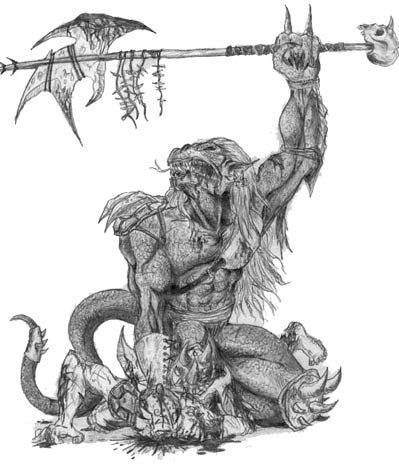 In almost every major city, and several minor ones, there exists a form
of entertainment based on arena combat. These battles are fought by warriors
trained, and often raised, for the fighting pit. Typically slaves, though some
have earned their freedom, these warriors are called gladiators.
In almost every major city, and several minor ones, there exists a form
of entertainment based on arena combat. These battles are fought by warriors
trained, and often raised, for the fighting pit. Typically slaves, though some
have earned their freedom, these warriors are called gladiators.
The gladiator (or gladiatrix, if female) exists only to die gloriously in the arena for the entertainment of the mob. Few free men are gladiators. Those that are not slaves typically once were, or simply have very little else to live for. Most gladiators learn to love the attention fawned on them by those they entertain. In fact, few slaves enjoy a better lifestyle if they can deliver an impressive show. Well-known and popular gladiators are often pampered with fine foods, wine, women, and parties. They become showpieces for their masters, often serving as bodyguards in public.
Adventurers: Slave gladiators act by
their master’s whims. They might be sent out to pursue a specific task, though 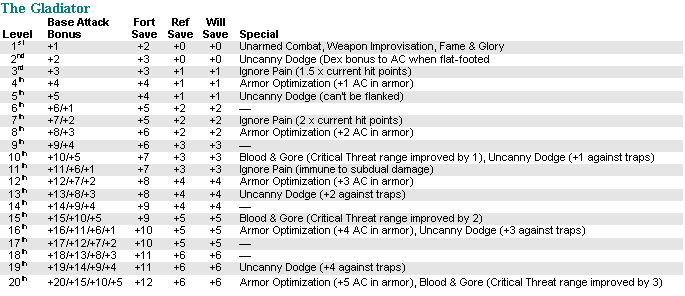 this is rare, and would usually
be little more than a publicity stunt. More often a slave will escape and join
an adventuring party for protection.
this is rare, and would usually
be little more than a publicity stunt. More often a slave will escape and join
an adventuring party for protection.
Characteristics: Gladiators are both warriors and entertainers. Many of their abilities center around making a fight last and keeping it interesting. Gladiators can take an incredible amount of abuse. Strength is very important to them, as is Constitution. They must be able to take a beating as well as give one out.
Alignment: Many gladiators are neutral. They often care nothing for good or evil, as these have little to no impact on the life of an entertainer.
Religion: A few gladiators have religion, though many slave-owners discourage it. They do not wish their slaves to recognize a higher authority than themselves. Those gladiators that do worship a god often worships gods of war and strength; those gods that will help them in the arena.
Background: Most gladiators are slaves or former slaves. They were trained to fight and to die. Very few gladiators raise very high in level…and those that do dominate the arena. These higher-level gladiators often earn their freedom, but usually remain pit fighters, as it is all they know. They become champions, beloved by the people, until they retire or die in the pit.
Races: Any race can become a gladiator, though slavers tend to favor larger, stronger races. Humans and half-orcs are the most common gladiator races. Dwarves are not entirely uncommon, either.
Other Classes: Gladiators most commonly associate with those other classes that find themselves in the arena. This usually means fighters and barbarians, plus the occasional rogue.
Game Rule Information
Gladiators have
the following game statistics.
Abilities: Strength and Constitution are important to the gladiator, as they help him survive in the pit. Charisma is important, as they are also entertainers.
Alignment: Any, usually neutral.
Hit Die: d12
Skill Selection: (2 + Intelligence modifier) x 4
Skill Progression: 2 + Intelligence modifier per
level
Starting Gold: 4d4x10 gp
Class Skills
The gladiator’s class skills (and the key abilities for each skill) are as follows: Climb (Str), Intimidate (Cha), Jump (Str), Listen (Wis), Perform (exhibition) (Cha), Sense Motive (Wis), Spot (Wis), and Tumble (Dex). See Chapter 4: Skills in the Player’s Handbook for skill descriptions.
Class Features
All of the following are class features of the gladiator.
Weapon and Armor Proficiency: Gladiators are proficient with all simply and martial weapons, plus three exotic weapons of choice. In addition, they are proficient with light armor and shields. Note that armor check penalties for armor heavier than leather apply to the skills Balance, Climb, Escape Artist, Hide, Jump, Move Silently, Pick Pocket, and Tumble. Also, Swim checks suffer a –1 penalty for every 5 pounds of armor and equipment carried.
Unarmed Combat: A gladiator wearing no armor or light armor gains the benefits of the Improved Unarmed Strike feat.
Weapon Improvisation: The gladiator receives the Weapon Improvisation feat without cost.
Fame & Glory: Any time a gladiator wins a fight in front of an audience (at least one spectator who is not involved in the fight) his confidence and renown are bolstered. This provides him with a +1 circumstance bonus to all Charisma based checks. This bonus may never exceed +5.
Conversely, however, if a gladiator ever loses a fight under these circumstances, he incurs a -1 circumstance penalty to all Charisma checks. This penalty may never be reduced to less than –5.
Uncanny Dodge: Starting at 2nd level, the gladiator gains the extraordinary ability to react to danger before his senses would normally allow him to do so. At 3rd level and above, he retains his Dexterity bonus to AC (if any) regardless of being caught flat-footed or struck by an invisible attacker. (He still loses his Dexterity bonus to AC if immobilized).
At 5th level, the gladiator can no longer be flanked; he can react to opponents on opposite sides of him as easily as he can react to a single attacker. This defense denies rogues the ability to use flank attacks to sneak attack him. The exception to this defense is that a rogue at least four levels higher than the gladiator can flank him (and thus sneak attack him).
At 10th level, the gladiator gains an intuitive sense that alerts him to danger from traps, giving him a +1 bonus to Reflex saves made to avoid traps and a +1 dodge bonus to AC against attacks by traps. At 13th level, these bonuses rise to +2. At 16th level, they rise to +3, and at 19th they rise to +4.
If the gladiator has another class that grants the uncanny dodge ability, add together all of the class levels of the classes that grant the ability and determine the character’s uncanny dodge ability on that basis.
Ignore Pain: At 3rd level, a gladiator gains an incredible resistance to pain. The gladiator will not lose consciousness from subdual damage until the subdual damage equal 1.5 x his current hit points.
At 7th level, the gladiator will not lose consciousness from subdual damage until the subdual damage equal 2 x his current hit points.
At 11th level, the gladiator becomes immune to subdual damage.
Armor Optimization: At 4th level, the gladiator learns to optimize his armor. He conditions himself to use his armor to its best advantage, dodging and moving his body in such a way that opponents are confounded by his armor. Provided he is wearing armor or carrying a shield, the gladiator receives a +1 competence bonus to his AC. This bonus improves by 1 every four levels thereafter. This benefit does nothing for gladiators who aren't wearing armor. Anything that grants an armor or deflection bonus to AC is considered armor for the purposes of this special ability.
Gladiators also gain the benefit of applying the competence bonus from Armor Optimization against their Armor Check Penalty. The Armor Optimization bonus never reduces the Armor Check Penalty below –1.
Blood & Gore: At 10th level, a gladiator gains the ability to deliver devastating blows to vulnerable opponents. The gladiator’s critical threat range with all unarmed and melee attacks improves by 1 (meaning an unarmed attack checks for a critical hit on a 19-20). This bonus is not doubled by the Improved Critical feat. Apply this bonus after applying the effects of Improved Critical.
This ability improves by 1 every five levels. Therefore, a gladiator improves his critical threat range for unarmed and melee attacks by a total of 2 at 15th level, and by a total of 3 at 20th level.
 New
Rules
New
Rules
The following new rules are applicable to the gladiator class.
New Uses for Skills
Perform (Cha)
Perform can be used for exhibition. This is the ability to display other skills not normally considered performance art in an entertaining fashion. The most common use of this skill is in displays of weapon prowess, though it can be used to “show-off” with just about any skill. This use of Perform does not grant any particular ability with the skill being displayed, it only allows a character to impress others with his apparent skill.
New Feat
Weapon Improvisation [General]
You can use nearly anything as a weapon.
Benefit: You are considered proficient in any object improvised as a weapon (e.g. chair, frying pan, rock, etc). This feat does not provide proficiency with actual weapons.
Normal: A character who attempts to use a weapon without proficiency suffers a
–4 penalty on attack rolls. Improvised thrown weapons have a range increment of
10 feet.