|
Familiars |
|


|
Few investments yield greater riches than
the time and gold spent to acquire a familiar. A lifelong companion, guard,
spy, and servant, it is every spellcaster's best friend and most trusted
confidante. The new Player's Handbook makes a few changes to familiars
(most notably: bonuses are increased from +2 to +3, and a few bonuses are
altered a bit; a bat now confers a +3 bonus on Listen checks and a hawk gives
a +3 bonus on Spot checks in bright light; and "lizard" joins the
list, with a +3 bonus on Climb checks). The really exciting change, however,
comes in the Dungeon Master's Guide with the
introduction of the Improved Familiar variant feat. As always, remember that nothing is
complete or final until you buy the book in the store. Improved Familiar [General] This feat allows spellcasters to acquire a
new familiar from a nonstandard list, but only when they could normally
acquire a new familiar (see Player's Handbook). Prerequisites: Ability to acquire a new familiar, compatible
alignment, sufficiently high level (see below). Benefit: When choosing a familiar, the creatures listed below
are also available to the spellcaster. The spellcaster may choose a familiar
with an alignment up to one step away on each of the alignment axes (lawful
through chaotic, good through evil). For example, a chaotic good spellcaster
could acquire a neutral familiar. A lawful neutral spellcaster could acquire
any familiar that isn't chaotic.
Improved familiars otherwise use the rules
in the Player's Handbook, with two exceptions: If the creature's type
is something other than animal, its type does not change; and improved
familiars do not gain the ability to speak with other creatures of their kind
(although many of them already have the ability to communicate). The list in the table above presents only a
few possible improved familiars. Almost any creature of the same general size
and power as those on the list makes a suitable familiar. Nor is the master's
alignment the only possible categorization. For instance, improved familiars
could be assigned by the master's creature type or subtype, as shown below.
Granted Abilities: In addition to their own special qualities, all
familiars grant their masters the Alertness feat, the benefit of an empathic
link, and the ability to share spells with the familiar. Improved Evasion (Ex): When subjected to an attack that normally allows a
Reflex saving throw for half damage, a familiar takes no damage if it makes a
successful saving throw and half damage even if the saving throw fails. Each of the potential familiars on these
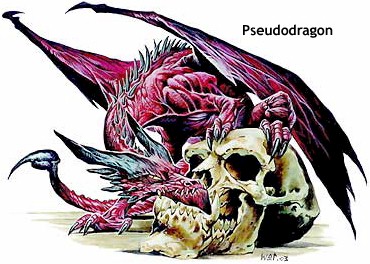
tables also is described in greater detail under its own listing. For example: Pseudodragon Familiar: CR --; Tiny dragon; HD 7; hp 1/2 master's; Init +0;
Spd 15 ft., fly 60 ft. (good); AC 22, touch 14, flat-footed 20; Base Atk
+2/-8; Atk +4 melee (1d3-2 plus poison, sting); Full Atk +4 melee (1d3-2 plus
poison, sting) and +0 melee (1, bite); Space/Reach 2.5 ft./0 ft. (5 ft. with
tail); SA poison; SQ blindsense 60 ft., deliver touch spells, dragon type,
improved evasion, speak with master, telepathy, granted abilities; AL NG; SV
Fort +4, Ref +3, Will +6; Str 11, Dex 11, Con 13, Int 10, Wis 12, Cha 10.
Blindsense (Ex): Can locate creatures within 60 feet by nonvisual
means. Dragon Type: Darkvision 60 ft., low-light vision, immunity to sleep
and paralysis effects. Poison (Ex): Injury, Fortitude DC 12, initial damage sleep for 1
minute, secondary damage sleep for 1d3 days. Telepathy (Su): Communicate telepathically with creatures within 60
feet that speak Common or Sylvan. |
||||||||||||||||||||||||||||||||||||||||||||||||||||||||||||