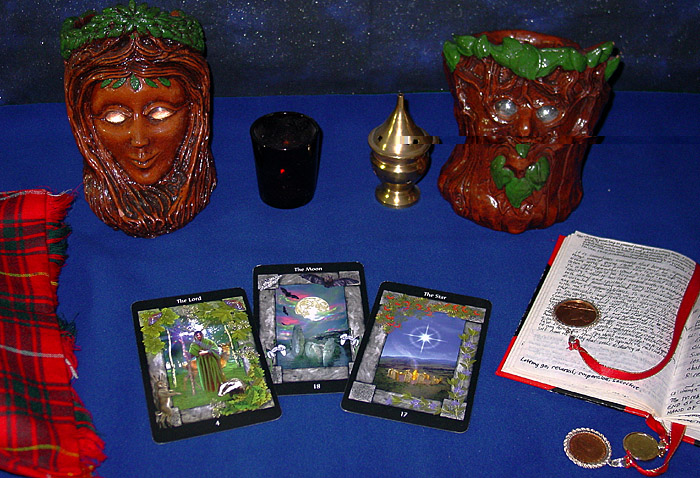
The Tarot is a system of divination using cards with symbolic images to reveal hidden information about the past, present and future. "Divination" has been variously defined as learning the will of the gods, revealing hidden knowledge using supernatural powers, and more simply, "finding things out". There are certain kinds of information, according to divination theory, that are inaccessible to the ordinary senses. Information about past events, present events taking shape and future events, unconscious beliefs and thoughts, hidden motivations and fears, and so on cannot be directly perceived by the senses. But with the aid of various divinatory tools, as well as the necessary skill and knowledge to accompany them, these bits of information can be recovered and used to answer questions, provide creative insights, and develop a deeper understanding of events and situations.
Countless methods have been employed to open the mind to this hidden knowledge. Everything including watching the flights of birds and the movements of swinging pendulums, meditation, seances, psychoactive drugs and computer-generated astrological charts have been pressed into service as gateways to the unknown. What makes the Tarot different from most of these methods is that over the years it has become a fairly stable system with a substantial body of knowledge and experience behind it. Even though there are countless different Tarot decks, all differing in their details of imagery and interpretation, there is a consistency to the system that lends an air of familiarity to all of the decks, and at the same time makes possible a careful evaluation of the system as to its usefulness and validity.
Origins of the Tarot
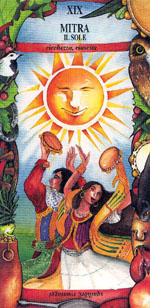
Some think that the strange images of the Tarot originated with Gypsies roaming Europe in ages past, but the Gypsies always seem to get blamed for everything occultists can't figure out. Others think the images originated on the walls of the Great Pyramid and were passed on through the ages in the form of cards, but since the Pyramid was sealed with all Pharaoh's slaves still inside, it is odd that we would have known what those images were before the Pyramid was excavated. Still others believe the images fell from a tree, bubbled up from a well, washed up on a beach, and on and on. Take your pick. No one knows where the Tarot came from. The real answer to the question is that the deck you have came from the store where you bought it. Everything else is pure speculation.
Well, maybe we can do a little better than that. Although we really don't know where the idea for the structure of the deck itself came from, it is known that decks similar to the modern Tarot existed in medieval Europe, and there are reproductions of those decks available commercially. Whether these decks were used for game playing, divination, or other purposes is unknown. The real history of the modern Tarot begins with the blossoming of occult lodges and orders in the late 19th and early 20th centuries, the most famous of which was the Golden Dawn. Through the work of these groups, philosophical and divinatory meanings became attached to the cards. From that time on, authors and illustrators of Tarot decks have designed them according to one philosophical system or another, and often for teaching purposes as much as for divination.
There are some people who seem to feel that the older something is, the better it necessarily must be. Telling the modern witch that her "rituals" trace back only as far as the Golden Dawn, and Dr. Gardner's interpretation thereof, will elicit roughly the same reaction as putting a dirty dinner plate in front of an anal retentive. Scream away. The facts are as they are, whether anyone chooses to believe them or not. The value of a philosophical system, whether for divination, education, inspiration, or yes, even the "scientific method" of today, has nothing to do with how long its creators have been dead. What matters is the creative insight, intuitive understanding, spiritual inspiration, and intelligent thought that went into the systems creation, and it makes no difference whether that happened centuries or minutes ago. If, as many users of the Tarot claim, its images are reflections of otherworld truths, then how and when they are seen by mere mortals is irrelevant to their validity and meaning. The decks created by modern authors are, in many ways, far better tools than those of the ancients, owing to advances in graphic design that permit a greater range of creative expression by the artist, and a greater range of imaginative interpretation by the reader.
Kinds of Tarot Decks
Even though there are somewhere around 700 different Tarot decks available today, and countless more out of print, there are certain general characteristics shared by all of them the make them Tarot decks, as opposed to something else. For purposes of description, Tarot decks are often separated into two divisions: the Major Arcana, or greater secrets, and the Minor Arcana, or lesser secrets. The Minor Arcana is already familiar to most people, in the form of ordinary playing cards. It has four suits of ten numbered cards each, usually illustrated as wands (staves, clubs, or rods), cups (chalices, hearts, or even cauldrons), swords (usually swords, or spades) and disks (coins, stones, shields, diamonds, or pentacles, whatever they may be). Each suit has four court cards or "dignitaries," variously known as Page, Knight, Queen, King, or Princess, Prince, Queen, and King (or Knight), or many other variations on this theme. This is the first difference between the Tarot and playing cards -- four court cards, as opposed to three. The second difference is the Major Arcana itself, consisting of 22 numbered cards, bearing the symbolic images that give the Tarot its reputation for mystery. I should at this point mention that there exist many Tarot decks, complete with Major and Minor Arcana, that are designed specifically for the game of Tarot, and have nothing to do with divination or esoteric philosophy. These decks are not the subject our discussion, but you can read more about them here.
There is, of course, a great deal of speculation and disagreement as to what the Arcana, as well as the individual cards themselves, mean in a reading. Roughly, the cards of the Major Arcana refer to forces, energies, or changes that come to bear on the question or situation being examined. These forces may originate from outside the "questioner," as the person for whom the reading is done is often called, or may originate within the psychology of the questioner herself. The court cards usually refer to persons, or to human-caused events and actions, while the numbered cards of the Minor Arcana may show situations in which the questioner finds himself, events in the past, or possibilities for the future. The exact interpretation of the cards is also influenced by the position of the card in the "spread" or layout used to read the cards, with certain positions in the layout indicating events or influences in the past, present or future. There are many different layouts, and eventually most diviners work out their own layouts, as well as their own meanings for the cards. Because the Major Arcana are indicative of changes and forces, some diviners read only with the Major Arcana, especially while learning the Tarot.
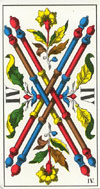
Given that so much of the Tarot relies upon individual interpretation, where do we begin to describe what the Tarot actually is? I think it is useful to categorize individual decks in one of three ways. First, there are the classical decks, which most closely resemble playing cards. These go back to the Renaissance, and their most notable features are the symbolic images of the Major Arcana, and the Minor Arcana cards being nothing more than numbered cards. The five of swords, for example, just has five swords on it, and nothing to suggest a meaning or interpretation. This makes the classical deck about the hardest for the beginner to learn. Many experienced readers, however, prefer classical decks, because they allow the reader the greatest freedom in interpreting the cards. Suppose, for example, the ten of swords is drawn. The reader may interpret this card to mean, "The evil has run its course, and a fresh start offers new possibilities." But if the card says "Ruin" on it, or shows a dead body with ten swords sticking in it, it may only confuse both the questioner and the diviner. Classical decks therefore have their advantages. Classical decks come in a rich variety of designs, from historical reproductions such as the indescribably ugly Tarot of Marseilles and the fairly attractive Swiss 1JJ, to the modern Tarot of Hellen, and the popular and semi-erotic Black Tarot -- you know, the one you bought for $50 on Ebay, when even a cursory search of the Internet would have shown you can get it brand new for $13. Congratulations, you have begun your study of the Fool card. Now you know why it's the first card in the deck.
The modern Tarot, originating as it did within the occult orders of the late 19th and early 20th centuries, was designed as much to teach the "secrets" of these orders, as for divination. Actually, the story goes back a bit earlier. First on the scene was the Comte de Saint Germain, who suggested that the Tarot had its origins in ancient Egypt. This idea was taken further by the French occultist Etteila, whose real name was Aliette, and was by profession a wig maker. He had the unfortunate coincidence of living during the French Revolution, and as there was not a great deal of business for wigmakers during those years, he had a lot of time to devote to the study of the Tarot. He produced a deck of symbolic images relating to Egyptian mysticism that became very popular at the time, but soon fell out of favor with students of mysticism when another French occultist, Eliphas Levi, suggested that the Tarot was in fact a symbolic representation of the Cabala (or Quabala, or Kaballah; you get the idea). The Cabala, as a mystical system, became the foundation for the Order of the Golden Dawn and other occult societies, and hence, on Levi's suggestion, the Tarot became an important tool in the teaching and practices of these orders.
The Golden Dawn had its own Tarot, supposedly produced by the wife of Samuel McGregor Mathers, one of the founders of the Golden Dawn, who, according to the Order's history lecture, obtained his secret knowledge by correspondence with certain Adepts in Germany. Ahh, the first recorded contact with the mysterious Bavarian Illuminati! Who knows? What we do know is that members of the Order were given Mathers' deck for study, and required to produce their own decks for their own use. Some members just made copies, while others embellished their decks with their own symbology. Lucky for us: the original deck, if the modern rendition by Wang and Regardie is a faithful copy, is little more than a more sophisticated classical deck. At least two members of the Golden Dawn, Arthur Edward Waite and Aleister Crowley, not only designed greatly improved decks, but published them for the general public. The decks produced by these two occultists remain probably the best known Tarot decks in print today.
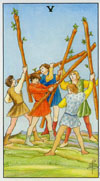
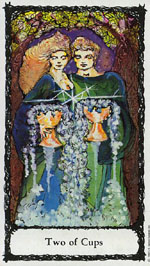
The deck designed by Waite, illustrated by Pamela Coleman Smith, and published by Rider, hence known as the Rider-Waite-Smith or RWS deck, is what I call a descriptive or illustrated deck. Each card, including those of the Minor Arcana, has a descriptive picture that illustrates the meaning of the card. The five of wands, for example, which is usually taken to mean "strife," has a picture of five people beating each other to a pulp. The two of cups, usually taken to mean "love," has a picture of a man and a woman in a romantic setting. And so it goes. Waite assigned the meanings of the cards in part based upon the Order's teachings, but also in part based upon his research into the various meanings assigned to the cards by traditional readers. Hence, the Cabalistic meanings do not always come through as clearly as one might expect.
Because the RWS deck is easy to learn, it is probably the most widely taught and used deck, at least by beginners. It has one major flaw. Waite, by his own admission, intentionally bowdlerized the esoteric symbolism in the deck. While his justification was to prevent certain secret teachings from becoming public, it is inexcusably dishonest, and renders the deck of limited esoteric value. The unfortunate thing is that because the deck is so popular, it has been copied, re-rendered, and embellished by Tarot designers more than any other deck. The majority of Tarot decks available today are RWS clones, and the arrangement and meanings of the RWS are regarded as "the standard" by many reviewers, authors and publishers; so much so that many decks which do not conform to the RWS "standard" never make it into publication or popular use. The comical and tragic result of this is the nearly complete permeation of the modern Tarot by a corrupt symbology. Nonetheless, the RWS deck, and its many clones, are probably the easiest decks to learn, and there is no harm in doing so, provided one maintains a critical eye toward their meaning and interpretation. I should also mention that in spite of the force of the RWS "standard," there do exist many illustrated decks that do not follow Waite's meanings. One of the most popular of these is the Arcus Arcanum, whose author, Dr. Gunter Hager, recast the symbolism and meanings into a more Germanic framework which many find easier to understand. If, in spite of all I have just said, you are determined to learn Tarot via the RWS path, there is an excellent free online course here that will have you up and reading in no time.
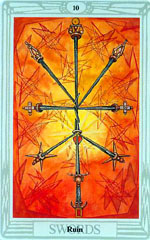
The other popular deck to emerge from the Golden Dawn tradition is the "Thoth" deck, designed by Aleister Crowley, and painted by Lady Freida Harris. Crowley had no reservations about incorporating every secret teaching he knew into his works; in fact, he considered it his duty to do so. However, Crowley eventually broke with the Golden Dawn, and founded his own "tradition," based partly on the Cabala, partly on Egyptian mysticism, partly on various western traditions, and partly on several eastern schools. The result is that many of his works, and his Tarot deck in particular, contain such a mixture of symbolism that they can be, shall we say, a little difficult to master for the beginner. I should add that while I consider Crowley's works to have been my most important sources of learning in matters occult, Crowley had the sometimes annoying habit of leading one on a wild goose chase, only to point out what a fool you are at the end of the road. He did this both to humiliate the pompous, and to teach the student to maintain both a critical and an open mind. But to the beginner, it can be frustrating.
Crowley's deck itself is what I call a symbolic deck. Each card is fully illustrated, but the images are abstract, and not descriptive as with the RWS. The symbols in the image, the colors, the arrangement, the background, and so on, suggest but do not directly state the meaning of the card. The ten of swords, for example, traditionally assigned the meaning of "ruin," does indeed look ruinous with its ten swords attacking each other and its red background and furious looking designs. But it can mean other things; as Crowley himself said, it can mean, "If you fight on long enough, everything is destroyed," which is not necessarily a predictor of personal downfall. The symbolic deck is, therefore, not as easy for the beginner to learn as an illustrated deck, but on the other hand, the abstract symbolism allows the reader flexibility without losing all direction in meaning as with a classical deck. The Thoth deck is the deck I learned Tarot with, and a number of popular decks, both within the Golden Dawn lineage and outside it, use this format. The Sacred Circle tarot, incorporating Celtic symbology as opposed to traditional Cabala and RWS meanings, is a symbolic deck, and has proven very popular among those who follow the Celtic path.
So there you have it: the classical, illustrated, and symbolic forms of the Tarot. Which is best for you depends partly on your level of understanding of the Oracle, partly on what you want to do with it, but most of all, on which deck you like the best. Trying to learn with a Cabala based deck may not work for you if you follow a Celtic path. You have to like the imagery, and you must feel some sympathy and harmony with the assigned meanings. You will, for example, notice the absence of reviews of "feminist" decks in my collection, mostly because I don't have any. I am not sympathetic to their symbology, so I don't buy them. On the other hand, I have several "Celtic" decks, because I am more attuned to that path than, say, the traditional Cabala. Just as you have to choose your own path, you also have to choose your own Oracle, or the Tarot will be nothing to you but ink on cards.
How the Tarot Works
We know, from history, contemporary experience, and scientific experiment, that some part of the mind is able to travel through time and across physical distance, and discover information that is not accessible to ordinary consciousness. That part of the mind is called the unconscious. The most famous scientific experiment demonstrating this ability is the Rhine experiment, in which subjects correctly identified cards that were drawn at a remote physical location, and cards that were drawn both before and after the predictions were made. If we could find a way to reliably tap into this part of the mind, we could, at least in theory, learn things about the past, present and future, as well as things happening far away, that we can't ordinarily know.
Unfortunately, the unconscious does not speak in terms that we can understand directly, at least not under normal circumstances. Though in the case of mystical visions and similar phenomena the unconscious can communicate directly, more often it communicates in the form of symbols. Symbols are images, usually visual but sometimes auditory or otherwise, that contain information that cannot be directly understood by consciousness, but must be interpreted to make any sense. Dreams are examples of this kind of symbol.
Through the unconscious, many fantastic things are seen. As well as visions of the past and future, the unconscious perceives Gods and Goddesses, angels and demons, and the spirits and fairies that haunt mystical and spiritual experiences. That these things are known through the unconscious means they cannot be directly understood by consciousness, but are understood indirectly through symbols. Whether these things "really" exist or not does not matter to our understanding of the Tarot. The unconscious behaves as though they do, and they are therefore valuable sources of information about hidden things.
Just what is the "unconscious"? When I use the term, I refer to that part of the psyche, or totality of all mental processes, that perceives things consciousness does not. As Jung describes it, the psyche is something like the electromagnetic spectrum: running the range from low energy sound waves up to high energy cosmic rays, we can see with the eyes only a narrow range of energies. We cannot "see" radio waves or heat because they do not have sufficient energy to activate the rods and cones in the eyes; similarly, we cannot see X-rays, because they are too energetic for the receptors in the eyes, and pass right through them. The psyche works the same way: some things, like body posture, for example, do not have enough energy for consciousness to be aware of them. And there are the things that are too energetic for consciousness to perceive directly; these are the things we often call "spiritual." You do not directly perceive the levels of sugar in your blood; instead, when blood sugar goes low, you perceive the situation through a mental symbol -- the feeling of hunger. Those things that are too energetic for consciousness are also perceived symbolically, through what Jung called archetypes. These archetypes are the way consciousness perceives superconscious energies, as visions of goddesses, fairies, and the like.
The images of the Tarot are symbols that form a link between the conscious mind and the unconscious. Indeed, Jung considered the Major Arcana to be images of archetypes themselves. Through the images, the diviner attempts to communicate with that part of the mind that "sees" things hidden to ordinary consciousness. Much like the predictions of card draws in the Rhine experiments, through the Tarot the diviner can "see" things far away and in the past or future through the unconscious. And as with dreams, to make any sense these images need to be interpreted, and therein lies the skill of the diviner. Anyone can pick up a card and say, "This means you will be rich." The difference is that those who have practiced this method are able to do so with a statistical frequency better than chance; as with the Rhine experiments, the better the diviner, the more accurate and useful the Tarot readings will be.
To take this just a bit further, Einstein's theory of Relativity describes time as a dimension that radiates out from each point in the universe, like length, width and depth. Terms like "past" and "future" are not objective terms that define the absolute qualities of objects and events, but rather are relative terms that describe the position of things in the universe in relation to your own. Since we can easily travel in length, width and depth, it should come as no surprise that means exist also to travel back and forth in time. It is only cultural prejudice and historical brainwashing that cloud the issue. Those first three words, "In the beginning...," and the linear cosmology that goes along with them, have done more to hinder humanity's intellectual and spiritual progress than perhaps any others. Once we enter the world of the Tarot, we leave behind the linear thinking of so-called "common sense," and enter a world in which the true magnitude of the mind's powers are wielded.
Now this raises another issue: If the Tarot is a gateway between consciousness and unconscious, through which energies are set in motion, then why can the cards not be used equally for moving those energies, as well as detecting them? In other words, if they can be used for divination, why can't they also be used for magic, such as the casting of spells and so forth? The answer is that they can, and are, used for those purposes, as well as for others such as astral projection. It is beyond the scope of this essay to discuss these uses of the Tarot, other than to mention the logical possibility of those uses.
It is essential to keep in mind that what I mean by "unconscious" is not the popular misconceived "subconscious." I don't really know what the "subconscious" is, since I am a student of Jung's work and he does not use the term. I gather what most Tarot writers mean by it is some sort of mental trash can into which everything one doesn't want to remember is thrown, and if so, this has nothing to do with the Tarot as an oracle. An oracle is a diviner of unseen forces in the universe, of what Charles Tart calls the "transpersonal," and not of personal or interpersonal psychology.
Applications of the Tarot
What is it good for? For telling the future, of course. Well, not exactly. It is impossible to "tell the future," in the sense of accurately predicting what will happen, because the universe we live in is probabilistic. The events of the future, and perhaps in the past as well, are not fixed in relation to the present in such a way that knowing the present will predict the future, or retrodict the past. Only in the last hundred years or so has science begun to understand the pervasiveness and the impact of probability on the structure of the universe. The theory of determinism, that everything in the universe is connected by causal rules and inevitable progressions of time and events, has collapsed in the face of Heisenberg uncertainty and dynamical systems theory. We are no longer the victims of destiny, but rather the authors of it. To be sure, some users of the Tarot read it as foretelling the future. This is not a vision of fate, but instead a profound understanding of the forces and energies revealed through the tarot, plus a lot of experience with it and a certain amount of talent in using the oracle in this way. There are also those who claim to be "psychic" readers, using the Tarot as a trigger for mental visions of one kind or another. Again, talent and experience are important factors in this application of the oracle.
Eliphas Levi said there are two ways to read the tarot: insight and wisdom. For those of us who are about as "psychic" as a lump of mud, we leave the "insight" to those who have it, and read the Tarot through the means of wisdom -- learning what the cards mean, and how to interpret them. Most Tarot decks are built around some kind of esoteric system, such as the Cabala, ancient Celtic and Egyptian mysteries, mythologies such as the Arthurian legends, or even modern fairy tales. These esoteric systems provide the basis for the links between conscious and unconscious, which are portrayed in the symbols of the cards. To the Cabalist, for example, the Major Arcana cards represent pathways or connections between specific aspects of existence known in their system as "sephiroth" or "lights," and their appearance in a reading indicates activity of one kind or another on that pathway. In other decks, the Major Arcana cards represent Gods and Goddesses, and their appearance in a reading signifies the presence or influence of the superconscious energies represented by those beings. The Major Arcana thus portrays superconscious energies, while the suits of the Minor Arcana are often taken to represent "elemental" forces arising within the unconscious at energy levels too subtle to be directly perceived. The court cards, as previously mentioned, are usually taken to represent specific individuals, or human-caused actions.
Most Tarot decks come with a book or booklet of some kind, that lists the meanings of the cards according to the author's intentions. Keep that in mind -- the book says what the author thinks the cards mean, but that is not the last and final authority. In a biology class I used to teach, we had a guiding principle -- the ultimate authority is the specimen, not the textbook. In the case of the Tarot, one should begin with what the author has to say about it, but the ultimate authority as to what each card means lies with the impressions that card creates in the individual diviner. Unless you are using the cards as a means of instruction in some particular system, it is pretty much up to you to work out what the cards mean for yourself. What the author has to say is a good place to start, but in the end it is only the beginning on your path of study.
The same thing goes for spreading, or laying out the cards. While most decks come with suggested layouts, this too is a matter for your own study and experimentation. Do regard divinations as experiments; each one is an opportunity to learn not only about what the oracle reveals, but also about how the oracle itself works. The "Celtic Cross" is the layout most beginners start with, and while it is an interesting method, it is not necessarily the best way of doing all readings. And then there arises the question of whether the cards should or should not be read "reversed" -- if an upside-down card has a different meaning than a rightside-up one. Some diviners have good luck with reversed cards, while others, such as myself, find that reversing the cards makes reading them next to impossible. I prefer to read by what is sometimes called "dignification," which means modifying the meaning of each card based upon the cards that surround it. Some people even use both methods; it is something you have to determine by experiment.
Do the cards actually work? Depending upon what you mean by "work," yes, they do. Don't even bother asking what you should invest in, or whether a marriage to so-and-so will be successful. Being an oracle of the metaphysical forces that shape the unvierse as a whole, first of all, your own little personal situation is of no universal significance and hence of no oracular importance, and second, the general theory of determinism required for such predictions is demonstrably false, and so are those readings that claim to rest upon it. This is generally true of all Tarot decks, and other oracles as well. I have heard the story that in Japan, a certain restaurant operator had a ceramic toad set up, which business men would approach with financial questions, after, of course, having paid the "seer" the appropriate fee. The advice didn't seem to help the economy much, and the police finally raided the place; the owner was jailed, but the toad was never found. Don't make a mockery of the Tarot by treating it as a toad; it will only reflect the mentality of those who approach it under those circumstances. The Tarot is an oracle of the metaphysical forces that permeate and influence -- but do not control -- the events of the universe. To the extent that you, and the things you think and do participate in universal consciousness, the oracle reveals how those forces participate in your destiny, and how you can shape your own destiny through awareness of those forces. He that consults the toad for advice lowers his mind below that of the toad; she who consults the oracle for vision, participates in the universal consciousness that reveals that vision.
What kinds of information does the Tarot reveal? Here we get into real trouble, for as anyone who does divination or studies it and is honest about it knows, what is revealed by the oracle has as much to do with the diviner as it does with the symbols on the cards. That being said, there are several general categories into which Tarot revelations fall.
First, there is fortune telling, in the sense that most people who have not studied that Tarot understand it. "A tall dark man will come into your life," says the gypsy fortune teller in a deep, subdued voice. Worse than that, some consult the oracle for specific advice on financial investments, etc. This kind of reading is generally frowned upon, partly because of its susceptibility to fraud, but also because it rests upon scientifically unsustainable cosmological theories like determinism. Nonetheless, some diviners seem to have a talent for reading this way.
A more popular method of reading the Tarot, and somewhat more successful, is using it as an oracle of unseen forces, to reveal how the events and influences of the past shape the present, and how the present can be altered to shape the future. Notice I use the word "shape," and not the words "control" or "determine." An understanding of how the present came into being, connected with your own decisions and actions, may help to shape what the future may be, but under the rules of probability cannot control or determine your future or anyone else's. This is perhaps the most useful way of reading the cards, for its purpose is to reveal the relationship of the questioner to the events and influences of the surrounding world, without suggesting that anything about the past or future is fixed or unchangeable. Unfortunately, under the influence of what Kierkegaard called chatter and levelling, many uses of the Tarot have, in recent years, descended into a kind of unprofessional psychoanalysis and psychobabble that insults the oracle and perverts its purpose. I refer to the common practice of using the Tarot to "discover your motivations" and "reveal your personality." In the hands of a trained and qualified psychoanalyst, maybe, but in the hands of anyone else, bullshit. In this kind of reading, the Tarot supposedly pours out the contents of the individual's psyche for public view, and to add to the insult, shows why the individual is responsible for everything that goes wrong. This leads to what I call "self immolation," which basically means pouring a can of gasoline all over yourself and lighting it. The incessant stream of self-criticism encouraged by many Tarot authors leads, in the end, to learning to hate yourself, and that to be "good enough," you must change or "reinvent" yourself. Hating yourself leads to the destruction of consciousness and personality; to trading "I" for "we." This is all fully explained in my book, "Spontaneous Human Consciousness," that can be found on my main page. I suggest that if you think the Tarot is there to encourage self criticism and self deprecation, or if you are sick of hearing the Tarot used for that purpose, that you read Spontaneous, where the consequences of this attitude are discussed.
There is yet another use to which the Tarot is put, and although it is not very popular, it is the method I favor most, and that is its use as an oracle of prophecy. Prophecy is a revelation of how the various forces and energies of the universe have shaped the present, and where the future is going, given circumstances and trends. It is a cosmological statement, a measure of the forces we characterize psychologically as unconscious, conscious and superconscious, but which have much vaster implications than what runs around in your own little head. To the extent that an individual's personal psyche participates in universal consciousness, prophecy may indeed be indicative of an individual's future, but that is not its primary purpose or meaning. Prophecy is always expressed in a strange poetic and symbolic language, which is ideally suited to the imagery of the Tarot. While prophecy has historically been important in formal religious systems, it need not be restricted to any religious or philosophical system, although it is usually expressed in terms of one symbolic system or another. Ancient diviners peered into ritual bonfires and listened to the wind; we still do those things today, but the Tarot gives us a much richer symbolic system upon which to draw. To this end, the kind of deck that is most useful for this purpose is the symbolic deck.
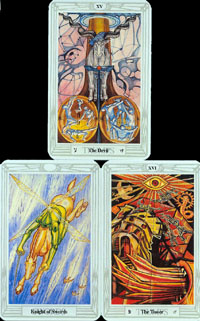
I will share one experience with this method. In the particular layout I was using, three cards indicate the future. I was using the Crowley Thoth deck, and in the future position appeared the Knight of Swords, the Tower, and the Devil. The Knight of Swords in this deck shows an armored Knight flying on his horse toward the object of his aggression, weapons drawn in both hands. The Tower depicts an abstract structure being destroyed and consumed by flames, and the Devil suggests the world gone haywire. I did not fully understand the meaning of those cards as they appeared on the night of September 10, 2001, but by the following morning both the meaning and the intent of the oracle were clear. Whether you consider the events predicted, or the world's reaction to them, to be the greater evil, there is no arguing that the world has become a more dangerous and evil place. That is the one drawback to reading by this method -- prophecy is much more easily understood backwards than forwards.