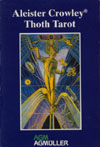
Crowley Thoth Tarot, by Aleister Crowley
Published by: U.S. Games Systems and AGM
reviewed by: David Bruce Albert Jr., Ph.D. ([email protected])
It's odd that it has taken me so long to write a review of this deck, for it is not only the deck I learned to read the Tarot with, and the primary source I used for the study of the Cabala and its associated symbols, but it is also the deck I use most frequently for readings of an esoteric nature. On reflection, it's likely those very reasons that make reviewing it difficult: my relationship to this deck is participatory rather than objective, so what you are about to read is as much a review of me as it is of the deck itself. Caveat lector.
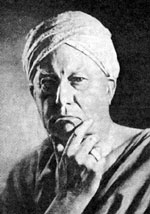
Aleister Crowley is probably the most controversial and misunderstood (or perhaps dis-understood, meaning intentionally obfuscated) practitioner and writer of modern occultism. From his dealings with the Golden Dawn and its various members, to the several paths of magick and spirituality that he traveled and, in some cases, founded, Crowley was more interested in the pursuit of Truth as he found it than in the aggrandizement of those who claimed to be the custodians and dispensers of that Truth. As a result, he became the bitter enemy of pretty much every pompous ass involved with magick and spirituality of every kind, and there were -- and still are -- quite a few of them. It really is funny to hear Crowley denounced by the very same "High Priestesses" who then proceed with their "secret" rituals of the Pentagram, the Watchtowers, and so on and so forth, pathetically unaware that the path by which they came to that "secret knowledge" was Crowley's publication of them in the Equinox. "Ancient tradition," yeah, right. Everyone knows the Druids invoked names like Elohim and Adonai. Everyone, that is, with an IQ low enough to be burying jars full of urine and rusty nails under their doorsteps to keep the bill collectors away.
While we're still treading these waters, I should mention that it irritates me even more to hear things like, "I hate everything Crowley brought to the Craft," to paganism, and to everything else you think you know everything about. First of all, there would probably be no Craft and no Paganism as they are known today, had it not been for Crowley and his deliberate and incessant defiance of the secrecy of the Orders to which he belonged. He considered it his spiritual duty to make the knowledge he acquired available to those who wanted it. The logic is obvious: knowledge in the hands of those too stupid to understand it is useless, while knowledge that is hidden from those who can understand it is shamefully wasted. Better to lose a few pearls to swine than to lose a few minds to ignorance. Second, whatever Crowley's personal characteristics may have been, the man is dead, and his personality is irrelevant to his teachings. I could point to any number of individuals and groups whose association with the Craft and Paganism I find not only shameful and disgusting, but sufficiently repulsive so as to preclude my participation in any kind of public or group activities. I deeply resent the fact that things I consider to be of profound spiritual and philosophical value have been taken over by perverts and degenerates, and have been twisted and altered in order to proselytize and justify their own ideologies, causes and lifestyles. It isn't hard to identify these sorts -- just look for those who are more concerned with you believing what you are told, than in finding it out for yourself.
"Do What Thou Wilt shall be the Whole of the Law!" This is Crowley's most famous maxim, and as may be expected, also the one most twisted by those who despise his work, and by those who would co-opt his work for their own purposes. It is not license to do what you want; it is an existential imperative to become who you are. Let's try an example. One of Crowley's exercises to develop mental control is to choose one word that you ordinarily use, and cut that word out of your vocabulary. To help you do this, Crowley suggests that you should cut your arm with a razor blade every time you use the word. Can you do this? How about the word, "we?" Can you cut this word out of your vocabulary, and force yourself to do it with physical punishment if necessary? That is Will, as Crowley means the word. It defines and develops who you, as an indidvual, are. It is an individuating quality, that breaks you as an indvidual off from the "we" of oversocialized society. This is the purpose of Crowley's magickal system, known variously as "Thelema" and "The Aim of Religion, the Method of Science." Crowley believed that every person has within themselves the seed of a god; that each individual is unique, and that the purpose of life is to grow and express that uniqueness. "Every Man and Every Woman is a Star," and "Do What Thou Wilt" is a command to shine in that brightness. No wonder he is so despised by those who "succeed" by subduing the will of others. The success of Crowley's system is the death of the master/slave and I/we dialectics.
The Craft, Magick, Paganism, and the Tarot for that matter, are not tools for controlling your thoughts or enforcing someone's code of ethics and behavior. They are pathways to liberation, opportunities to leave life as a social animal behind and move onward to other things. What other things? That can only be discovered through your own study and experiment. We have much knowledge from the ancients, and, thanks to Crowley, much contemporary knowledge as well. But knowledge by itself is worthless without understanding. What do I mean by that? There is a certain radio preacher whom I regard as being completely insane; yet, as with many madmen, there are occasional utterances of truth so profound that it almost makes their babbling tolerable. One of those utterances is roughly this: "Unless you have a witness that what I am saying is the truth, you should not believe it." What is meant by a "witness"? That is a little difficult to explain because it is not an objective phenomenon; it is the participation of your own consciousness in ideas, beliefs and practices that carries with it a conviction that what is being said or done is something that comes from within your own self, and not something that is simply observed at a distance. It is something that rings true within your own consciousness, as though it was always there, but never quite expressed or experienced until it is brought out by an encounter with something in the world. I first had that kind of "witness" in reading the works of Crowley, and later those of Kierkegaard, and in the study of Celtic mysticism. You get the feeling that they are saying what you already believe but never really knew it; that it is not so much a learning of something new as it is a discovering of what was always there.
Unless you have that kind of "witness" to what I am saying, or to what any other writer in philosophy or spirituality is saying, you had better stay away from it, as it will have no value for you. I had that kind of problem with the study of the Cabala. It was simply book learning; I really never formed any kind of conscious connection with its teachings or rituals. Useful learning, as it has turned out, but not intrinsically meaningful. Most of what I have said about using spirituality to justify social agendas, causes and lifestyles also carries with it that kind of worthlessness. The ancients came to much of their knowledge through participation and not through objective study, and unless a particular system or body of knowledge carries with it a sense of your own participation, it will be of little value to you. For example, I recognize the importance and value of the various Eastern schools of mysticism, yet I have no sense of participation in them. Many do, and I respect them, but I do not join them. Which also means that I do not have the kind of understanding of their teachings that they do. You can learn all about something -- you can read all about the chemistry of n-butyl-mercaptan and dicrotyl sulfide -- but until you actually get sprayed by a skunk, you won't really understand what that knowledge is all about. You can read all about a belief or religious system, but unless you have actually grown up within it, as Campbell said, you will have no real appreciation of it. The "witness" gives you the participatory understanding that objective learning cannot provide.
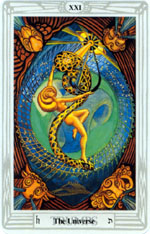
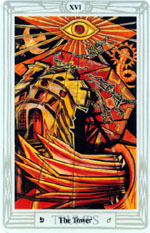
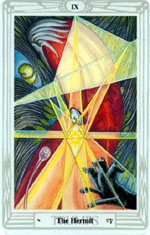
This kind of "witness" is also important in reading the Tarot, and is especially important in reading a deck like the Thoth. The Thoth deck is an abstract, symbolic deck. Unlike the Waite deck, or other illustrated, descriptive decks, the images in the Thoth deck do not tell you what they mean. You will never figure out what these cards mean by looking at them, nor will you understand them by memorizing a set of canned key words; the images are too abstract for any kind of objective interpretation. They only "mean" anything at all by virtue of what they draw out of your own consciousness; the cards "mean" what they call forth from within you. If you do not have this kind of connection with a particular deck, then it will be useless for you. Reading the cards by memorizing keywords is simply reading fortune cookies; unless the cards make a connection within your own consciousness that draws the meanings from the inside outward -- by which I mean gives you the kind of "witness", or feeling of revealing what is already known but not yet presented -- then the cards will not be performing as an oracle for you. Many people find the Thoth deck works for them in this way, while others get nothing out of it. Fear not; if the Thoth deck doesn't work for you, there are some 700 other decks out there to try.
The deck itself comes in many formats and languages, and in different editions, most of them having been printed by AGM. I believe Lo Scarabeo at one time published their own edition, but I have not seen it. The edition that I first acquired around 1980 came in a white box, the large format being printed in Belgium and the "standard" size being printed in Switzerland. And here we step directly into the lion's mouth, for the differences between the "Belgian" and "Swiss" decks are topics of endless controversy. It really is very simple to tell which you have: if the cellophane wrapper around the cards inside the box says, "Printed in Switzerland," then you have a Swiss deck. If it says, "Printed in Belgium," then you have a Belgian deck. Meanwhile, back at the Sorbonne...
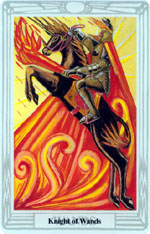
There is, unfortunately, a reason for this discussion. The decks printed in Switzerland have a different color rendition than the Belgian decks. The early white-box Belgian decks have a greenish tint to them that makes the images appear dull and ruddy. The newer Belgian decks that come in a blue box no longer have the greenish tint, but are still a bit off in their colors: the Emperor appears in day-glo orange, whereas in the Swiss decks, he is blood red. Many readers feel that the Swiss decks give a more appealing and "correct" rendition of the colors. I don't know; I have never seen the original paintings by Lady Harris, so I can't say whether one version is more "correct" than the other. What I do know is that many retailers have been selling the blue-box Belgian decks as Swiss decks, and that is intolerably dishonest. I sent the ones I got back.
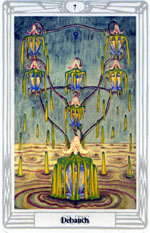
There is yet another difference between the Belgian and Swiss editions. Since Tarot decks are typically printed on large sheets of card that are cut up after printing, and those sheets are square in shape, there are actually 80 images printed, which means there are two extras along with the 78 card deck. In the Swiss editions, those two extra cards portray different versions of the Magus (Magician) card. Crowley "experimented" with different ideas for his cards, and these two extra magicians are simply experiments that the printer used to fill up the extra blank cards. In the Belgian editions, one of the blanks depicts Crowley's unicursal hexagram, and the other contains information from the O.T.O., an Order with which Crowley was affiliated.
My understanding is that AGM has closed its Swiss printing facility, which means no more Swiss decks. That's not too bad; the newer Belgian decks are perfectly good for reading and study. But if you are really picky about the colors, you may have some trouble getting a genuine Swiss deck at this point. When I last ordered from AGM, the only "Swiss" edition they had was some large format cards printed in French. You may yet find Swiss decks through various Internet sources, but be very sure that if you are buying a Swiss deck, that the cellophane wrapping is unopened and that the little gold label says "Switzerland" on it. Otherwise, you didn't get what you paid for. Unless you are a collector, you probably don't need to go to the trouble, but you would want to avoid the original green-tinted edition if you are a newcomer to this deck.
The deck is available from just about anywhere Tarot cards are sold, and in several sizes, as well as in sets that come with various guidebooks to interpreting the cards. The definitive guidebook is Crowley's own book, "The Book of Thoth," published by Samuel Weiser. While the book is a thorough treatment of the deck, along with some suggestions on how to read it, much of the information is highly esoteric and abstract, as is most of Crowley's writing. The little book that comes with the deck gives you enough information to get started. As I said, this is a highly abstract deck, and successfully reading it depends more upon your own rapport with it than in learning anyone else's meanings, including Crowley's. I should also mention that very few readers outside of the Golden Dawn tradition use the reading method Crowley describes; sometimes known as the "all day method," it is rather tedious and, I have found, uninformative. You can use the Celtic cross, or the 15-card method described in the booklet that accompanies most Thoth decks, or whatever other method you like.
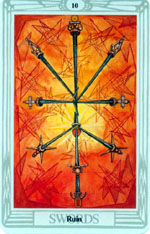
As is usual for decks in the Golden Dawn tradition, the Thoth deck consists of a Major Arcana of 22 cards, and a Minor Arcana divided into four suits of Wands, Cups, Swords, and Disks, to which the usual elemental correspondences apply. The cards themselves are loaded with astrological, elemental, and cabalistic symbols. Since Crowley was himself a student of many traditions, he incorporated their symbology into many of the cards. It is not unusual to see Tibetan, Celtic and cabalistic symbols in the same card. Fortunately for us, the illustrator of the cards, Lady Frieda Harris, had the esoteric understanding and the artistic talent to translate Crowley's symbolic collages into a unified presentation that resonates in conscious and unconscious imagery, without requiring a detailed understanding of the symbols themselves. While Lady Harris is often regarded by many reviewers as relatively ignorant of the principles of the Tarot, any serious consideration of the deck makes it obvious that she had a profound understanding not only of the Tarot, but also of Crowley's ideas and intentions for the deck. Much of the material in the booklet that accompanies the deck was written by her.
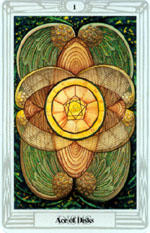
Most reviews include some kind of detailed description of the images of the deck they are reviewing. I hope I do not disappoint you too much in failing to do so here. There is very little that can be said about the images themselves. They are archetypal, abstract, and just too bloody weird to describe. But that is the whole point: these images are not for memorizing or for explaining. They are the images in which the superconscious mind communicates, and their purpose is to draw forth meanings from within, and not to explain or describe like a fortune cookie. To that end, I have found that a somewhat different kind of layout than one would ordinarily use is best for the Thoth deck. Before going into the details, I should again caution the reader that I tend to read cards more abstractly and prophetically than many diviners, and that success in this method is entirely dependent upon one's own impressions of the cards, and not what anyone else says they "mean."
The layout I use for the Thoth deck I call "The Mountain of Madness," for who but an utter madman wants to know the truth? It is a 10-card layout. The first four cards form the base of the mountain. These may represent elemental forces, influences from the past, or fundamental questions and conflicts. They refer generally to the Earth which, while giving the appearance of stability, is always in a state of change. Next, three cards are placed above these. These cards are the province of the Sun, and generally refer to the passage of time, and the changes that passage brings. They are present-tense cards, and may have to do with consciousness, with things of which one is aware, or with directions and pathways. Above those cards are placed two cards that refer to the Moon. These are future-tense cards, and depending upon what cards they are, may indicate situations, persons, or forces that will come into play. One may be a Dark Moon and the other a Bright Moon, suggesting hidden and revealed things, or good and bad possibilities, but this must be determined during the reading itself. Finally, the last card is placed above the Moon cards, and this card is in the province of the Stars. The tense of this card is Eternity, and while it may be indicative of general outcomes, it is more usefully regarded as a broader perspective in which the energies of the other cards are situated. In my introductory article on the Tarot, it was this layout I used in the example that ends that article.
I have also found that a "progressive" layout works well with these cards, though not was well as it does with the Sacred Circle, another symbolic but much less abstract deck in the Celtic theme. In a progressive layout, cards are dealt out, interpreted, and then more cards are added, modifying the interpretations and meanings as one goes along. It would probably require a textbook to fully explain this, but the method I use starts with a basic Celtic Cross, and then adds cards until a 3x7 rectangle is obtained. For some reason I was in an Arthurian mood when I came up with this, thus the somewhat bizarre but nonetheless logical assignment of meanings in the final layout:
Lower left 3 cards: The Knight, the questioner or her present situation as she sees it.
Middle left 3 cards: The Deeds, things in the past, or past ways of thinking and feeling.
Upper left 3 cards: The Challenge, obstacles, or what are perceived as obstacles, or influences of others.
Lower right 3 cards: The Quest, immediate future events and influences, or what lies before the questioner.
Middle right 3 cards: The Adventure, future events and influences, things the questioner must do or accomplish.
Upper right 3 cards: The Attainment, what will be realized, how it will turn out, what the overall effect on the questioner will be.
Cards 1 & 2 of the original Celtic cross, in the middle, usually refer to questions, obstacles or pathways in moving from Deeds to Adventure; the lower card refers to the transition between Knight and Quester (or Seeker), and the upper card to the transformation from Challenge to Attainment.
See? I do think about the cards the same way as everyone else. Sort of. Occasionally.
At this point, I think it might be useful to add a suggested reading list of works by Crowley or related to them, for those who may be interested in learning more about his teachings, and why he is so despised by every pompous jackass in the occult world. Crowley grew up, spiritually at least, in the Masonic and Cabalistic traditions, culminating in his membership and eventual departing from the Golden Dawn. As such, many of the terms he uses are specific to those traditions, and may be quite foreign and confusing to those who have followed different paths. The following is an annotated bibliography of suggested readings that will give you the background and the basics of Crowley's philosophical and magickal system.
1. "Foundations of Practical Magic", by Israel Regardie, published by Aquarian Press. This book is long out of print, and that's a shame, but you may yet find copies available through Internet sources or used book dealers. Most introductory texts on the Cabala, the mystical system that forms the basis of the Golden Dawn tradition, and hence the background from which Crowley's works are written, are long, dry, and tedious affairs. This is the only text I have found that will give you a quick, but sufficiently detailed account of the subject that will help you to figure out what Crowley is talking about. It is not necessary to be a Master in the Cabalistic tradition to understand Crowley's works, but it is necessary to understand the terms and concepts he uses, and this is by far the best introduction to the subject for that purpose.
2. "Book Four", by Aleister Crowley. Well, here the going gets tough, because it is a little difficult to explain just exactly what "Book Four" is. Crowley intended it to be a practical guide to his system of magick, but unfortunately it has never appeared in a single, complete edition. It is most often seen published in four separate parts, although an edition including the first three parts appeared under the editorship of John Symonds and Kenneth Grant, published under the title "Magick" by Samuel Weiser. Part one, sometimes known as "Mysticism", or "Yoga and Magick," deals with the preliminary preparations necessary for the understanding and practice of magick. While the terminology and methods are Eastern, the point of the exercises is to learn how to take control of your own mind -- how to rid yourself not only of undesirable spiritual influences, but also how to free your own thinking from the influences of those around you, and from your own prejudices and self-imposed restrictions. Part two, entitled, "Magick", or "Magick and Mysticism," is a detailed description of how the tools used by the aspiring magician -- the wand, cup, pentacle, and so forth -- are to be prepared. Of course the real point is to begin training the mind, now freed from external influences, in the necessary methods of ritual concentration required for the practice of magick. Part three, "Magick in Theory and Practice," is widely available from several publishers, but is quite useless on its own, without having at least understood the contents of parts one and two. It is Crowley's most famous work, for it details the actual rituals and principles of magick itself. Part four, better known as "The Book of the Law," is a psychically received document. It purports to be a message from the Prophet of the Egyptian god Horus, who is about to seize control of the world and transform it into a new age of enlightenment. There is a much better version of The Book of the Law, entitled "The Law is for All," published by Falcon Press. It contains Crowley's own commentaries, which provide important insights into how Crowley viewed the state of the world, and how he thought it would eventually be transformed. You may or may not like or agree with his views, but if you want to understand them, this is an indispensable work.
3. "Magick Without Tears," by Aleister Crowley, available in several editions. This work, written late in Crowley's life, is perhaps his most lucid and straightforward presentation of his views. It is written as a series of letters, each treating a different subject, and offering his views and theories on just about every subject related to the occult. While "Magick in Theory and Practice" may be Crowley's best known work, "Magick Without Tears" is, at least from a philosophical standpoint, his most important. You will learn more about magick by reading this book than any other, and it will force you to think about your own views on the subjects he discusses.
4. "Undoing Yourself," by Christopher S. Hyatt, Falcon Press, 1982. Now this is not a work specifically by or about Crowley; it is an adaptation of his magickal system to transformative psychology. Its purpose is to set the "I" free from the "we." It is an excellent example of the theory and practice of "Do What Thou Wilt," and may be very helpful to those wishing to proceed along the path of Crowley's system, but find Crowley's procedures a little daunting, or difficult to understand. This book is a beginning, and a step that should not be taken lightly, for success in this method is the beginning of the end of life as a social animal. There are other methods and other paths, but for those who are called, here is at least one Way.
These are, I think, the basic works one should read to understand what Crowley and his system of magick are all about. Crowley was a brilliant thinker and a prolific writer, and there are scores of books written by him, about him, against him and for him. There is no aspect of the occult, including the Pagan and Wiccan variations thereof, that has not been influenced by Crowley's thoughts and writings; some for the better, and maybe some for the worse. However you look at it, understanding Crowley is essential to understanding the occult as it exists today, and there is no better way to understand Crowley than through his own works.
