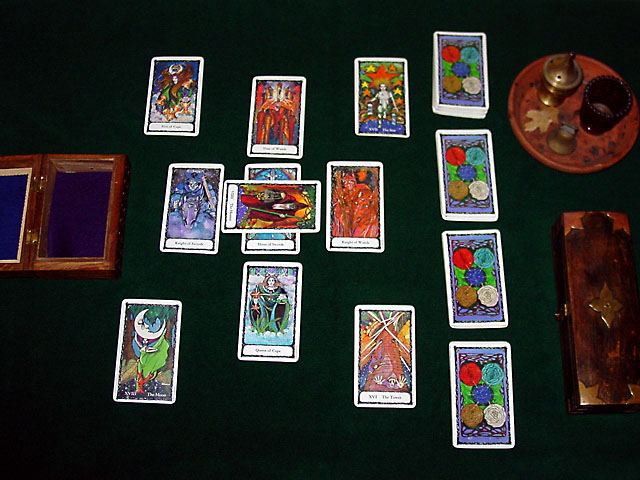
In studying the Tarot, or any other oracle for that matter, the question sooner or later arises as to why certain meanings are given to the positions occupied by cards in a layout. Why, in a simple Celtic Cross layout for example, should the first card refer to the Question, the second to Obstacles, the tenth to Outcomes, and so on? Actually there is a much deeper problem: why should any significance at all be attached to the order in which the cards are drawn, when shuffling the cards is an apparently random act? If there is no rhyme or reason as to which card is the first to be drawn, then why should that card be assigned any particular significance? Worse than that, why is it that diviners often assign their own meanings not only to positions in the layout, but also to the cards themselves?
From the standpoint of common sense, the whole thing looks as though it must be a sham. And it would be, if "common sense" had anything to do with it. If there isn't any reason why the cards appear in a certain order, and why that order reflects any philosophical or divinatory significance, then the Tarot would be nothing but silliness, and divination just a waste of time. Now, I would not be wasting my time and yours if I thought it was just silliness and phoniness. But I should warn you that the explanation is not simple. As philosopher Peter Van Inwagen once said, "common sense" is there to keep you from standing in front of moving trains, and not to answer questions in philosophy, or in science for that matter. The answer to the question of why the Tarot means anything at all will require us leaving common sense behind. But then, as physicists discovered, learning anything about science requires the same thing.
Let's turn the clock back to the scientific Renaissance of the 15th and 16th centuries, when Galileo, da Vinci and others introduced experimental science and mathematical analysis as new ways of learning about the world. One of the most important ideas to appear during that time was the idea that events in the world are governed by natural laws, abstract principles that relate conditions and events in the world much as mathematical equations relate numbers to each other. If you have so much water, and you apply so much heat, it will boil; if you have a certain volume of gas, and you compress it to a certain pressure, then its temperature will go up by a predictable amount. And so on. Perhaps the greatest achievement to come out of this way of looking at the world was Newton's "Principia," which describes the entire universe as a system of laws that govern the motion and behavior of objects, including the stars and planets. Newton himself was, by the way, a strong supporter of the science of Astrology; when irked by a detractor, Newton is said to have replied, "Sir, I have studied it, you have not."
Underlying this idea of natural laws lies a philosophical principle that goes back to Aristotle and the ancient Greeks, and this is the principle of causation. Causation is the idea that progressions of events are linked to outcomes by what philosophers call necessity. If you drop a piece of chalk onto a hard floor from a certain height, it will break. Why? Because it hits the ground with enough force to break it. Everything that happens, from the dropping to hitting the ground, including the weight of the chalk, its density, the force of gravity, the hardness of the ground, and so on, is described by natural laws that predict, without exception, what will happen. There is an unbroken linkage of forces and laws that inevitably result in the chalk breaking. But there is more to necessity than prediction; under this way of looking at the world, the equation-like laws constrain or force things to happen in a certain way. No one knows what necessity really is, or what makes causation work from the standpoint of physics, but we do know that looking at the world from the standpoint of causal laws made it possible for science to take great strides forward in understanding the world. So much so that many came to believe that everything in the universe that happens is the result of causal principles; that the universe is a progression of events invariably and inevitably linked by causal laws. This is the theory of determinism: that there is nothing that happens in the universe that is not the result of events occurring under the control of causal laws. Even the way we talk, relying upon the word "be-cause" as an explanation for things, reflects this way of viewing the world. Causation and determinism became so deeply buried in the way science and philosophy are done that Kant declared causation to be a category, a condition for the possibility of having rational thought at all. Well, we'll see about that.
Now we advance the clock to the end of the 19th century, when science was beginning to break new ground in the study of the cosmologically vast and the infinitesimally small. As observations of the planets and stars became more accurate, and the techniques for studying electrons and atomic nuclei with extremely precise measurements emerged, it became painfully obvious that the causal laws of classical Newtonian physics were not working. Worse, more and more sophisticated experiments on light and other physical phenomena were showing that given the same conditions, different, and often unpredictable, results were being obtained. As physicist Richard Feynman put it, physicists like to think that once you know the initial conditions, the results can be predicted, but this way of looking at things was beginning to fail, and fail dismally. When physics consisted of rolling balls down inclined planes, and dropping things off the Leaning Tower of Pisa, causation and determinism worked -- or seemed to work -- well as ways of explaining things. But with ever increasing sophistication in theory and experiment, scientists knew they needed a new way of looking at things, and it was during this time that the groundwork for what we now know as Relativity Theory, Quantum Theory, and Chaos Theory -- probably the three greatest intellectual achievements in human history -- was being laid down. Einstein and others didn't just pull these ideas out of a hat; they were the results of experiments and theoretical analyses that grew out of the failure of classical, deterministic physics to explain the world as scientists were now seeing it. Kant's category of causation was becoming more of a problem than a solution, and ideas like necessity and causation, once basic principles for understanding how the world works, would soon be discarded in favor of new principles that more successfully explained and predicted how the new experiments came out.
It is out of these theories that appeared near the end of the 19th century, and continue to develop today, that our understanding of how the Tarot works will emerge. You can forget about explanations that look like the laws of classical physics, for, like the double-slit experiment in physics, this way of looking at things will do us no good. This also means that "because" type explanations will also not work; the way the Tarot works, like the way experiments in particle physics work, cannot be explained in this way. As happened in science, an entirely new vocabulary, and an entirely different understanding of what an explanation itself is, will be required. To understand how the Tarot works, we will need a grasp of some basic principles originating out of modern science and mathematics. These principles are dynamical systems, participation, entrainment, and superposition; fancy words for relatively simple ideas, and, as it turns out, also very ancient ideas. They are explained in much more detail in my book, "Spontaneous Human Consciousness," available on this website; my intention here is to discuss how they specifically relate to the Tarot. These are ideas that are difficult for the mind trained to think in terms of "because" to deal with. Nonetheless, we will find that what has been discovered in modern science, no matter how strange these ideas may be, vindicates and even explains many ancient beliefs. And this will leave "common sense" standing, where it belongs, in front of a moving train.
The dynamical system is simply the idea that the totality of something is more than the sum of its parts. A house is more than just a pile of bricks, for example. You can't live inside a brick, and knowing everything there is to know about bricks still won't tell you what a house is. A house is something more than just the mathematical sum of its bricks; it is a thing with qualities of its own that cannot be derived from the qualities of bricks alone. A human being is more than the mathematical sum of all the cells in the body. Knowing everything about the cells of a human body will not tell you about the thoughts, actions, beliefs, and so on of the person whose body they make up. The relationship of the cells to the body cannot be described in an equation or a causal law; there is much more to it than that. The 19th century biologist Hans Driesch said, "There is something in the organism's behavior which shows that the living organism is more than a sum or aggregate of its parts." Driesch called that something the Entelechy, which he considered to be a special or vital force that differentiates living from non-living things. We now call that something a dynamical system, and dynamical systems appear in non-living as well as living things. Human consciousness is a dynamical system; although the brain and its parts are essential for human consciousness to exist, who and what a human individual is, what he or she thinks and how he or she behaves cannot be explained on the basis of brain anatomy alone. There is something more to it, and while consciousness may be a combination of brain functions, unconscious and perhaps superconscious or "spiritual" factors, it cannot be explained on the basis of any of these alone, any more than what goes on inside a house can be explained on the basis of the physical qualities of its bricks or other materials.
Maybe the clearest example of a dynamical system, as it relates to our discussion here, is the relationship of individual musicians to the overall performance of a band or orchestra. Listening to the sound tracks of individual performers will not tell you what the overall performance sounds like. The performance has a life of its own, an emotional impact and aesthetic appeal that cannot be derived from the notes produced by individual musicians, nor can they be derived by simply adding the individual sounds together like numbers in an equation. The individual musicians are therefore not the causes of the performance, in the way that numbers in an equation are the causes of its solution, but instead are participants in the performance, in the way that individual cells are participants in a human body. This leads us to the second principle we need to understand, that of participation.
Participation traces back to Heisenberg's Uncertainty Principle, one of the founding ideas behind modern Quantum Theory. This principle states that any time we study something, we change the way that thing is, and we change it in ways that cannot be predicted by causal laws. While the Uncertainty Principle was developed specifically in response to certain experiments, its more general philosophical impact is that our presence and actions change the way the world works, and not always in ways we expect. The ancients understood this principle as what Levy-Bruhl called participation mystique, the idea that we are not just detached observes of nature, but are active participants in it. Nature religion, ritual magic, beliefs in fairies, gods and goddesses are all examples of participation; one could think of Heisenberg's principle as the reincarnation, so to speak, of this ancient idea in modern physics. It means that when we interact with, or participate in something, we change the way the world is, as well as us being changed by it. The world is not simply something we look at like bacteria under a microscope; it is something with which we interact, and our actions change the world just as it changes us.
Participation is a characteristic of dynamical systems, but just as individuals parts are participants in the overall whole, so do dynamical systems interact with one another. Returning to our example of a musical performance, musicians know that a performance in front of a dull audience will be a dull performance, while a concert in front of a lively and energetic audience will be brilliant. This is because dynamical systems interact with one another and with the outside world, and in ways that can no more be explained by causal laws than can participation. The interaction of one dynamical system with another is the principle of entrainment or mode-locking, and just as classical physicists did not know what causation really was, no one knows what, in terms of basic physics, entrainment is. It is a basic explaining principle of how dynamical systems interact; it is the same idea Jung called synchronicity, and physicists have called action at a distance and the acausal connecting principle. We don't know what it really is, but it is a useful explanation of how things work, and that is what a scientific theory is supposed to be. The important thing about the entrainment principle is that is describes how one dynamical system, such as human consciousness, can affect and be affected by other things; it is an alternative to causal explanations, doing the same work for dynamical systems that causal laws did for classical physics.
There is one more idea we need in place to understand how a Tarot reading works, and that is the idea of superposition, perhaps one of the strangest ideas ever put forth in science, or any other discipline for that matter. This idea originates out of the failure of classical physics to explain the phenomenon of radioactive decay. To make a long story short, classical physics teaches us that there is a certain way the world is, and once our knowledge matches the way the world "really" is, we will know the truth. The world is just the way it is, whether we notice it or not. But classical physics has failed to explain many things, partly because it regards us as objective or detached observers, rather than as participants. Suppose we have a piece of uranium, or other radioactive material. Classical physics tells us that some of the atoms will have decayed, and others not, independent of whether we know it or not. Modern physics, on the other hand, tells us that a more useful way of looking at it is that until we observe them, atoms of radioactive elements are in a state of being both decayed and undecayed; since it is possible for the atoms to be in either state, we say they are in a superposition of all possible states, until we observe or measure which state they are in. Physicist Erwin Schrodinger developed the following example to explain this idea. Suppose we have an experimental apparatus, consisting of a box in which there is a cat, a bottle of cyanide, an atom of a radioactive element, and a device that breaks the bottle and kills the cat, once the atom decays. Now what Schrodinger said is this: until we open the box and see whether the cat is alive or dead, it is both alive and dead at the same time. It is not simply that we don't know whether it is alive or dead; it is in both states, a superposition, until we open the box and observe it. A given system exists in all possible states until it is observed, and that is an idea that is completely incompatible with classical physics.
Of course the act of observing is, according to Heisenberg's Principle, a participatory act, and we can see that all of these principles are interrelated. Dynamicality, participation, entrainment and superposition are all at work in our interactions with the world around us, and especially, as I will argue, in the case of doing a Tarot reading, or consulting any other oracle. We cannot explain how a Tarot reading works in terms of classical laws and causation, but that is nothing new, and it is nothing that physicists have not known about for nearly 100 years now.
So how does a Tarot reading work? It might be best to think of a Tarot reading as a dynamical system, something like a musical performance. It is a series of participatory acts involving many participants: the cards, the diviner, the questioner, the question, the meanings and interpretations the diviner assigns to the cards, and many other factors. It is not simply that once the cards are shuffled, the final meaning of the divination is already established. Instead, a divination is an ongoing series of participatory acts and events, whose final meaning, like the overall performance of a band or orchestra, does not emerge until the process is completed.
First of all, when we shuffle the cards, it is not simply the case that we are randomizing the order of the cards. We are creating a superposition of cards; instead of thinking of the cards as being in some particular order that we discover by drawing them, it is more useful to think of the cards as being in a superposition of states -- in no particular order, until we begin observing them through the participatory act of drawing them. It is because -- and that is a convenient but inappropriate use of the word "because" -- of the participation of the consciousness of the diviner, including his or her beliefs about the meanings of the cards, the significance of the order of the cards, and the question, if any, being addressed, that the cards appear in some particular order, and have any meaning at all attached to them.
"Now wait a minute," you say, "that just can't be. You are saying that what the diviner believes about the cards has something to do with which cards are drawn, and the order in which they appear. That's crazy, it just doesn't make sense." All right then, tell me how you make sense out of the fact that the same side of the moon always faces the earth, why it is that fireflies in a tree blink their lights in perfect synchronization with each other, why pendulum clocks set against a wall synchronize themselves, and why the supposedly "random" radioactive decay of Cesium-137 occurs in such precisely timed bursts that it serves as the basis for atomic clocks. Go ahead, show me the equations and the causal laws. I'm not holding my breath. There are no such equations or laws, and these phenomena cannot be explained in terms of the science that relies on such laws. But they are easily explained using the principles we have put forward here. The reason they don't "make sense" is that what most people consider "sense" is based upon outdated and demonstrably false principles.
So yes, we are saying that through the principles of superposition and observation, entrainment, and participation, the consciousness of the diviner has something to do with the way the cards appear in a particular draw. If the diviner is using the Celtic Cross, for example, the first card refers to the Question because the diviner believes it does, and the consciousness of the diviner participates in the ordering of the cards. Now I should point out here an important consequence of the principles we are using -- that although the consciousness of the diviner is a participant in the reading, the results of that participation are not always what is expected or desired. Divinations fail, and fail often, more often that most diviners are willing to admit. The Uncertainty Principle tells us that although we, as observers, are participants in the way things turn out, the effect of our participation is subject to the rules of probability and not causal law. So the cards may present a clear answer to a question, but it might not be the question that the diviner has in mind when the cards are drawn. Some diviners take this as a hint that there are things involved that the questioner does not realize, or that maybe there is a more important question needing attention than what has been asked, but it is really just a consequence of the uncertainty principle that the cards tell a story that isn't what we wanted (or expected) to know. Even more troublesome is the fact that the cards sometimes appear to be revealing nothing, or just confused gibberish. This doesn't mean the diviner is incompetent, or the cards are somehow "contaminated"; it is just another consequence of the fact that the very principles that allow us to participate in the way the cards are drawn and what their meanings are, also predict that there will be glitches and miscommunications between the diviner and the oracle.
A card means what it means, both in terms of the meaning of the card itself and its position in the layout, not because of anything to do with the cards themselves, but because of their participatory relationship with the mind of the diviner. Moreover, a reading of the Tarot, or any other oracle, has a meaning that is not simply the sum of each individual card drawn. There is a total picture that emerges from the divination as a whole, just as the energy and ambience of a performance emerges from the participation of each musician. That is one reason why many diviners pay close attention to the relationships between the cards drawn, sometimes even more so that what position each card occupies. The outcome of a divination, its overall meaning or message, is something that emerges from the totality of its participatory events. And the same observation about dullness and brilliance of a performance also applies to divinations -- a dull, stupid question like, "Does so-and-so love me?" is likely to produce a dull and stupid reading, whereas a well thought out question, or even better yet, asking no question at all, tends to produce brilliant and inspiring results.
But how can it produce any results at all, one might legitimately ask, even if all of the above principles are true and apply, if the participatory relationship is between the cards and the consciousness of the diviner and questioner? Would it not be the case that what a divination reveals is just what is already in the mind of the diviner and the questioner? The standard answer to this question is that it is because the unconscious -- those mental operations of which consciousness is not directly aware -- is also a participant in the divination, that things hidden from consciousness are revealed. It is through unconscious factors such as Jungian archetypes, superconscious energy, spiritual inspiration, and so forth, that the divination is able to connect with things of which consciousness is not already aware. The symbolic imagery of the Tarot seems ideally suited to communications with the unconscious, and indeed Jung thought that the Major Arcana were images of archetypes themselves. I tend to agree with this position, and I have argued in "Spontaneous Human Consciousness" that Jung's description of the unconscious and how it works is really what we now understand as dynamical systems theory, expressed in psychological terminology. His ideas of synchronicity, symbolic representation, and so on fit perfectly with our current understanding of how dynamical systems work, and together with ideas like uncertainty and participation, Jung's theory of the unconscious coheres very well with currently understood scientific principles. It is not the case, as some have declared, that Jung's work was "unscientific;" instead, I believe, it is the case that science has caught up with Jung's visionary ideas.
There is, however, more to the oracle than psychology, even the transpersonal psychology of Jung's unconscious. To find what that "more" is, we return to the ideas of Hans Driesch who, in the vocabulary of his time, suggested that living organisms might be dynamical systems. But the ideas of vital force and Entelechy go further than that. Recall that the principle of entrainment tells us that dynamical systems can communicate with and affect each other, without adherence to causal laws. While causal interactions are physical phenomena, requiring the physical transfer of energy between the cause and effect, acausal principles like entrainment and action-at-a-distance have no such requirements. Entrainment is, as Driesch suggested, not a physical phenomenon itself, but can nonetheless affect physical objects and systems. This means that events related by the entrainment principle are not limited to the laws of physical interactions; it means that the relationship of conscious and unconscious minds to other dynamical events in the universe is not restricted to physical contacts, or even limited by or to space and time. So, in theory, divinations really can reach across space and time, can see into the past or the future, and can literally peer into the Unknown because they are based upon acausal and not causal principles.
To do that, however, there must be something that encompasses all of space and all of time, to which the participatory events of a divination are acausally related. Terms like "all of space" and "all of time" sound a lot like the theological terms infinite and eternal. What, then, is this thing Driesch called the Entelechy? Consider, for a moment, that dynamical systems have been found nearly everywhere in nature. From within the human body to the event horizons of black holes, now that we know how to look for dynamical systems, they seem to be an inescapable feature of nearly every phenomenon in nature. Could it be that the vital force that Driesch and others suspected is really a kind of entrainment between all of these dynamical systems? Could everything in nature, including human consciousness, really be connected in some way that science is only beginning to understand? Could the Entelechy really be a kind of universal consciousness, a massive conglomeration of all the events and phenomena of nature that spans across space and time, that both affects, and is affected by, everything that happens in the universe? Is what we call human consciousness really only a small part of something unimaginably larger and greater, of which our oracles and visions give us only a fleeting glimpse?
We will leave answering these questions to the reader as an exercise. You can read more about this idea and its consequences in "Spontaneous Human Consciousness." But I think we have sufficiently established, based upon sound, albeit strange, scientific principles, that there are good reasons to believe that the Tarot, and other oracles as well, can tap into sources of energy and information to which ordinary consciousness does not have direct access. Physicist Edward Teller once said he didn't like science fiction because it was not as imaginative as science. I like to think that what has happened in recent years is that science has put magic back into the world. Where deflationary theories like determinism and materialism once made science the enemy of imagination and vision, it appears that science, as it is now understood, has opened the doors to a much deeper understanding of what mysticism, divination, magic, and many other beliefs of the ancients are really about.
I will finish by offering a selected list of readings; not a bunch of "guidebooks" to interpreting the Tarot, but instead a list of readings that will give you an understanding of the theories upon which I have based this analysis. Read them, learn what science has to say about the way the world works, and decide for yourself whether divination and magic are nonsense, or are really the fulfillment of rediscovered ancient wisdom.
"Alice in Quantumland," by Robert Gilmore, pub. Copernicus/Springer-Verlag, New York: 1995. This book is without a doubt the best introduction to the ideas of Quantum Theory, including the consequences and impact of the Uncertainty Principle. It is written in the style of Lewis Carroll's Alice in Wonderland, except that the Wonderland Alice visits is the real world as it is seen through the eyes of modern physics. You think what I have written is strange? You haven't seen anything yet! But this is reality, the reality that modern physics describes. Why would you want to read it? Because if you do, you will realize that ideas like magic and divination are not so different from the science of today as you might have thought.
"In Search of Schrodinger's Cat," by John Gribbin, pub. Bantam, New York: 1984. This is a more formal and comprehensive, though not highly technical and mathematical, introduction to quantum theory. You should probably have had basic college physics to fully understand it. Many of the experiments that show the failure of classical physics are described, along with the modern theories to which they gave rise. It is more difficult than "Alice in Quantumland,” but it is also more thorough, and if you have an interest in the subject, it will give you a solid background in the ideas of quantum theory, and, I believe, a good understanding of how many "occult" theories might actually work.
"QED: The Strange Theory of Light and Matter," by Richard Feynman, pub. Princeton University Press, New Jersey: 1985. Haven't had enough yet? OK, here it is -- Quantum Electro-Dynamics is the theory that explains how quantum mechanics works. This is pretty rough going, but on the other hand, once you understand it, you will understand things like time travel, antimatter, parallel universes, and much more. I have always believed that those who study metaphysics, and particularly those who do so with the title of "Professor," ought to know something about physics first. So when they tell you that time travel is impossible, hand 'em this and walk away. And try not to laugh too loudly.
"The Relativity Explosion," by Martin Gardner, pub. Vintage Books, New York: 1976. Relativity theory is the other side of the quantum coin: while quantum theory deals primarily with small things like electrons and photons, relativity primarily deals with large things like galaxies and black holes. It is, in many ways, even stranger than quantum theory, for it tells us that the universe as a whole is a very different place than Newton ever imagined. This is a very easy to understand, non-technical treatment of the various aspects of relativity theory, and it is a good compliment to the ideas of quantum physics presented in "Alice."
"Chaos: Making a New Science," by James Gleick, pub. Viking, New York: 1987. This now classic text was the public's, and much of the scientific community's, first introduction to the idea of dynamical systems and chaos theory. Chaos theory has transformed nearly every field of science, and has, in many ways, been the final nail in the coffin of outdated world views like causation and determinism. The ideas of fractals, strange attractors, and dynamical systems are explored as they pertain to various fields of science and mathematics, all in a non-technical and jargon-free style that is a pleasure to read, and an even greater pleasure to understand.