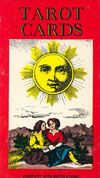
Swiss Tarot 1JJ
pub. U.S. Games Systems (English)
AGM (English, French, German)
reviewed by: David Bruce Albert Jr., Ph.D. ([email protected])
"The Swiss Tarot 1JJ breathes the spirit of a distant past when the supernatural was still omnipresent." So states the AGM catalog description of this deck. Well, for those of us who haven't composted our brains in the materialist dung heap, the supernatural is still omnipresent, and this deck still has an aura of mystery and charm that few modern decks can rival. The imagery is simple yet haunting, seeming to stir things in the collective unconscious that modern culture has all but forgotten, or more likely repressed.
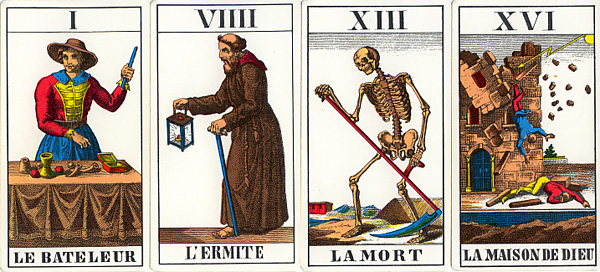
The 1JJ is a classical deck, meaning it has 22 illustrated Major Arcana cards, and a Minor Arcana whose numbered cards simply show the required number of clubs, cups, swords, and coins. The cards measure 6x11cm, making them easy to shuffle, and have a simple criss-cross pattern on the backs. The Major Arcana have the number of the card in Roman numerals at the top, and the name of the card at the bottom. The "JJ" designator comes from the author's substitution of Junon and Jupiter for the Priestess and Hierophant, supposedly done so as not to offend the clergy. I imagine they were offended anyway, but it makes little difference as the deck survives, and they did not. The booklet that comes with the deck gives brief meanings for the Major Arcana only, and a short explanation of the Celtic Cross layout for reading the cards. The deck also comes in a set with a book that gives meanings for the full deck.
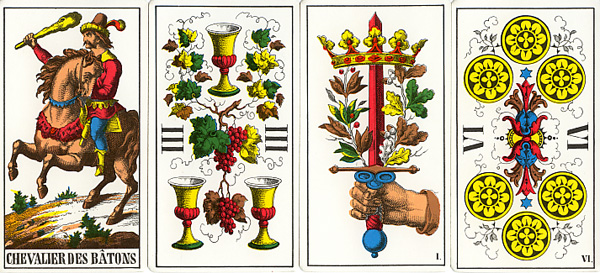
Some have advised beginners to learn with this deck, but I think it is probably one of the more difficult decks to learn. Other than the Major Arcana, there is nothing on the cards to reveal or suggest their meanings. Far better to learn with one of the modern illustrated decks, such as the Sacred Rose, or even (choke, gag) the Rider-Waite, and then move on to a deck like this when you have worked out your own understanding of what the cards mean. On the other hand, as I said above, there is something absolutely enchanting and spellbinding about this deck, such that at least as far as the Major Arcana is concerned, it has an appeal to beginners (and to many experienced readers as well) that other decks can't match. So, if you like this deck, you might want to learn the Major Arcana with it, then move on to an illustrated deck to study the Minor Arcana, and then come back to this deck once you have settled upon your own interpretations of the cards.
Or maybe not. The whole point of learning the Tarot is not to memorize someone else's interpretations of the cards, but rather to develop your own understanding of the cards and the Oracle they represent. There is nothing in this deck that tries to force some particular esoteric system down your throat, and many find it easier (and a lot more enjoyable) to learn the cards independent of any "secret" system or metaphysical gobbly-gook. You need some place to start, though -- some point of reference on which to build an understanding of what the cards mean. There is a fairly simple system given by Papus in his "Tarot of the Bohemians." Unfortunately, the translation was done by Arthur Edward Waite, who had a talent for turning the simplest of things into the most unintelligible. So I give here a brief (and hopefully intelligible) summary of the meanings he presents:
Note: Suggested interpretations for the Major Arcana are given in the booklet that comes with the deck.Batons (Wands) - Fire: Enterprise and glory.
Cups - Water: Love and happiness.
Swords - Air: Hatred and misfortune.
Coins (Pentacles) - Earth: Money and interest.
Aces: The beginning or commencement of something (i.e. Ace of Cups, beginning of a love affair).
Twos: Opposition to the beginning (initial difficulties).
Threes: Equilibrium of the beginning (difficulties overcome, project successfully started).
Fours: Beginning of opposition (serious troubles brewing, the appearance of obstacles).
Fives: Opposition to obstacles (triumph over difficulties, obstacles overcome).
Sixes: Triumph of obstacles (failure of the project or affair).
Sevens: Beginning of equilibrium (certain success of the project or affair).
Eights: Opposition to equilibrium (project or affair only partially successful or satisfying).
Nines: Triumph of equilibrium (successful outcome, and continuing success).
Tens: Uncertainty or changes (success or failure which may not last).
Kings: Man
Queens: Woman
Knights: Young Man
Page (Knave): Child
Note that these meanings have nothing to do with the "standard" RWS meanings. Also, the swords generally having unpleasant meanings in this system, the Six of Swords would be a favorable card to draw, whereas the Nine of Swords would be just about the worst. The court cards can mean specific persons, or the qualities one might imagine such persons to have. I present this system only as a suggested guide as to how to read the cards without reference to any of the complex metaphysical systems that have come to be associated with them. While Papus does suggest specific meanings for the cards, you can pretty much figure them out on your own using his guide.
This deck has an interesting history to it in modern times. It was the first commercially available Tarot deck, making its appearance around 1971. The story goes that a salesman from AGM (then known as Ag Muller & Cie.) showed the deck to Stuart Kaplan, owner of US Games Systems at a trade show. Kaplan ordered some decks, added his own booklet, and offered them for sale. Thus began the modern Tarot revival.
I purchased this deck in 1972, at a gift shop in a small shopping center (this was before the mall and super mall era). I found it interesting, and went back a week later to get another one, in case I lost or damaged any of the cards. I couldn't find the shop; it was gone, as though it had never been there. I even asked at other shops in the center, and no one could remember the gift shop. Let the neophyte be warned: you had better get used to this kind of thing, if you plan on getting involved with the Tarot in any serious way. The cards are only symbols of something much greater in scope and power, and there will always remain the question as to whether one is predicting the future by reading the cards, or creating it by believing the cards.