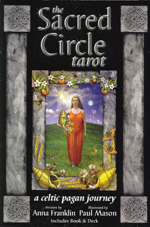
The Sacred Circle Tarot
by Anna Franklin and Paul Mason
Llewellyn Publications
Reviewed by: David Bruce Albert Jr., Ph.D.
Into my loneliness comes --
The sound of a flute in dim groves that haunt the uttermost hills.
Even from the brave river they reach to the edge of the wilderness.
And I behold Pan.
The snows are eternal above, above --
And their perfume smokes upward into the nostrils of the stars.
But what have I to do with these?
To me only the distant flute, the abiding vision of Pan.
On all sides Pan to the eye, to the ear;
The perfume of Pan pervading, the taste of him utterly filling my mouth,
so that the tongue breaks forth into a weird and monstrous speech.
The embrace of him intense on every centre of pain and pleasure.
The sixth interior sense aflame with the inmost self of Him,
Myself flung down the precipice of being
Even to the abyss, annihilation
An end of loneliness, as to all.
Pan! Pan! Io Pan! Io Pan!
-- Aleister Crowley, Liber Liberi vel Lapidis Lazuli,
"Being the Voluntary Emancipation of a certain Exempt Adept from his Adeptship. These are the Birth-Words of a Master of the Temple."
There comes a time when, to move forward, certain things must be left behind. The child leaves the crib behind to learn to walk, the bird leaves the nest to fly, the doctor leaves his books to heal, and the Adept surrenders his Adepthood to become a Master. Certain ways of thinking, while useful for a time, must eventually be set aside in order to gain insight and wisdom. This is as true for the Tarot as for anything else.
For decades, the Tarot has been regarded as having a certain necessary structure, theme and meaning, in order to qualify as a Tarot at all. It must have 22 Major Arcana and 56 Minor Arcana; these must be in a certain order, depict a certain set of images one way or another, and relate a certain set of meanings, or something close to them. Otherwise, it isn't Tarot. It doesn't meet the standard, it doesn't fit the mold.
Who says the Tarot must have these characteristics? Ultimately, Eliphas Levi says -- the French master who first suggested that the Tarot was a symbolic representation of the Cabala, the secret doctrine adopted by most occult orders in the Masonic tradition. After that, Arthur Edward Waite says -- the Golden Dawn member who, together with artist Pamela Coleman Smith and publisher Rider, created the first illustrated Tarot deck available to the general public. Never mind that Waite was notorious for altering esoteric symbolism in his writings, in order to prevent you from knowing what you are, in his opinion, too stupid to know. Never mind that Waite himself couldn't figure out the meanings of some of the cards (read his description of the seven of swords in The Pictorial Key to the Tarot), which apparently the cards felt Waite was too stupid to know. The facts that the symbolism and artwork are relatively simplistic, and that the assigned meanings are sufficiently general to be twisted however the reader wants them twisted, have made the RWS deck popular not only with beginners, but with the majority of modern Tarot artists who, fearing their decks will be rejected as "non-standard", simply rehash the RWS structure in different themes.
Whatever good or bad may be said of Levi, Waite, and those who follow in their path, it is their path, and not necessarily everyone (or anyone) else's that has come to dominate the modern Tarot. Not everyone is attuned to that path. Many of those who hear the call of the flute in dim groves find the RWS lineage alien and decidedly uninspiring. While there have been many attempts to cast the RWS legacy into a "Celtic" format, most of them fail because they are pushing a square peg into a round hole. The Masonic and Cabalistic RWS lineage, no matter how badly Waite corrupted it or other authors have twisted it, is still not the tradition, ambience, and energy of the grove. Those who are called by the sound of flutes in distant groves, who yearn to smell the smoke that rises through the trees to the nostrils of the stars, and who seek the wisdom of the weird and monstrous speech first uttered by the ancient Druids and kept alive through their rituals and teachings, must first throw themselves into the abyss that lies beyond the Cabalistic oracle and its offspring.
Not surprisingly, there have been many attempts to devise a Celtic oracle rooted in pagan tradition. Several versions of the Ogham, a druidic system based upon ancient tree wisdom, have appeared in recent years; some as sticks, some as cards. Other systems, such as animal and fairy cards, have also been published, and while all these systems are effective oracles, there is a lingering feeling among many that the Tarot taps into a certain wisdom that other oracles miss. To be sure, the opposite is also true: the Ogham and its divinatory relatives interact with natural energies that the Tarot seems to miss completely, but the abstract Tarot seems better suited to divining superconscious and archetypal energies than the Earth-based Ogham. So, at least up until now, the Celtic diviner has been stuck with a Tarot that does not speak her language or hear her voices.
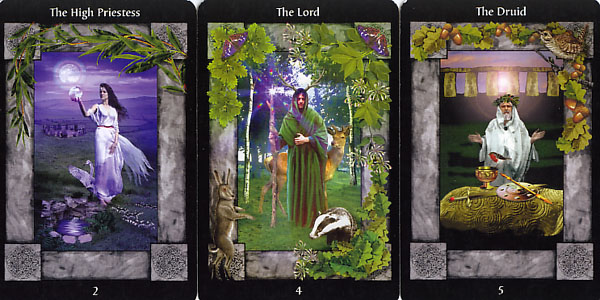
With the publication of The Sacred Circle Tarot, the Celtic bird has finally flown the Rider-Waite nest. No longer is the Celtic diviner restricted to a set of images and interpretations outside of his tradition and frame of reference. The feat was accomplished by re-interpreting the Major Arcana in the context of a story called "The Journey of the Fool," told from the standpoint of Celtic lore. Beginning with The Green Man which "represents the energy that triggers the process of dawning consciousness," the journey of the Celtic spirit moves through a series of growths and transformations, culminating in its attainment of The World Tree, the "center pole that links all the realms of being and knowledge," and beyond that, freedom from the tired and corrupt symbology of the RWS tradition at long last. To do this, the authors changed the names and order of many of the cards, and applied an ingenious blend of photographic and computer-generated imagery that leaves one wondering where the rest of the Tarot world has been sitting twiddling its thumbs. This is state-of-the-art technique, and the effect is both visually dramatic, and at the same time stimulating to the imagination without restricting interpretation. The Magician always should have been The Druid, and always should have followed the Priestess/Priest and Emperor/Empress dualities, uniting physical and spiritual polarities into the perfect balance of power and wisdom. And the Emperor, now renamed The Lord – this is, and always was, the essence of the male energy principle: the power of spontaneous creativity, and the liberation of the spirit from its bonds of social indoctrination. More philosophically, it is the Self, the uniqueness of the individual, and, together with The Lady and her archetypes and energies, the very source of human consciousness. It is Pan, the freer of souls, the caller from distant groves the lures the spirit from the mundane to the magnificent. Finally, the male and female principles are liberated from their thrones of oppression and control.
Each card deserves an essay in its own right. But with this deck, that probably isn’t necessary. The imagery of the card opens a portal into an enchanting and somehow familiar world, a world to which the traditional symbolism gives no access. The Sacred Circle Tarot opens the gate to the myth and lore of the grove. One of the purposes of myth and lore is to provide a connection between consciousness and the unconscious, allowing the mind access to information that otherwise remains hidden. This is how the process of divination works, and it is by encouraging this connection that the Tarot functions as a divinatory system. For those who are drawn to the sound of the dim flutes in distant groves, the Sacred Circle is probably the best Tarot yet devised.
The Minor Arcana is similar to the RWS scheme, although, at least to me, it seems closer to the Crowley Thoth cards. It is a symbolic presentation, meaning that the cards suggest, but do not directly illustrate, their meaning. The Minor Arcana are arranged into four suits: swords, wands, cups, and disks, each with 10 numbered cards plus four court cards -- Page, Knight, Queen , and King. The images on the cards themselves have, in most cases, some sacred or legendary Celtic site such as Glastonbury Tor, a stone circle, or even the Cerne Abbas Giant, upon which are superimposed the appropriate number of symbols for the card. The main image is surrounded by a border indicating the elemental correspondence of the card: clouds for swords, flames for wands, a wave-like design for cups, what looks like lichen-covered stones for disks, and for the Major Arcana, a stonework design bearing carvings and often plants and animals that enhance the symbolism of the card. The entire card has a black border that makes the brightly colored image seem to glow, at the top of which is the name of the Major Arcana card or keyword for the Minor Arcana card, and at the bottom is the number of the Major Arcana card or suit and number for the Minor Arcana. The suits themselves correspond to the seasons -- swords for spring, wands for summer, cups for autumn, and disks for winter.
The cards are larger than most decks, although if you use the Thoth deck, they are just a bit smaller, measuring 8.5 cm X 13 cm. The back design is an arrangement of the elemental suit symbols -- wand, sword, shield and cup -- set against a stone background. Some have complained that this reveals whether a card is reversed or not before it is drawn, but I see little significance to this, partly because I don't read reversed cards, and even if I did, I would read the fronts and not the backs. The cards come as a set, boxed with book and a small, thin cardboard box that is not adequate to hold or protect the cards. You will need a cloth, or else a substantial box, for the cards.
The book is a substantial paperback volume, of 322 pages plus some additional LLewellyn advertising. The logic of the deck structure is explained, along with several suggested layouts and applications for the cards. The bulk of the book consists of a detailed description of each card, including the lore and symbolism of the card, and its upright and reversed interpretation. The discussion of the myth and lore is extensive, and the cards are as good as an introduction to Celtic lore as they are for divination. However, I do have one complaint, and it is a fairly serious one. Far too much of the book contains the kind of psychological analysis, self-criticism and "advice" that discredits the Tarot as a symbolic system and insults the oracle as a metaphysical system. This problem is not unique to this product; if what I read on the internet and in book reviews is correct, this kind of crank psychology is what most Tarot authors, teachers and organizations actually encourage. I categorically reject any metaphysical, psychological, or belief system that presupposes or advocates anything like, "There is something wrong with YOU, and you must change yourself to be good enough." This can only lead to self-deprecation and ultimately self-destruction, and the conversion of the "I" into "we," the consequences of which are examined in my books available on this website, and therefore need no further discussion here.
What I will do is to reiterate what I have said elsewhere: you should read the book to understand what the authors intended when they created the cards. After having read, the reading eye moves onward -- you must, no matter what cards you read, develop your own understanding of what they mean and how those meanings are revealed. Tarot decks are self-consuming artifacts, by which is meant their meaning is derived from the way the reader interacts with them; the cards, at least in a symbolic deck like the Sacred Circle, do not wear their meanings on their sleeves, but instead produce meanings through the responses of those who use them.
While it is true that Tarot cards can produce a wide variety of meanings among those who read them, it is not true that those meanings are arbitrary. By incorporating the history, lore, and mythology of a culture or a belief system into a logical and cohesive progression of images, a well thought out Tarot deck draws the reader into the world of its symbols. A card does not mean what it means in isolation, but rather in its relation to the sequence of images of which it is a part, and in its relation to the metaphysical system that underlies its symbols. In this way, the cards are gateways into an entire mileau of symbols and energies, acting like cue cards that trigger the individual's participation in the metaphysical system itself. While one might argue that the Tarot is an expression of universal truths, those truths are inaccessible without being given form, and it is that form that both makes those truths meaningful, and shapes how they are understood. I am not sure I agree with the proposition that those universal truths are the same truths for all who comprehend them. The god of a religion that orders eyes plucked out and women stoned to death is not the Lord of the belief system portrayed in the Sacred Circle.
Wherever that argument may lead, it is clear that the Sacred Circle is not only a major step in the evolution of the Tarot, but also a major step in enriching the path of the Celtic mystic. It does for those of the Celtic path what the RWS does for those of the Cabalistic path, and what the Crowley Thoth does for those of whatever path you consider Crowley to have been an avatar. It is a deck rich in symbolism for divination. and evocative of th very spirit of Celtic tradition. It is every bit as useful for reading, for study, and for active imagination. There simply isn't any other product like it.
From my own experience, I find the deck something like a "Celtic Crowley" deck. I read metaphysically, meaning that I use the oracle for insight into the energies active in the particular state space surrounding the question, or just the state of the world in general, and then try to figure out what role those forces had in shaping the past, how they bear on the present, and how the future is taking shape under their influence. As such, a symbolic deck like the Crowley or the Sacred Circle is the most effective type of deck because it reveals the energies as abstract qualities, whose precise form and meaning must be filled in by the reader, considering the circumstances and the relationships between the cards drawn. This is where the Sacred Circle outshines the Crowley Thoth. It not only reveals hidden forces and energies, but also situates them within a familiar -- at least to me -- context that allows the reading to take shape as a coherent story. It is this interplay of cultural, personal and divinatory myth that yields meaningful insight. Not always what one expects, but then, if the truth were always what one expected, one wouldn't need an oracle in the first place.