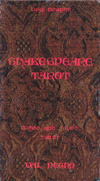
The Romeo and Juliet Tarot (Shakespeare Tarot) by Luigi Scapini
Published by: dal Negro (English/Italian)
available from Alida.
reviewed by: David Bruce Albert Jr., Ph.D. ([email protected])
An oracle is a symbolic system through which the mind of the seer connects with the unseen forces and energies of the universe, and through which the unfolding patterns of activity influenced by those forces can be discerned. This process can result in "seeing" into the future, in a deeper understanding of the present and how it came to be, or can even erupt into the spontaneous archetypal visions of prophecy or mystical experience. Whatever the result, the connection between the mind of the seer and the more cosmic superconscious energies and subtle natural forces must be forged in order for the process to work. The connection is usually made through a set of symbols that orient the mind of the seer in such a way that consciousness becomes receptive to the otherwise inaccessible energies of the "unconscious", a broad term that includes not only psychological material but also the cosmological forces to which diviners seek access. The ability to make this connection is often acquired through a combination of study and ritual concentration, involving various practices during which the aspiring seer learns to associate symbolic images with the feelings and insights produced by the action of unconscious forces upon consciousness.
This process of association can be made considerably easier if the symbolic images used to represent those associations already have meaning to the student. This is one of the functions of a mythology; myths are, among other things, collections of images and symbols that have become culturally associated with unconscious forces. Gods, goddesses, legendary heroes, monsters and fairies, according to this theory, are ready-made symbolic systems through which the mind of the individual can obtain access to the otherwise elusive cosmological and natural forces that yield visions and insights. Mythological systems such as the stories of King Arthur and the Knights of the Round Table, and the various religious or animistic pantheons of ancient peoples are often used for this purpose, and several Tarot decks have been produced that draw upon these symbolic systems. Even simple childhood fairy tales can be pressed into this service, and there are several Tarot decks that use this approach.
Another source of symbolic imagery can be found in well-known literary works, and particularly those that are deeply integrated into the common knowledge and experience of a culture. I shudder to use the word "classics," for it conjures horrid images of scolding grade-school teachers and their endless tirades against anything other than incomprehensible works by people whose names defy pronunciation, and who must have lived before the mountains were made, but it is nonetheless the correct word. A "classic" is a classic because it does indeed speak to a common imagery and symbology; it has meaning century after century because it invokes the timeless imagery of the unconscious. I sometimes think that to be understood, a "classic" must be discovered and not taught; works that I detested in school I have now come to see as invaluable records of the participation of human consciousness in the cosmos.
An excellent example of this use of literary imagery is to be found in the Romeo and Juliet Tarot, also called the Shakespeare Tarot and Tarocchi di Giulietta e Romeo, by Italian artist Lugi Scapini, published by dal Negro. I confess to being absolutely partial toward Scapini's work; he has created several decks, and they are all outstanding. Many Tarot collectors will already be familiar with Scapini's work without knowing his name: he is the artist commissioned to create the missing cards in the original Visconti deck published by U.S. Games Systems.
As is usual for del Negro's large format decks, the quality is outstanding. The deck comes in a slip case, and is accompanied by a substantial book in English and Italian that gives background on the deck and detailed descriptions of each card. The cards themselves measure 8.5 x 15cm, or about 3-1/2 x 6 inches; a smaller format version of this deck has recently been released. They have a slippery matte finish that makes them shuffle easily while not sticking to each other; you have to be a little careful in handling the deck or the cards will slide every which way, and you will be doing "78 pickup." Metallic gold and silver inks are used throughout the deck, and the brightly colored artwork set against golden tapestry-like backgrounds in the Major Arcana and court cards give the cards visual impact while maintaining a Renaissance aura similar to the Visconti decks. The Major Arcana have Roman numerals at the top and titles in Italian and English at the bottom; the numbered cards of the Minor Arcana carry no labels or numbers, while the court cards have titles in Italian and English at the bottom.
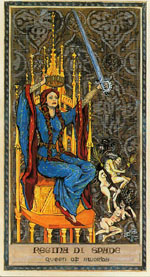
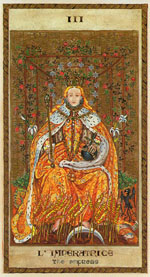
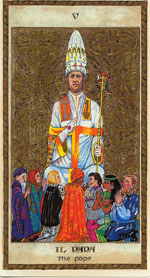
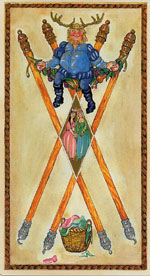
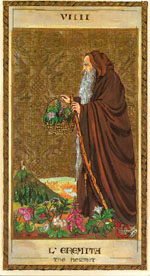
While the focus of the deck is on characters and scenes from Romeo and Juliet, characters from Shakespeare's other works make appearances, as well as historical figures from the time of Shakespeare, and from the times in which his plays are set. The Magician is none other than Shakespeare himself, and the Empress is Queen Elizabeth I, herself childless but, "... the spirit of an age of gold, intelligence fecund and fecundating..." The Hierophant is Pope Boniface VIII, so warmly regarded by Dante, at whose feet grovel the seven deadly sins represented by characters from Shakespeare's plays, while the Hermit is Friar Lawrence tending his garden. The numbered cards of the Minor Arcana are classical in design, with characters added from the plays. The Four of Wands, for example, shows Falstaff happily perched upon crossed staves while his fate is plotted; the Seven of Cups depicts the dreaminess of A Midsummer's Night. The Queen of Cups is of course Juliet herself. If you ever had any doubts about the Queen of Swords, the appearance of Lady Macbeth will lay them, as well as other things, surely to rest.
The use of Shakespearean characters and scenes allows the reader to develop a much richer set of associations than would a set of keywords. "Sacrifice" is a commonly associated meaning with the Hanged Man, yet Hamlet hanging helplessly over the dead Ophelia suggests loss and suffering through inaction more than willful or necessary abandonment. The couple appears again in Judgement, and together with Romeo and Juliet appear more to be reunited by Grace than judged for their faults. Returning to Lady Macbeth as the Queen of Swords, where Waite's Pictorial Key speaks of "Widowhood, female sadness and embarrassment, absence, sterility," and so on, the Hostess from Hell carries with her a whole train of associations with motivations, actions, and their consequences. Those associations may, in turn, lead the seer to a deeper understanding of how certain forces act in certain situations, and how patterns of behavior relate to outcomes and results.
It is an unfortunate trend in modern culture that familiarity with classical literature -- not to mention literacy itself -- are regarded as less important than skills and technical training. The thinker has become subordinate to the do-er, and education has been replaced by training; even the term "university" has been reduced to pay-for-degree programs that crank out skilled laborers that wouldn't know a "classic" if they tripped on it, and wouldn't know what to do with it in any event. Consciousness and thinking are more often regarded as obstacles to "success" than as respected abilities. This trend has only one possible endpoint. The survival of a civilization depends not upon its profitability or affluence; it is directly dependent upon its adaptability to change, and this adaptability requires mental capacities that are enlivened by reflective thought and not by skills and productivity. The society that stops thinking stops adapting, and cannot survive in the face of a changing environment.
What has happened in modern culture is that the imagery that connects consciousness with the unconscious has been replaced by mindless slogans, cliches, music that appeals to the lowest aspects of human nature, and the speech of madmen and idiots. The filth and excrement of urban culture has displaced the possibility of attaining spiritual and natural insight with mental wallowing in talk shows and rap music. At the core of this degeneracy lies the filthiest excrement of all -- the deflationary and nihilistic philosophies of materialism and determinism that have robbed humanity of its soul, and condemned individuals to live as ants and termites. No wonder depression and psychosis are so prevalent today. Human consciousness was never meant to live as a "social animal" -- the whole point of consciousness is NOT to live that way. Of course society has a "cure" for that -- endless psychobabble, much of it coming from "modern" Tarot readers, and an array of poisonous chemicals claimed to be "miracle" cures. Psychotropic medication does not "cure" anything; it chemically changes people's brains so that their behavior is acceptable to a materialist culture -- they are the chemical equivalent of a frontal lobotomy. The only things they "cure" are individuality and consciousness itself, both of which are undesirable in a materialist culture driven by profit and power.
If you don't think individuality is a disease, and if you don't think that productivity is the ultimate purpose of life, then maybe you have already read the "classics", or been otherwise infected with the disease of human consciousness. If so, you might also think that spreading this particular "disease" is a good thing. It might even be a lifesaving thing. If people are miserable without their "medication", chances are it is the society and not the individuals who are sick. The "cure" is to flush the medication down the toilet and reconnect the mind of the individual with the superconscious and natural energies from which the mind arose in the first place. This is the role of mythology, it has always been the role of classical literature (and even some non-classical writings), and it is also one function of the Tarot and other oracular systems. Which is why I hope that my reviews of these Tarot products will encourage others to study and experiment. The world, as a whole, probably can't be "saved" at this point; the destructive processes set in motion by urban industrialized culture probably cannot be reversed. But the destruction of individual consciousness can be reversed, and the imagery of the Tarot can begin that healing process through reconnecting consciousness with the unconscious energies the cards portray.