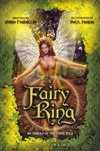
The Fairy Ring: An Oracle of the Fairy Folk, by Anna Franklin and Paul Mason
Published by: Llewellyn
reviewed by: David Bruce Albert Jr., Ph.D. ([email protected])
"When I was a boy I was a firm believer in fairies; and now as a Christian minister I believe in the possibility and also the reality of these spiritual orders... It is very certain that they exist. I have been in a state of ecstasy, and have seen spiritual beings which form these orders." -- Rev. Robert Kirk, Secret Commonwealth, quoted in W. Y. Evans-Wentz, The Fairy Faith in Celtic Countries.
What does it mean to believe in something? Does it mean that the "evidence,” whatever that might be, is so overwhelmingly in favor or against that there can be no doubt about the truth or falsity of it? No, it can't mean that, because there is always evidence that points in the opposite direction; appealing to evidence simply begs the question of what it means to be "convinced." Evidence never decides the issue; what decides the issue is how much weight you give to each particular item of evidence. Evidence winds up being justification -- what you appeal to after you have already made up your mind. Could it mean that one just knows certain things are true and false, based upon what one has already accepted as true? If one has accepted, for example, that the universe is just made up of matter, energy, and the other phenomena described by the laws of classical physics, then it follows there are no gods, no spirits, and no fairies. Unfortunately, it also follows that there are no laws of physics, because such laws are properties of objects and not objects themselves, and this theory cannot admit the existence of abstract properties that constrain the behavior of physical objects without also having to admit the existence of other abstract, immaterial entities that can have physical effects.
We have therefore eliminated the two possible explanations of belief offered by classical philosophy -- empiricism and rationalism. Neither can adequately explain why one believes certain things and not others. This is especially true with what we might call basic beliefs -- the kinds of beliefs that shape the way one looks at the world and one's own self. These beliefs are not conclusions, but rather form the premises by which experiences and ideas are judged. Beliefs about good and evil, about right and wrong, and about time and space are in this category, along with beliefs about what exists and what does not. It is this latter set of beliefs that we are concerned with here, and more specifically, with the existence of certain kinds of abstract, non-physical beings that have historically been described as fairies.
If we cannot turn to science or reason for an answer, what can we do? First, we can dismiss skepticism. The mental knee-jerk response to discredit everything that does not cohere with one's world view is not a philosophical or scientific position; it is a character defect. A person who is so insecure in his or her own viewpoint that other ideas cannot be tolerated has a psychological problem and not a valid argument. We can also dismiss objectivism -- the idea that there is a certain way the world is, and if one just comes to know that way, one is in possession of the truth. This view is rejected for the reasons stated above: neither evidence nor deduction can ever establish any conclusion without doubt. The fourteenth century healer was just as sure that depression was the result of demonic possession as the modern medic is sure that the cause is "biological" -- the arguments, evidence, and conclusions are equally valid (although unsound) for both views. To find the truth, and more specifically to find out why one believes certain things are true, it will do no good to look out in the world for an answer. You have to look inside.
The nineteenth century Danish philosopher Soren Kierkegaard did just that. What he found is that neither evidence nor reason can decide the issue, and the more important the issue is, the less helpful "objective" evidence can be. Why? Because the more important the consequences of whether what one believes is true or not, the more significant even the slightest doubt becomes. Suppose, for example, you want a certain kind of salad dressing, and you believe the bottle on the table is the kind you want. You will gather evidence -- smell it, read the label, and so forth -- and that may be enough to "convince" you to eat it. It could be something else, but if you are wrong, the consequences are only a ruined salad, and it will pass. Now suppose the results of what you believe are more important -- to use Kierkegaard's example, whether or not to believe in the existence of God. What hangs in the balance is an eternal happiness -- you go to Heaven, or you don't, based upon whether or not you believe in God, and what His characteristics might be. With this kind of outcome, any doubt at all becomes overwhelming. It is not that the evidence does not contribute to the matter; it is that evidence cannot decide it, because the consequences are so great that any incompleteness or contradiction in the evidence could have eternal consequences. What sort of doubt is there? One example is the problem of theodicy -- if God is good, and omnipotent, then why is there evil in the world? A good God would surely not allow evil if He were all powerful, so maybe He is not all good, or maybe not all powerful. However the issue is argued, it certainly casts some doubt on the nature of God, and if the consequence of believing in God being a certain way or another is the acquiring or losing of an eternal happiness, it is enough to throw the whole thing into disarray.
What Kierkegaard concluded is that evidence does not decide what one believes or one does not, and the more important the issue, the less important the evidence is. What makes the difference, in the end, is an act of will -- a commitment on your part to the truth or falsity of something, not because of the evidence, but more often than not in spite of it. When applied to religious or spiritual beliefs, this act of will is called the leap of faith, although this same kind of willed commitment applies to other kinds of belief as well. Consider the way you look at time: perhaps you believe that time is linear, meaning it has a beginning and an end, and time always progresses in one direction, from past to present to future. Not everyone looks at it that way; many ancient philosophies, and those who adhere to them today, look at time as recurrent or even as a relativistic phenomenon that simply relates movements of objects to one another. So, why do you think of time the way you do? For many, it is simply accepted in a certain way because of social convention, without ever having been seriously questioned. For others, it comes from having accepted a certain religious doctrine, "In the beginning . . . ,” again without serious examination. It is something you have accepted, which, on our argument above, means that it is something you have, whether consciously or not, chosen or willed to believe.
Belief is not something that happens to you; it is something you choose to do. This thesis, known as voluntarism, is further developed by William James in his essays The Will to Believe and The Sentiment of Rationality. To carry these arguments just a bit further, truth is not something you stumble upon, but instead is a willed act that to some extent defines who you are as an individual. Kierkegaard makes the remarkable statement that one cannot find the truth; one must become the truth. That's a very odd statement, for where we might have thought that truth is something that is discovered through reason and experience, it now appears that it is something one becomes through the willed act of faith. If that were not a shocking enough revelation, what it means is that when one commits to the truth of something, one essentially becomes a part of the thing one believes, and it becomes a part of the believer. To accept something as true is to become a participant in the world defined by that truth.
So now, finally, we arrive at the point of this discussion: To embrace a belief in a metaphysical system is to become a part of that system. For the Christian, to embrace the truth of God by an act of will is to come into communion with God. And to believe in the world of the fairy is to become a part of that world, and for that world to become a part of you. Who and what you are as a person is to some extent defined by the things you have accepted as true, and by the worlds -- or realities, if you wish -- in which you participate by reason of your having committed to their truth. The person who has not committed to the truths of quantum physics and chaos physics cannot and does not participate in the worlds they describe, and the person who steadfastly believes that fairies and spirits do not exist has little chance of meeting them.
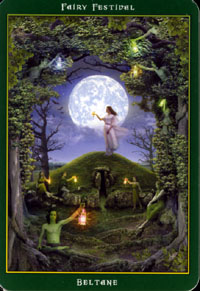
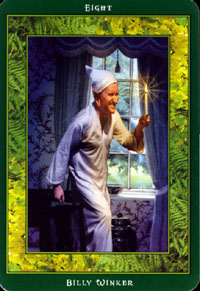
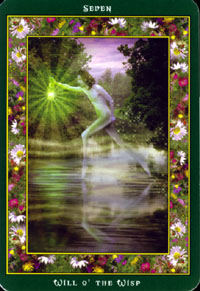
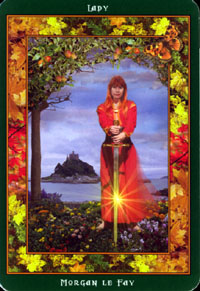
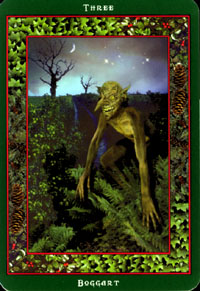
But to the person who does believe in these things -- and the world of quantum physics and the world of the fairy may have more in common than you at first think -- The Fairy Ring by Anna Franklin and Paul Mason opens the gateway to the strange and interesting world of the little people that populate Celtic mythology and folklore. Using a style combining photographic and computer imagery similar to that of the Sacred Circle Tarot, the authors bring the ancient lore to life in a way that is both artistically beautiful and unconsciously stimulating. Here are the images of childhood stories that stir memories of the emergence of individual consciousness, along with representations of things that lie in the collective unconscious, perhaps recalling the emergence of consciousness itself out of its bicameral minded precursors.
The deck itself is not a Tarot deck, although there are some superficial resemblances. There are 8 cards representing the fire and cross-quarter festivals, bringing to mind the cosmic forces that underlie all physical and spiritual manifestations, and their interplays of energy and change. The remaining cards are divided into four suits of nine numbered cards and four court cards each, with each suit dedicated to one of the four seasons. The cards are of high quality, and are smaller than the Sacred Circle, which should make them easier to shuffle for those who have trouble with large format cards. The backs have a golden double circle design against a green background, and are reversible. Several additional cards are included that illustrate suggested layouts. Like the Sacred Circle, the set includes a substantial book that holds a wealth of information on the history and lore of the fairies, as well as suggestions for reading the cards and detailed information on each card and the fairy it illustrates.
There is an important difference between this oracle and the Tarot. While the Tarot is an excellent representation of superconscious energies and their relationship to consciousness, it all but ignores the unconscious forces of nature that played a crucial role in the emergence of human consciousness, and continue to permeate all aspects of life and thought today. The lives of modern humanity's ancestors were shaped by the events and forces of nature around them. The ancient rituals of the seasons, the practices of magic, and eventually the evolution of nature gods and goddesses all spring from this intimate connection between consciousness and nature, and the participation mystique that linked the human mind to the world around it.
And it is here that we reach a critical juncture, for it is through this mystic participation that human consciousness itself arose, and arose as a part of nature and the world around it, and not apart from them. While we often associate consciousness with spirituality, superconscious energies and the archetypes through which they appear, it is only because of the mind's participation in the forces of nature that consciousness exists at all, and is able to apprehend the "spiritual" energies. The "spiritual" energies are really only amplifications of the more subtle natural forces, just as the forces at work in the supermassive black holes that lie at galactic cores are amplifications of the more subtle energies at work in the atoms of your own body.
The problem here is that the technology of modern culture has isolated humanity from the natural forces out of which its consciousness arose, and deprived the mind of its participation in nature. Gone, for the most part, are the cyclical variations of the seasons and their effects on human activity, replaced by controlled environments and concrete jungles. The result of this isolation is that human consciousness is no longer sustained by the natural forces of its origins, and consequently has also become isolated from the spiritual energies that drew consciousness up from its insect-like precursors. The substitution of the urban environment for the natural world has led the human mind on a downward path from consciousness toward unconscious bicamerality, a mental condition in which the mind of the individual is replaced by a socially constructed and controlled pattern of thought and behavior. While to some this might seem like a good thing, the fate of bicameralized civilizations has, without exception, been annihilation and extinction. The bicameral mind is incapable of adaptation to environmental changes (and intellectual changes as well), and life in a probabilistic universe is subject to the very changes that exterminated the bicameral civilizations of ancient (and modern) times. You can read more about this theory in my Spontaneous Human Consciousness, available elsewhere on this web site. What is important here is that consciousness isolated from the forces of nature is in peril of disintegration, even when it aspires to "spirituality" or wallows in technology.
While superconscious energies have historically been understood by consciousness as gods, goddesses, and similar phenomena, the more subtle energies of nature are more often seen in the guise of fairies, or felt in places and circumstances where the natural forces themselves are manifest - wells, mountains, groves, during storms, and so on. The bicameral mind sees nothing in these, and often seeks to destroy them, but consciousness feeds on their energies and draws on their powers. What we have in The Fairy Ring is an illustrated compendium of those forces, and the images through which they are often seen.
It should therefore not be surprising that The Fairy Ring, as an oracle, yields very different results from the more abstract Tarot. It has much more in common with the Oghams and rune stones, being an oracle of natural forces and their effects on consciousness. Of course it could be argued that in some sense nature, mental, and spiritual energies are simply different reflections of the same thing; whether this is true or not, the dynamics through which those energies manifest often carry different meanings according to how they appear to consciousness. Oracles that deal in nature energies tell you different things than oracles that deal in archetypes, and, in turn, invoke different kinds of mental energies -- energies that may appear quite unusual and foreign in a culture permeated by technology and media babble.
But the oracle will tell you nothing, if you choose not to believe it. You only participate in the world of the fairy, if you make a conscious commitment to do so. When I was in graduate school, I heard the constant refrain from philosophy professors that they couldn't understand modern physics, and refused to think about its meaning and implications. What this means is that their ideas are comically and tragically irrelevant to the world as it is understood by cosmologists and theoreticians. As it turns out, the world described by theoretical physics has a great deal in common with the world of magic and mystery, and the world of chaos and uncertainty is much more like the world of the fairy than it is like the world of the materialist and the mechanist. Concepts like participation and action at a distance ring true with the knowledge of the ancients, and likewise, the understanding of ancient beliefs such as magic has been greatly enhanced by what has been learned in the theoretical sciences.
As Kierkegaard said, to find the truth, you must become the truth. All of this is lost if you shut your mind to it. Perhaps even humanity itself is lost, if the mind is shut to the influences of nature and spirit. If, on the other hand, you make the effort to understand those things that appear strange and even "hard" at first, you take the first step toward becoming the truth that is both the knowledge of the ancients and the ideas of today. The only way to know the fairy is to become a participant in its world, a world that could lead away from the destruction toward which urban civilization is inevitably headed, and a world that could lead toward the unknowable future that is the fulfillment of human consciousness.