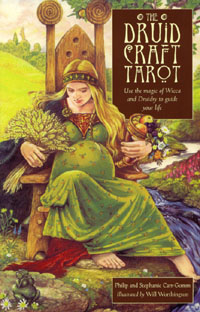
The DruidCraft Tarot
by Philip and Stephanie Carr-Gomm
illustrated by Will Worthington
published by St. Martin’s Press
reviewed by David Bruce Albert Jr., PhD, [email protected]
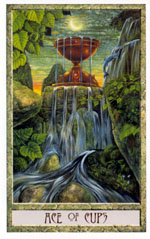
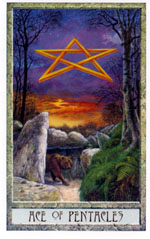
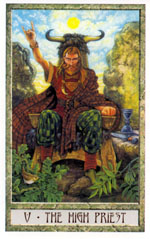
The DruidCraft Tarot is one of the most recent additions to the lineup of Celtic themed Tarot and related divination products. This is a card and book set, that comes in a large and colorfully illustrated cardboard box. Unlike many of the available Celtic divination decks, the DruidCraft retains the traditional design of the Tarot, while adding its own artistic variations and interpretations.
A number of the deck’s features immediately suggest a comparison to the Sacred Circle Tarot by Anna Franklin and Paul Mason, reviewed elsewhere on this site. First is the size – this is a large format deck, the cards being about 9x14cm, or about ¼” wider and ½” taller than the Sacred Circle. The backs, which remind me of gold embossed leather, are not reversible -- a feature which I love hearing Tarot reviewers whine about – although you would have to look very carefully at the small knot work design to see the difference. There are some similarities in the design of the individual cards; that’s not too surprising, as the authors credit the Sacred Circle Tarot, along with several others, in their “Sources of Inspiration” on pg. 8 of the book.
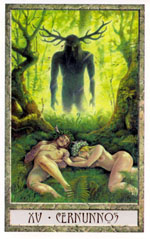
But there are important differences between the decks, differences that make them completely different projects, even though both are based upon Celtic tradition and lore. I won’t say the DruidCraft is a Rider-Waite “clone,” but the imagery is certainly in the Rider-Waite lineage. The deck has the familiar structure of 22 Major Arcana, and Minor Arcana suits of wands, cups, swords and pentacles. The reason it isn’t a clone is that a number of changes in symbolism, and in some cases meaning, have been made to correspond to Celtic lore instead of Golden Dawn tradition. For example, one of my favorite cards is XV Cernunnos; while in Celtic themed decks it is common to substitute the god of the forest for the traditional Devil, there is a fundamental difference in both imagery and meaning introduced in the DruidCraft. Here, the figure of the Horned God stands vigil over a pair of sleeping (or exhausted) lovers, and we read in the accompanying book:
“Calling the figure represented by this card The Devil, though, suggests that the forces he represents are evil. We have renamed the card Cernunnos, after the horned god of fertility, because in Druidry and Wicca the powers of the animal, instinctual, sexual and material worlds are not considered evil. In fact, they represent the very forces which govern life on earth in all its abundance. However, it is undeniable that many human beings find it hard to accept, mediate and utilize these forces in responsible ways – hence the rape of the biosphere, and the rape and abuse of human beings. Some people believe Paganism to be immoral, when in fact Witches and Druids work to develop a powerful sense of social and environmental justice…” (pg. 147)
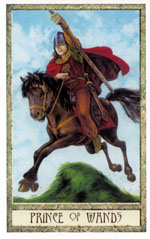
The court cards in this deck are King, Queen, Prince and Princess. This leaves me a little high and dry, as I am used to the Knight, Queen, King/Prince, and Princess arrangement. In this arrangement, I read Knights as “Doer” or “Crusader”, and Kings as “Protector” or “Guardian” (with, for the sake of completeness, Queens as “Seer” or “Vision” and Princesses as “Teacher” or “Deliverer”), so the Knights really can’t be dumped from their positions. However, the Princes in this deck do show a knightly figure on a horse, so if you are used to the Thoth type arrangement, you can just ignore the title on the Prince card and read merrily along.
This deck is one case where I must enthusiastically recommend the book as much as the cards. There are the usual keywords and meanings with an all too psychological gabbiness, but there are also more abstract and mythological discussions that lead the reader away from the mother-in-law’s criticism aspect of most decks, toward a deeper understanding of the ancient tradition and lore depicted in the images. While there are many divergences of opinion between the ideas in the DruidCraft and the Sacred Circle, as well as many areas with which I disagree, one should not be surprised to find these differences when dealing with an unwritten tradition that is thousands of years old. Agreement and disagreement are, after all, not the point – what matters is the wisdom in each individual that is inspired by the lore and tradition, and this card and book set is a fountain of wisdom and inspiration.
Nonetheless, there are points of general disagreement I have with this deck that should be mentioned for the sake of honesty and completeness. First, we are told that the name DruidCraft was chosen to indicate that this deck reflects a fusion of “two powerful streams of magical spirituality – Wicca and Druidry.” (pg. 7) Only problem is, we are never told exactly what either Wicca or Druidry are. One could, I suppose, read Gerald Gardner’s Witchcraft Today, and Ross Nichols’ Book of Druidry, to get an idea of what the founders of modern Wicca and Druidry thought and intended. But even that has little to do with what either of those traditions, or the various ways they have been combined and differentiated, have developed (or in many cases, degenerated) into. Other sources are suggested that may shed some light on these topics, but it would have been more convenient if the authors had addressed this, even if only briefly. Most people who buy this deck will probably have their own ideas about what these two traditions are, but those ideas may or may not cohere with what the authors mean, which may lead to some mis-interpretations of the symbology in the deck.
My most serious gripe with this deck is, as with many “Celtic” decks, the attempt to combine Western tradition with the imagery and teachings of the Golden Dawn. The GD, whose members themselves may have studied and practiced in many traditions, is nonetheless founded upon Masonic and Cabalistic systems that have their origins and doctrinal bases in a different part of the world than where Wicca and Druidry emerged. The discussion above, concerning the XV Devil/Cernunnos card, serves as a good example of how Western and Middle Eastern traditions differ. While the Celts had their Cernunnos and the Greeks had their Pan, the Middle East had only its Devil, and what they represent, morally, spiritually, and philosophically, is incommensurably opposed. That’s just the tip of the iceberg; the entire project of trying to visualize Celtic, Druidic and Wiccan tradition in imagery based upon Middle Eastern belief systems is shot through with problems from beginning to end. The authors claim that, “[the GD] succeeded in synthesizing many of the disparate strands of the Western Magical Tradition.” No, I really don’t think so; concepts like stoning women to death go about as well with Celtic tradition as whipped beets go with Bosco, and the entire moral attitude and spiritual tradition of the Middle East mixes with Wicca and Druidry about as well, or have we forgotten, “Thou shalt not suffer a Witch to live?”
I will grant this much: many of the ideas developed in the GD, and by members and successors to the GD such as Aleister Crowley, have contributed a great deal to the way magic and spirituality in the Western traditions are understood. As the authors state, “A quantum leap in the understanding and appreciation of the Tarot occurred thanks to the stimulus of the Golden Dawn,” (pg. 8) and that is undeniably true. The whole idea of a Tarot deck illustrated with either symbolic or descriptive images certainly took a great leap forward with the Rider-Waite and Crowley Thoth decks, both of which are products of members of the GD. But let us be very careful to look before we leap; let us always bear in mind that the gods, beliefs, and spiritual, social and moral traditions of the Middle East from which the underlying magical and spiritual systems of the GD emerged are not those of either Wicca or Druidry, any more than the god that orders eyes plucked out and women stoned to death is the horned lord of the ancient forest.
Yes, we learned a lot about how to do rituals, magic and divination from the GD, but let us apply that knowledge to our own beliefs, rather than copying it without thought or reflection. Let us not, in so doing, substitute the beliefs of the GD and its spiritual roots for those of our own traditions. It ought to be funny, but is really tragic and sad, to hear “Celtic” ceremonies begin with the invocation of Old Testament angels. Some might say that in “learning” from the GD, we lost too much of our own traditions in the bargain. I’m not so sure. I am a student of Crowley’s work, and there is much there that is of value to any tradition or belief system. Crowley himself drew upon many traditions and systems, even as I find myself, in my studies of the philosophy of consciousness, increasingly drawn toward Eastern systems, for the simple reason that most Western systems just don’t deal with the subject, or don’t have anything philosophically sophisticated to say about it.
If we keep in mind that it is possible to learn from other traditions without abandoning our own, and at the same time we are careful not to substitute those traditions for our own -- if we don’t slide from burning wicker men to burning witches – then trying to develop a Wiccanized or Druidized Rider-Waite deck could be enlightening, provided it is well thought out and executed. The authors of the DruidCraft Tarot have probably done the best job of this to date, without altering the basic structure of the deck itself. The advantage to this approach is that it makes it easier for those who are familiar with the Tarot via decks in the GD lineage to adjust to the different symbology and interpretive framework of the Western traditions.
For the newcomer to either the Tarot or the study of Wiccan and Druidic tradition, this deck is probably the best resource available. The beautifully illustrated cards bring the text of the very well written book to life, and at the same time stimulate one to think beyond keywords and meanings, into the traditions from which they emerged. For those experienced with the Tarot, this deck opens a new dimension of meaning and interpretation that many, and particularly those who work in Wiccan and/or Druidic traditions, may feel is more inviting than those based on other systems.
If you are interested in what happens when black holes in distant quasars collide, and how those energies vibrate through the Entelechy of Universal Consciousness, resonating in archetypal imagery that suggests patterns of unfolding events in which your own consciousness is a fractal participant, you may find this deck a bit on the shallow side. I am interested in that sort of thing, and I find most decks, other than the Crowley Thoth and the Sacred Circle, to be on the shallow side. These decks have the symbolic complexity and interpretive agility to study metaphysical and philosophical questions, but those very qualities also may make them a little difficult for the beginner to approach. To that list should also be added the Gilded Tarot which, although similar to the Rider-Waite and therefore a little easier to learn, has the artistic depth necessary to make it useful for philosophical interpretation. On the other hand, if you are interested in being told why you aren’t good enough for so-and-so to fall in love with you, or which jar you should bury your life savings of pennies in this week, you might find this deck over your head, along with pretty much anything taller than an ant.
However, if you are interested in learning about the ancient Druidic lore, how that lore relates to your own situation, and what advice it has to offer, then the DruidCraft Tarot is one of the best resources available. The only deck that has much in common with it is the Sacred Circle, and of the two, the DruidCraft is probably the easier for the beginner to learn because of its fully illustrated Minor Arcana. Though clearly cast in the Rider-Waite lineage, the artwork is extraordinarily beautiful, and the book is well written and very helpful in learning the lore and how it applies to the cards.