 Return to top
 Return to Physiology
Download a copy of this study guide
| ITEM | NORMAL VALUE | COMMENTS |
General Stuff | ||
| Pleural Pressure:
Beginning of Inspiration (At Functional Residual Capacity) |
-5 cm H2O | 5 cm H2O less than atmospheric pressure |
| Pleural Pressure:
End of Inspiration |
-8 cm H2O | With normal inspiration, the change in pleural pressure is very small. |
| Total Alveolar Surface Area for Gas Exchange | 75 m2 | |
| Normal alveolar diffusion barrier | 1 micron | |
Airway Resistance and Flow | ||
| Overall Airway Resistance | 0.5 - 1.5 cm H2O / mL / sec | 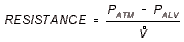 |
| Fraction of Vital Capacity in
the First second of a forced
maximal exhalation
(FEV1 / FVC) |
70% - 80% | The FVC test is used to measure airway resistance. Subnormal value indicates COPD. |
Gas Exchange | ||
| Atmospheric PO2 | 21% of 760 mm Hg
160 mm Hg |
|
| Inspired PO2
PIO2 |
= (21%) x (747 - 47
mm Hg)
= 147 mm Hg |
Air becomes saturated with water
which has partial pressure of 47 mm
Hg.
Thus we take the PO2 of dry air = (21%)(700) |
| Inspired PCO2
PICO2 |
Virtually 0 | Atmospheric air contains virtually no CO2 |
| Alveolar PO2
PAO2 |
100 mm Hg | O2 has gone down from 147 mm Hg because some O2 moves to the blood. |
| Alveolar PCO2
PACO2 |
40 mm Hg | This is the amount of CO2 that enters alveoli from blood in a healthy lung. |
| Mixed Venous PO2
PVO2 |
40 mm Hg | 40 torr is the standard O2 concentration of mixed venous blood, as determined by how much O2 the tissues need. |
| Mixed Venous PCO2
PVCO2 |
46 mm Hg | The CO2 gradient for gas transport is only 6 mm Hg -- difference between 46 and 40. |
| Arterial PO2
PaO2 |
90 - 95 mm Hg | It is slightly less than PAO2 due to contribution of venous admixture. |
| Arterial PCO2
PaCO2 |
40 mm Hg | It is virtually the same as PACO2 but theoretically higher due to venous admixture. |
Dead Space | ||
| Tidal Volume | 450 - 500 mL | Volume of air during normal inspiration |
| Anatomical Dead Space | 150 mL | The individual's weight in lbs = anatomical dead space in mL |
| VD / VE Ratio
Ratio of dead space to expired air |
0.2 to 0.3, i.e. 20% -
30% of expired air is
dead space.
When VD/VE ------> 0.6, patients are put on a ventilator. |
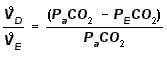 High dead space occurs with pulmonary embolism, and with low VA/Q
ratios. High dead space occurs with pulmonary embolism, and with low VA/Q
ratios. |
| Respiratory Quotient
VCO2 / VO2 |
0.8
We exchange about 80% as much CO2 as O2 with each inspiration |
The reciprocal is 1.2, the fudge-factor for the alveolar ventilation equation. |
Gas Transport and Acid-Base Balance | ||
| Plasma Solubility Coefficient of O2 (SO2) | 0.003 mL O2 / dL
plasma, or
0.003 Vol-% |
|
| Plasma Solubility Coefficient of CO2 (SCO2) | 0.03 mL CO2 / dL
plasma, or
0.03 Vol-% |
CO2(g) is thus 10x more soluble than O2(g) |
| O2 Carrying-Capacity of Hemoglobin | 1.34 mL O2 / g Hb
One gram of Hb holds 1.34 mL of O2. |
Thus:
Maximum HbO2 = (Hematocrit)(1.34) |
| Hematocrit | 15 g Hb / dL blood | |
| HbO2
Normal O2-Carrying Capacity of hemoglobin |
20 vol-% | (Hematocrit)(1.34) =
(15 g Hb / dL)(1.34) = 20 mL O2 / dL |
| Arterial Hb-Saturation
Arterial PaO2 (Oxygen partial pressure) Arterial CaO2 (Oxygen Content) |
100% saturation
PaO2 = 100 mm Hg CaO2 = 20 mL / dL |
Arterial:
100% saturation ------> 100 mm Hg ------> 20 mL / dL O2 content |
| Venous Hb-Saturation
Venous PvO2 (Oxygen partial pressure) Venous CvO2 (Oxygen content) |
75% saturation
PVO2 = 40 mm Hg CvO2 = 15 mL / dL |
Venous:
75% saturation ------> 40 mm Hg ------> 15 mL / dL O2 content |
| P50 | 50% saturation
P50 = 26 mm Hg |
P50 is the PO2 required to achieve 50% hemoglobin saturation |
| Normal plasma HCO3- | 24 mM | |
| Normal blood pH | 7.4 | A 0.1 decrease in pH corresponds to a 1 mM increase in HCO3-, in healthy, uncompensated hypoventilation. |
Ventilation / Perfusion of the Lung | ||
| VA/Q Ratio, Lung Apex (Top) | 3.0 | Apex of lung gets less ventilation and less perfusion, but perfusion is substantially less than at base. |
| VA/Q Ratio, Lung Base (Bottom) | 0.5 - 0.6 | Base of lung gets greater perfusion and ventilation, but perfusion is substantially greater than at apex. |
| VA/Q Ratio, Overall | 1.0 | Overall ventilation / overal perfusion 1 |
| Overall Perfusion of Lung | 5.0 - 6.0 L / min | That is, overall lung perfusion = Cardiac Output |
| Overall Ventilation of Lung | 5.0 - 6.0 L / min | This is equal to (respiratory rate) x (tidal volume) |
PNEUMOTHORAX: A knife wound will equilibrate the pressure between the pleura and lung, making the chest expand and the lungs collapse.
NEGATIVE PRESSURE BREATHING: Lung pressures are usually measured in cm H2O because they are relatively low pressures, and cm H2O is a smaller quantity than mm Hg.
PRESSURE AND FLOW:
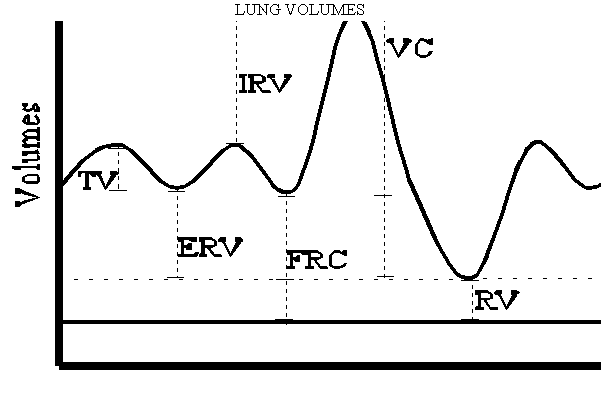
LUNG VOLUMES:
STATIC PRESSURE-VOLUME CURVE: A pressure-volume curve of the lung, where each point is measured when there is no airflow. This implies that the total pressure at that instant is equal to the transpulmonary pressure since there is no pressure gradient for airflow.
COMPLIANCE: DeltaV / DeltaP, the slope of the Static Pressure Volume Curve. In other words, it is the slope of a P/V curve when there is no airflow and the pressure thus represents transpulmonary pressure.
AIRWAY RESISTANCE: 
BRONCHIAL SMOOTH MUSCLE: Autonomic control of airway resistance.
CHRONIC OBSTRUCTIVE PULMONARY DISEASE (COPD): Various pathologies will all lead to the common symptoms of COPD, which is caused by chronic increased airway resistance.
DYNAMIC Pressure-Volume Curve:
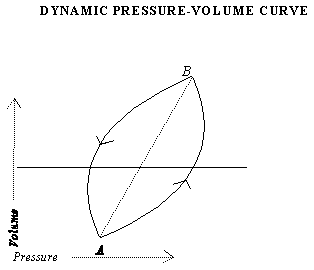 The slope of the line AB is overall lung compliance.
VENOUS ADMIXTURE: The pulmonary capillary (freshly oxygenated) blood leaving the lungs, combined with venous blood that did not perfuse the lungs.
EXERCISE:
PHYSIOLOGICAL DEAD SPACE = ANATOMICAL DEAD SPACE + ALVEOLAR DEAD SPACE. Dead space is defined as inspired air that is not perfused by blood and thus "waisted" because it does not contribute to gas exchange.
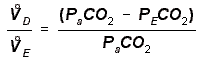
ALVEOLAR VENTILATION:
PULMONARY DIFFUSION: 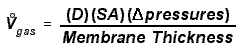
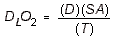 , and VO2 then becomes
Thus: 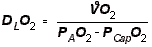
Thus we can measure DLO2 in terms of DLCO: 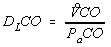
OXYGEN TRANSPORT:
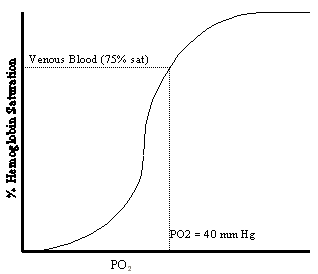 Hematocrit = Hemoglobin concentration of blood (g Hb / dL
blood)
Hematocrit = Hemoglobin concentration of blood (g Hb / dL
blood)From above two equations:


CARBON DIOXIDE TRANSPORT:
ACID-BASE BALANCE: Blood pH is determined by the HCO3- : CO2 ratio, according to a derivation
of the Henderson Hasselbach Equation: 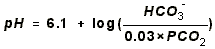
ACID-BASE IMBALANCES:
VENTILATION / PERFUSION BALANCE:
REGULATION OF RESPIRATION: