 Return to Physiology
BODY FLUIDS and ELECTROPHYSIOLOGY
Download a copy of this study guide
 Return to top
BODY FLUIDS
Distribution of Body Fluids:
- TOTAL BODY WATER: About 57%, in liters, of body weight in kilograms. Or 72% of lean
mass.
- EXTRACELLULAR: About 40% of total body water.
- PLASMA: About 22.5% of extracellular water.
- ECS: The remaining portion of extracellular fluids.
- INTRACELLULAR: About 60% of total body water.
- OBESITY lowers your total body water, because you have a smaller lean mass.
INDICATOR DILUTION METHOD: Volume = Amount / Concentration. A way to measure the
volume of body fluid compartments, by measuring concentration of an administered indicator at some
time after administration.
- We want to know the concentration that would have been measured, if the indicator had been
distributed instantaneously. Therefore we extrapolate the linear part of the curve back to time
zero.
- TOTAL BODY WATER?
- Tritiated Water. You have to use the extrapolation method to measure, though, as it takes
a long time for tritiated water to distribute to all body compartments.
- If you use 3H2O, it takes a long time get results.
- Radiosulfate: It will distribute into the extracellular space within an hour, so it is quicker.
It can also be used to measure plasma volume.
- EXTRACELLULAR VOLUME?
- Large molecules like inulin and mannitol tend to stay in the plasma, while small ions tend
to get into the intracellular spaces.
- Mannitol is the best indicator we have for ECS, and was used in one of the problems.
- Radiosulfate is used to determine extracellular volume.
- TRANSCELLULAR WATER? These are special body compartments, separate from ICS,
ECS, and plasma.
- EXAMPLES:
- Cerebrospinal Fluid
- Fluid in the GI Tract
- Bladder
- Intraocular Fluids
- Fluid in potential spaces (pathological) such as the pericardial or pleural sacs.
- This volume of fluid is small and is not normally considered in measurements, but should
be kept in mind, especially in cases of pathology.
- PLASMA VOLUME?
- Evans Blue Dye: It binds to serum proteins in bloodstream as soon as it is injected.
- Radioiodinated Serum Albumin (RISA): RISA is also a large protein that stays in the
bloodstream.
- INTRACELLULAR VOLUME?
- Cannot be measured by any direct method, but can be determined by elimination.
OSMOTIC PRESSURE: The amount of hydrostatic pressure necessary to exactly counter a
concentration gradient. It is directly proportional to the concentration of a fluid.
PI = R T (Total Solute Concentration)
(mm Hg) = (19.3) (Total Solute Concentration)
DeltaPI = (19.3) Delta(Solute Conc)
- Water flows from solution of low osmotic pressure to high osmotic pressure.
TONICITY -VS- OSMOLARITY:
- OSMOLARITY: Refers specifically to the concentration of all impermeable particles across a
membrane.
- ISOOSMOLAR: A 300 mOsm solution is the same as normal body osmolarity, both
intracellularly and extracellularly.
- HYPER / HYPO OSMOLAR: Having higher or lower concentration of impermeable solutes
across a membrane.
- TONICITY: Refers specifically to the movement of water into or out of a cell.
- HYPERTONIC CELL: Having a higher osmolarity inside, such that water will come in
the cell and the cell will swell.
- HYPOTONIC CELL: Having a lower osmolarity inside, such that water will leave the cell
and the cell will shrink.
- If you put a cell in a HYPERTONIC SOLUTION, it's the opposite -- water will leave the
cell and the cell will shrink.
- If you put a cell in a HYPOTONIC SOLUTION, water will come in and the cell will swell
up.
SHIFTS OF BODY WATER:
- If you add an ISOTONIC solution to the body, all (most) the water will remain in the extracellular
spaces, as you have not changed the concentration gradient and there will be no net movement
of water after addition of the new fluid.
- Add a HYPOTONIC solution, and water will move into the intracellular spaces.
- Add a HYPERTONIC solution, and you will draw additional water out of the intracellular spaces
into the extracellular space.
- Principles:
- Over the whole body, water moves rapidly to equilibrate any osmolarity difference between
extracellular and intracellular spaces.
- Unless solute is added or removed, the amount (but not necessarily concentration) of solute
in a compartment remains constant.
- Sodium and Chloride are confined to the extracellular space.
- In an equilibrated system, the movement of water will follow the movement of solute into
or out of cells.
- At equilibrium, pure water is distributed to body compartment according to the total solute
content in each compartment.
- So, if we have 50% of all impermeable solutes in the extracellular spaces and 50% in the
intracellular spaces. Then 50% of total volume after addition will be in each respective
space after equilibrium.
COMMON ION CONCENTRATIONS:
| ION |
Intracellular Conc |
Extracellular Conc |
| K+ |
140 mOsm -- high |
4 mOsm -- low |
| Na+ |
10 mOsm -- low |
145 mOsm -- high |
| Cl- |
4 mOsm -- low |
105 mOsm |
| Ca+2 |
Virtually zero |
2.5 mOsm -- pretty low |
EQUIVALENTS: Moles of charge. 1 Molar solution of Ca+2 = 2 equivalents of Calcium.
MEMBRANE PERMEABILITY:
- Small ions (Na+ and K+) have very limited permeability through the membrane directly, i.e.
through small, transient, water-filled holes in the membrane. They are not completely impermeable.
- DIFFUSION: Movement of a substance with its concentration gradient, due to random thermal
motion over time.
- FLUX = the amount of solute that crosses a given area in a given amount of time, in millimoles
/cm2sec.
- The flux is proportional to, and has the opposite sign of, the electrochemical gradient.
- Fick Diffusion Equation: For a non-electrolyte, J = -P DeltaC = -(Permeability)
(Concentration Gradient).
- So, flux is proportional to the permeability of a substance through the membrane, and the
concentration gradient.
- THICKER MEMBRANE ------> Greater Area ------> Lower Permeability ------>
Lower Flux ------> Lower Concentration Gradient
FACILITATED DIFFUSION: Properties
- No energy required
- With concentration gradient
- There is a saturation point, when all channels are occupied
- Competition among solutes. You can slow down glucose flux by adding galactose to the system
(assuming galactose can get through it).
SECONDARY ACTIVE TRANSPORT:
- The Na/K ATPAse creates the concentration gradient: three Na out for every two K in.
- The Na gradient thus created, there is a Na/Glucose symport into the cell, to transport glucose
into the cell, against glucose's concentration gradient.
CHOLERA: Patient treated with glucose and sodium chloride in water. This allows patient to absorb
water along with the glucose and sodium.
RENAL GLYCOSURIA: Excretion of some glucose into urine, due to a defective (lower saturation
point) Na/Glucose symport in the kidneys.
Na/K ATPase PUMP MECHANISM:
- WITH PHOSPHATE BOUND (not ATP)
- The port is open to the outside.
- We have 2 high affinity K-binding sites.
- We have 3 low affinity Na-binding sites.
- Potassium binds outside
- DEPHOSPHORYLATION ------> OUTER GATE closes.
- ATP BINDS to the inside
- INNER GATE opens.
- In this conformation, the K-binding sites become low-affinity, so K lets go.
- The three Na binding sites are high affinity, so Na latches on.
- Binding of Na+ to the inside promotes ATP hydrolysis.
- INNER GATE closes, and we start over.
OUABAIN: A cardiac glycoside that inhibits the sodium pump. Ouabain is used to treat "cardiac
insufficiency."
- It blocks the Na+ pump ------> Na+ levels of inside of cell go up ------> More becomes
available for the Na+/Ca+2 Pump ------> Intracellular levels of Ca+2 go up as a result ------>
Cardiac muscle contractility increases
CELL VOLUME REGULATION: In the absence of active transport, cells tend to swell, due to
impermeable solutes in the cell.
- The Sodium pump makes sodium behave as though it were an impermeable solute, as it
constantly restores any small amounts of Na+ that leak into the cell. This effect is important to
maintain fluid / volume homeostasis.
Return to top
ELECTROPHYSIOLOGY
NERNST EQUATION: The chemical gradient of an ion, expressed in volts:
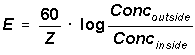
E = The Nernst Potential (Volts)
Z = The Charge of the ion
Conc = Concentration of the ion (Molarity) inside and outside the membrane.
NERNST (CHEMICAL) POTENTIAL: An ions chemical potential. The energy an ion would
generate if it alone moved across the membrane with its concentration gradient.
- K+ has a negative Nernst Potential (-90mV). It would generate a relative negative charge on
the inside if it moved across the membrane.
- Positive charge would leave the cell.
- Na+ has a positive Nernst Potential (+40mV). It would generate a relative positive charge on
the inside if it moved across the membrane.
- Positive charge would enter the cell.
- Cl- has a relative negative Nernst Potential. It would generate a relative negative charge on
the inside if it moved across the membrane.
- Negative charge would enter the cell.
ELECTRICAL POTENTIAL: The energy an ion would create if it moved with its electrical gradient.
This is dependent on the volt potential of the membrane.
- A positive volt potential means there is more positive charge on the inside of the membrane.
- This would make positive ions want to leave the cell.
- This would make negative ions want to enter the cell.
- A negative volt potential means there is a negative charge on the inside of the membrane.
- This would make positive ions want to enter the cell.
- This would make negative ions want to leave the cell.
ELECTROCHEMICAL POTENTIAL: DeltaE = V - E = (Membrane Potential) - (Chemical
Potential)
- Electrochemical Potential:
- Positive: There is relative positive electrochemical force on the inside, so positive charge
wants to move outward.
- Negative: There is relative negative electrochemical force on the inside, so positive charge
wants to move inward.
- Membrane Potential: The relative difference in charge on both sides of the membrane.
- Positive: There is positive charge on the inside, so positive charge wants to move outward.
- Negative: There is negative charge on the inside, so positive charge wants to move inward.
- Chemical Potential: The membrane potential that would be created if an ion were to move with
its concentration gradient.
- Positive: Positive charge would move inside to go with its concentration gradient, as that
would create a positive electric potential.
- Negative: Positive charge would move outside to go with its concentration gradient, as that
would create a negative electric potential.
IONIC CURRENT: Amperes = Coulombs / Second
- The sign of the current follows the electrochemical energy.
- Positive current = positive charge is moving out of the cell.
- Negative current = positive charge is moving into the cell.
- From Ohm's Law, V = IR, we derive: I = gDeltaV = g(V - E)
- g = Conductance
- Conductance is proportional to the number of channels open.
- = 1 / resistance
- DeltaV = V - E
- = Electrochemical Potential
- Conductance: Depends on ion permeability. The more permeable an ion, the higher its
conductance. When membrane channels open, conductance goes way up.
- Conductance is also dependent on concentration. The higher the concentration gradient,
the higher the conductance.
- Conductance is measured in Siemens = 1 / resistance.
- General range of conductance for 1 channel is 2-100 picosiemens (10-12 siemens)
VOLT-CURRENT RELATIONSHIPS: Plot of voltage -vs- current for each type of ion. The X-Axis
is voltage and the Y-Axis is current.
- Zero-current, i.e. when the line crosses the X-Axis, occurs at the Nernst Potential for the ion.
That is, when there is no current, the net voltage is equal to the Nernst Potential, DeltaE = 0 -
E = E
- Conductance is proportional to the slope of the ion-current relationship.
- The higher the conductance, the steeper the slope.
- Conductance is dependent on the permeability of the membrane -- i.e. on the number of
open channels for the particular ion.
- CURRENT:
- POSITIVE CURRENT: Means that net positive charge is leaving the cell.
- NEGATIVE CURRENT: Means that net positive charge is coming in the cell.
- The sign of an ion's current is always the same as its electrochemical potential.
- EXAMPLE: Consider a membrane potential (Electrical Energy, V) of -70.
- K+ Nernst Potential: EK = -90mV
- K+ electrochemical potential = V - E = +20mV
- K+ has positive current; it will go out of the cell
- Na+ Nernst Potential: Ena = +40 mV
- Na+ electrochemical potential = V- E = -110mV
- Na+ has negative current; it will come in the cell strongly
- Cl- Nernst Potential: Ecl = -50 mV
- Cl- electrochemical potential = V- E = -20mV
- Cl- has negative current: It will result in net positive charge coming into the cell.
- The electrical energy of -70mV will drive Cl- out of the cell, and it stronger than the
counteracting chemical energy of -20mV to bring Cl- in the cell.
- Hence more Cl- will leave the cell, against its chemical gradient (but not electrochemical gradient)
DETERMINATION of MEMBRANE POTENTIAL:
- Current Sum: The membrane potential of a cell will be equal to sum of the individual currents
of a cell, each one times its own fractional conductance:


- When the current sum is negative, positive charge wants to enter the cell, so the cell's
membrane potential becomes more positive.
- EXAMPLE: Increase extracellular level of potassium ------> more K+ enters the
cell ------> resting potential goes up.
- When the current sum is positive, positive charge wants to leave the cell, so the cell's
membrane potential becomes more negative.
- EXAMPLE: Decrease extracellular level of potassium ------> more net K+ will leave
the cell ------> resting potential will go down.
- SINGLE CURRENT: The membrane potential of a cell with only one type of ion channel is
the Nernst potential for that ion.
- Corollary: When the membrane potential is equal to the Nernst potential for an ion, then
there is no net current.
- Say we have a membrane, permeable only to K+, with a membrane potential (V) of
-70mV.
- That means there is net negative charge on inside of cell, making K+ want to
come inside cell.
- The K+ ion furthermore has a Nernst Potential (E) of -70mV.
- That means that the K+ wants to leave the cell, leaving a net negative charge on
the inside if it left.
- If Nernst Potential is equal to electrical potential, then electrochemical potential is
zero and the cell is balanced.
- Math: DeltaE = -70mV - (-70mV) = 0
- Sum current is inversely related to potential. When current becomes more positive, the
electrochemical potential becomes more negative, and vice versa.
CHANNEL-STATE CONSIDERATIONS:
- Voltage-Gated Potassium Channel: On-or-off.
- As voltage increases, there is a higher probability that any individual potassium channel will
be open.
- Thus, on average, potassium conductance will increase (i.e. become more positive) as
membrane voltage increases, thus tending to counteract the increase.
- Voltage-Gated Sodium Channel: Active/Inactive Model
- RESTING: Resting is the default and is most likely negative to about -70mV.
- The channel can go from resting to the inactive or active state.
- INACTIVATION: Likely from -80 to -50 mV. Past -50mV, inactivation is about 100%
sure.
- Inactivation occurs more slowly than activation.
- The inactive state can do back to resting, but it can't go back to the active state.
- ACTIVATION: Usually likely past about -40mV. Activation is about 100% likely to occur
past that point
- Activation occurs more quickly than inactivation.
- The Active State can only go to the Inactive State, because the probability of it being
inactive at a high voltage is virtually 100%. So, at standard activating potentials
(around -20mV), the channel will always go from the active state to the inactive state.
- ACTIVATION CURVE: You can then plot an activation curve for either sodium or potassium,
showing membrane voltage -vs- probability of a channel being open (or percentage of channels,
on average, that are open). Typical S-Shaped curve for a voltage-gated channel.
- Effect of Membrane Potential on Channel Activation:
- Generally, a higher relative membrane potential will make activation and inactivation happen
faster.
- There must be channels available in the resting state, in order for voltage to activate them.
- It is possible to have a voltage sufficiently high to activate channels, but to have no channels
available for the activation. This would result from any sort of failure to repolarize the
nerve.
ACTION POTENTIALS:
- THRESHOLD
- Threshold occurs when there is more sodium moving into the cell than there is potassium
moving out of the cell.
- Both sodium and potassium are voltage-gated, but the voltage-level required to open
potassium channels is significantly more positive.
- How to affect the threshold level:
- If you make the membrane more permeable to potassium, then the threshold will go
up -- i.e. a higher starting voltage will be required so that a sufficient number of
sodium channels will be open to counteract the extra potassium conductance.
- Value of Threshold Potential: It is generally 20mV to 30mV positive of the cell's resting
potential.
- ALL-OR-NONE. The action potential is usually of uniform magnitude, but it can be affected
by various factors. Basically the factors that affect ionic current (i.e. conductance and
electrochemical potential), can affect action potential.
- If you lower the sodium conductance of a membrane, three things will happen:
- You will lower the rate of rise of the membrane potential, i.e. the frequency of potentials.
- You will lower the overall magnitude or peak of the action potential.
- You will raise the activation threshold for the action potential -- i.e. more voltage will be
required to start the potential.
- TETRODOTOXIN: The above can be achieved with tetrodotoxin which blocks sodium-channels. They lower sodium conductance and can kill ya.
- Death occurs from respiratory failure.
- PROCESS OF ACTION POTENTIAL:
- UPSTROKE PHASE: There is a negative net current, such that net positive charge is
moving in the cell.
- So, the sum of negative sodium current and positive potassium current is negative.
- SPEED OF UPSTROKE PHASE depends on the following:
- The magnitude of the stimulus. The great the stimulus, the greater the sodium
current, the faster the upstroke phase.
- Sodium conductance. The greater the sodium conductance, the faster the
upstroke phase.
- Potassium conductance: The lower the "background" potassium conductance,
the greater the speed of the upstroke phase.
- OVERSHOOT: An action potential will generally overshoot zero membrane potential.
- The magnitude of an action potential depends on the Nernst Potential of the incoming
ion: Ena for a sodium channel or Eca for a calcium channel.
- The PEEK of potential occurs when the net current is zero -- when the outward
potassium flow equals the inward sodium flow.
- REPOLARIZATION: There is a net positive current, net positive charge leaving the cell.
- Membrane depolarization causes the voltage-gated potassium channels to open.
- The same membrane depolarization causes sodium and calcium (when applicable)
channels to convert to the inactive state, a process which occurs more slowly than
conversion from resting to the active state.
- Open sodium channels may exist during the repolarization phase. It is just that the
net current is positive, with K+ moving outward more than any Na+ may still be moving
inward.
- CARDIAC ACTION POTENTIAL: The cardiac cells contain special channels that make the
action potential slower (i.e. about the speed of a heart beat).
- Slowly Inactivating Ca+2 Channels: They slow down repolarization, as they remain open
for much of the repolarization phase.
- Inward Rectifier Potassium Channels: These close early during the repolarization phase,
further slowing down repolarization.
- Delayed Rectifier Potassium Channels: They open upon depolarization (like normal),
but only after a considerable delay. This prolongs the upstroke phase.
- Calcium Channels: These guys are responsible for generating an action potential when
the resting potential is elevated, such as when there is cardiac injury and potassium has
leaked out of cells.
- Calcium channels have a lower density but they do not inactivate as sodium channels
do. Thus they can act as backups when sodium channels get inactivated.
- REFRACTORY PERIOD: The period after an action potential, during which no more action
potentials can be propagated no matter what the stimulus, as Na+ channels are in the active or
inactive state.
- Absolute Refractory Period: From the beginning of the action potential until the return
to resting potential.
- This is the time during which the majority channels are either in the active or inactive
state, such that they cannot activate another action potential.
- Relative Refractory Period: The period of time, after restoring to resting potential has
started, but before it is done.
- Takes into account the additional time necessary for all inactive channels to restore
to the resting state. The lower the voltage and the longer you wait, the more likely
this is to occur.
- It is possible to fire an action potential during the relative refractory period, but
the potential will be slower and weaker.
- Effective Refractory Period: The minimum time interval between successive stimulations
in which the cell will generate an action potential
- RESTING POTENTIAL: If you increase the resting potential to, say, around -60mV, then you
decrease the cell's excitability, as you convert more sodium channels from the resting to the
inactive state.
- This would both increase the threshold potential and slow down the rate of rise.
- This occurs with hyperkalemia -- too much extracellular K+ resulting in increase in resting
membrane potential.
- PROPAGATION: Length of A.P. = (Speed of Propagation)(Duration of A.P.) This is
equivalent to d = (r)(t)!
- SPEED of PROPAGATION: Several factors affect speed of propagation of an action
potential.
- NERVE DIAMETER: Ions flow more easily through a larger diameter cell.
- Non-Myelinated Nerve: Speed alpha r2. Generally in a non-myelinated nerve,
speed is proportional to the diameter of the nerve squared. If you make the
diameter of the nerve four times bigger, it will propagate twice as fast.
- Myelinated Nerve: Speed alpha r: For a myelinated nerve, speed is directly
proportional to radius! Big difference. This allows us to keep smaller nerves
and still have fast conductance.
- PROPORTIONALITY CONSTANT: 6 meters / sec for each micron of
diameter. So a 5micron neuron can go 30 m / sec.
- Myelinated nerves can accomplish propagation speeds of up to 10 m/sec, while
non-myelinated nerves cannot.
- RATE OF DEPOLARIZATION: The faster the rate of depolarization, the faster the
conduction velocity.
THE LETHARGIC PATIENT: Patient had extracellular K+ levels of 10 mmolar (whereas normal
is 3.5 mM).
- Physiologic Consequence of Symptom:
- High extracellular K+ will raise the resting potential of the cell, from -90mV to about -72mV.
- This will lead to more sodium channels going into the inactive state.
- This, in turn, will raise the threshold potential, i.e. the potential necessary to reach an
action potential.
- Along these same lines, death could occur if a patient presented with extracellular K+ levels
of 15mmolar of higher.
- TREATMENT for acute Potassium Overload (Hyperkalemia): Give a glucose / insulin drip.
- As promoted by the insulin, the glucose will get transported into the cells along with Na+
down its gradient.
- This will put more Na+ on the inside of the cell ------> activating the Na+/K+ ATPase
pump ------> Pump Potassium back inside the cells where it belongs.
- TREATMENT: Calcium can also be used to treat a lethargic patient, although that may seem
paradoxical because it also raises the resting potential and thereby increases the number of inactive
sodium channel.
- Calcium lowers the voltage at which sodium channels open. This exactly counteracts the
effect of more inactive sodium channels.
| Perturbation |
Threshold Potential? |
Rate of Depolarization? |
Peak Potential? |
Propagation
Velocity? |
| Two-fold reduction in extracellular sodium? |
It would go UP.
Less Na+ outside
means a higher
voltage is required for
threshold. |
It would go
DOWN |
It would go
DOWN |
It would go
DOWN |
| Block 50% of
Sodium Channels |
It would go UP,
due to lower Na+
conductance. |
It would go
DOWN |
It would go
DOWN |
It would go
DOWN |
| Shift the activation curve for
Na+ 10mV to the
left |
It would go
DOWN. Na+
channels are
now activated at
a lower potential |
It would go UP,
given the same
magnitude of
stimulus. |
It would remain
UNCHANGED,
as Na+ conductance hasn't
changed |
It would go UP,
because depolarization rate went
up. |
| Inactivate 25%
of Na+ channels
at the resting
potential of the
cell |
It would go UP |
DOWN |
DOWN -- we
have effectively
decreased sodium conductance... those
25% will never
activate |
DOWN |
| Increase the
RATE of inactivation of the
channels |
It would go UP |
It would go
DOWN |
It would go
DOWN |
It would go
DOWN |
PACEMAKER GENERATION: SA-Nodal Cells, etc.
- PACEMAKER CHANNELS
- Hyperpolarization-Activated Cation Current (Ih): This channel is responsible for
generating pacemaker potential. The more hyperpolarized a cell becomes, the more likely
it is to open.
- At hyperpolarization levels (around -80mV), this channel opens, aiding in depolarizing
to a level high enough to generate action potential.
- But the channel still inactivated normally -- as membrane potential becomes more
positive.
- Delayed Rectifier Potassium Channels (IK): Primarily responsible for repolarization.
- The cardiac K-Channel deactivates fairly slowly during the repolarization phase,
slowing down the process of repolarization.
- This is the standard potassium channel, which is voltage-sensitive and therefore opens
during depolarization.
- T-Type Calcium Channels (ICa,T): They are activated in the potential range that the h-channels bring the cell to.
- They continue carrying the cell along the "slow depolarization trajectory."
- L-Type Calcium Channels (ICa,L): Kick in at a higher potential, giving rise to the full
action potential. The L-Type Calcium channels are the final channel to open, and they are
responsible for generation of the peak.
- IK interplays with Ih during repolarization.
- The K-Channels remain open for a while, as the membrane potential moves more and more
negative.
- This negative potential causes the h-Channels to open, so that positive charges moves in.
This counteracts the K-Channels.
- At a point, the h-channels and K-channels are equal to each other, then the h-channel current
takes over as the membrane begins to depolarize again.
- NOREPINEPHRINE: It speeds heart rate. The ultimate target of modulation is the
hyperpolarization-activated h-channel.
- It makes the h-channel activation threshold more positive.
- This results in shorter action potentials, as h-channels start kicking in at a higher
membrane potential.
- The faster h-channel activation also results in faster depolarization.
- It makes the L-Type calcium activation threshold more negative.
- This means a lower potential is required to activate the L-Type Calcium channels,
resulting in higher calcium conductance and a faster rate of rise.
- This speeds the rate of depolarization.
- It has no effect on T-Type calcium channels
- It increases Ik ------> Faster hyperpolarization ------> Ih channels kick in quicker.
- ACETYLCHOLINE: It slows heart rate. The ultimate target of modulation is the
hyperpolarization-activated h-channel.
- It makes the h-Channel activation threshold more negative.
- This results in longer action potentials, as h-channels don't start kicking in until a
lower repolarization potential.
- It makes the L-Type Calcium channel activation threshold more positive
- A higher potential is required before L-Type Ca channels open, resulting in a slower
rate of rise.
- It has no effect on T-Type Calcium channels
- It opens K-Channels, hyperpolarizing the cell.
- It decreases Ik ------> Slower hyperpolarization
SPIKE FREQUENCY ADAPTATION: As modulated by the cell body, a period of burst-firing in
response to an initial stimulus, followed by no AP-generation at all, even though the stimulus is still
present. Hence the neuron "adapts" to the stimulus and effectively ignores it unless and until the
stimulus changes.
- "Simple Encoding": The frequency of firing is directly proportional to the strength of the stimulus.
- A-Type Potassium Channels: They help set the trajectory of slow depolarization in repetitive
firing models.
- It behaves like a sodium channel: depolarization both activates and inactivates the channel.
- Inactivation is a slower process than activation.
- How A-Type Channels lead to a long duration of depolarization:
- As cell begins to depolarize, the depolarization is held in check by the rapid activation
of A-Channels: K starts flowing out of the cell during depolarization.
- This outward counter-current actually produces a hyperpolarizing notch close
to the time of maximal A-Channel current.
- Then the A-Channels start to move into the inactive state, so the inward current starts
kicking in and the upstroke begins.
- MODULATING FREQUENCY: The important thing to modulate is the frequency of the
action potential!!!
- A strong stimulus will override A-Channel activation more quickly, resulting in a
faster action potential.
- Calcium-Activated Potassium Channels: Afterhyperpolarization.
- What they do:
- An action potential often results in a rise in intracellular calcium. This activates these
potassium channels, which will then prolong the repolarization so that you get an
"afterhyperpolarization," following an action potential.
- ABSENCE of Ca+2 gets rid of the afterhyperpolarization. Calcium is necessary for
this effect, and chelating it will speed up AP frequency and abolish the afterhyperpolarization.
- BK / Maxi Channel: One type of Ca-Activated Potassium channel.
- It has a large fractional conductance.
- It is primarily responsible for the early component of the afterhyperpolarization.
- The name of the produced current is IC.
- Scorpion Venom blocks these channels.
- SK / Slow Channel: Second type of Ca-Activated Potassium channel.
- Responsible for the late, slow phase of afterhyperpolarization.
- Slow phase can last from 50 to 1000 milliseconds.
- It has a smaller fractional conductance.
- Name of the produced current is IAHP.
- Honeybee Venom blocks these channels.
- The (SK) Slow Calcium-Activated Potassium Channels are responsible for Spike Frequency
Adaptation.
- The SK channel conductance slowly and continually increases, as the action potentials cease
to fire.
Return to top