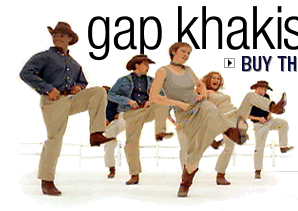
One prime function of advertising is to establish brand identity. This is vital especially among certain categories of consumer goods in which brand identity constitutes the more significant portion of the purchase. When an ad mentions no real qualities of the products named, it's a fair bet the ad is meant to "brand" the company. Even armed with this knowledge, some campaigns are hard to comprehend.
Consider Old Navy and The Gap. These sister companies have paid oodles of money for ad campaigns that, taken at face value, suggest a corporate suicide attempt.
In one of the current ads for Old Navy's "drawstring pants," we gape incredulous while that inexplicably horrible batty old lady with the huge spectacles stands stupidly and Morgan Fairchild struts in a bizarrely cheesy way towards the camera, which seems to retreat in horror. Following this are scenes of people flitting about and waving their arms as if mimicking the stylized movements of synchronized swimming, all in rhythm to a smarmy, faux-60s soundtrack.
The old bat had been Old Navy's spokesperson for a year or so before she was allowed to mention in an ad that she was once a fashion reporter. Up to that point (and, I would argue, afterwards), her identity was left deliberately obscure. Did Old Navy think their 20-something market would find the bat's big glasses and viscous voice enticing?
But as in so many things, the key to this is Morgan Fairchild. She's a washed-up TV actress. Her cachet (like that of Joan Collins, Larry Hagman and many other 80s prime-time soap stars) derives from a kind of winking hipster-doofus nostalgia, the same sense of recent history that drives the thrift store craze. From the near-sighted perspective of the present, the styles of the past look quaint, silly, idiotic. To absorb that past in the present is to affirm one's superiority over it. Such is the ideological complexity of the reaction: "God, look at Morgan Fairchild! What a no-talent schmaltztress loser!"
The appeal, if successful, is to connect Old Navy with what passes for irony these days. It's market is a bit brainier, a bit more non-conformist, a bit more throughtful. That is, compared with The Gap.
The Gap's image is more finely honed and the advertisements are more clever, largely because they are less clever. Like the brightest and best of corporate America, The Gap's ads no longer need to rely on thought control. Instead, The Gap beckons us to "fall into" it, which is a lousy pun on "fall in," i.e., stop by, and "fall into," i.e., descend, as into a gap. As if that weren't sophisticated enough, The Gap has hired various celebrities to do little musical bits in their own styles, concluding with a variation on a single thematic word, "easy." There's certainly few things easier than falling, especially when there's a gap. I guess that's the idea.
The variety of musical styles and performers suggests that The Gap caters to all tastes. The location and stock of The Gap suggests that they cater to one taste: hipster wannabes.
The Gap has also cashed in on the same faux-nostalgic trendiness that Old Navy evokes in its perverse way. When The Gap debuted khaki pants (which, for nearly six months, were deemed out of style), they needed to cast them as something retro-cool to overcome the fact that the product was in no way new. The first bet was to use Brian Setzer's recording of "Jump, Jive ‘n Wail," a song written by a white guy in the 40s attempting to evoke cool black bands from the 20s who were imitating white bands from the teens mocking minstrels from the turn of the century. This kind of deep understanding of history no less motivates The Gap than neo-swing; the marriage of these hopelessly inauthentic perspectives to one another, and to khaki pants, was inevitable.
Now that neo-swing has hit the big time, it's already outré, so The Gap has turned its eyes futureward, to the late 60s, to resurrect go-go dancing in its latest offering. (To give the ad that air of genuineness - and for no other reason, of course -, the chicks aren't wearing bras.)
Someone just slightly older than The Gap's target audience (for instance,
me) would remember the time 10 years ago when The Gap sold nothing that
wasn't black, white or gray. Then, in a blink of an eye, the entire
store was navy denim. That was spun off into the Old Navy chain,
and The Gap turned to a mix of khaki, knit, occasional denim - in a word,
Garanimals for young adults. The premise of the store seems to be
that any consumer who fits available sizes can walk into any Gap worldwide,
pick any shirt from any rack, any pair of pants from any rack, and wear
them together without clashing. The premise of the ad campaign is
that engaging in this cookie-cutter consumerism will create an individual
identity, a stamp of uniqueness, for each and every consumer. This
is, to be sure, brainlessly easy.