Return to Doc Nagel's Den of Iniquity **** Go to Doc Nagel's Ad Reviews Page
A common and easy way to advertise is to associate a product with a person of some standing. When it works, the magnitude of its effectiveness can hardly be measured - the endorsement or appearance of Michael Jordan, for example, could probably sell hell to the angels.
But there are subtleties to this art that must be carefully observed. First and foremost, the celeb's image must cohere with the product or the brand. The sneaker-Jordan connection is obvious; the clever ad kids were the ones who put him in underwear, cologne, and cars. The furthest extension of this is the current MCI long distance campaign featuring Jordan and Warner Brothers cartoon characters. (Somewhere tonight there's a film theory student with a head full of Jean Baudrillard and cheap Chardonnay dancing a crazed jig over the perverse ontology of these ads: Jordan, the former basketball player, of flesh and blood, refers to the animated cartoons as his "Space Jam buddies" because he "starred" in a movie with them. Now this flesh and blood person recalls, in an advertisement for long distance service, a fictional film as if it were a real event in his past, and the cartoons as if they were persons with whom he could share a human relationship, only to overturn the humanity of this relationship by cashing it in for an ad slogan, but somehow this is perfectly alright because, of course, there never could have been such a relationship to begin with... That's what film theory students do.)
What makes this scenario an effective advertisement for long distance? Do phone customers watch it and think to themselves, "Well, hell! -- Michael Jordan saves a bundle when he calls Foghorn Leghorn using MCI. It must be a good service!"
No doubt some do, but none of them are probably reading this, the ninnies.
Jordan (and for that matter, the WB characters) are proxies, stand-ins for something else. Even though Jordan has a horribly wooden way with punch lines, even though the scenario isn't actually amusing, it resembles amusement closely enough that it passes for cute. And cute is the secret of Michael Jordan, Inc. His managers noticed this when he was back in Chapel Hill, and his career (I mean, of course, his showbiz career) has been directed carefully all along. This, and not destiny, made so many youngsters of the 90s want to "be like Mike." His cuteness is his official trademark, which he generously shares with products far and wide, for a reasonable fee.
(Other players have followed in what now appears to be the natural course of things. This course is not without its pitfalls. Advertising Age reported an "image crisis" involving Shaquille O'Neill several years ago, but luckily this was ameliorated with a cheesy kids' movie starring Shaq as a superhero. Shaq's problem persists, in as much as he's still kinda big and scary looking compared to Mike.)
In short, the celebrity's "personality" or image are not created as much as re-constructed, enhanced, and in instances of over-reaching, grotesquely distorted. This sells, and it's clear that it sells not because the celebrity is presumed to be an expert on anything ("I'm not a doctor, but I play one on TV"), but because a celebrity's image can be used to symbolize traits to be pasted onto the brand's image. Everything Jordan touches turns into Mike.
When this system fails, it tends to fail monstrously. I doubt very much that the shark-eyed visage of Joan Lunden sells much Claritin. The ads look like a cruel joke at her expense.
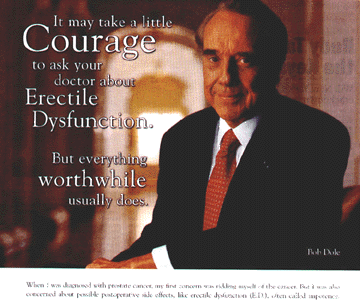
Which brings me to the occasion for this exegesis, far and away the best example of the power and pitfalls of celebrity endorsements.
Return to Doc Nagel's Den of Iniquity **** Go to Doc Nagel's Ad Reviews Page