|
|
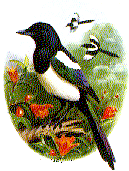
Magpies are adaptable, gregarious, intelligent, noisy, intrusive birds that eat anything, makes nests out of anything, and live nearly anywhere. They're the phenomenologists of the avian world, at least, if you ask me.
I've been trying to find ways to express my way of thinking about how phenomenology relates to other philosophical and scientific approaches to understanding and interpreting the world, and while most of the academic philosophers I know would disagree, I think "philosophical magpie-ism" aptly names how phenomenologists work. That is, how they should work. That is, how I think they should work.
Since I started on this endless project of a phenomenology of media and of media experience, I've been finding bits of useful stuff all over the place. My usual habit has been to just take whatever I want, use it however I want, and never mind the alleged methodological consequences. This will strike a lot of self-proclaimed phenomenologists as perverse, and that's fine with me. Academic phenomenologists all to often defend the purity of their method, especially in reference to specific things Husserl wrote.
What I see Husserl advocating is a much less doctrinaire approach, a much less theoretically grounded approach - in effect, an antifoundationalist approach (decades before it was hip to be anitfoundationalist back in the 80s and 90s). Like magpies, phenomenologists who maintain reservations about theoretical and metaphysical commitments can relax and take hold of anything that makes itself available. Also like magpies, phenomenologists can't just move in to other birds' nests, because they don't fit well. But they can take hunks of nests away to build their own.
But to be frank, the main way phenomenologists should be like magpies is that they should be loud.
The paper on Merleau-Ponty and Baudrillard is a good example: the very last thing Baudrillard would normally be associated with is phenomenology. He comes from the French post-structuralist social theory tradition, which is a generation or more removed from the group that rejected phenomenological "subjectivism" in the early 60s. Now, I shouldn't blithely insert Baudrillard into a phenomenological account, especially since Baudrillard never grounds his often outrageous claims in something like a description. Nevertheless, Baudrillard's stuff is full of insights that provoke (for me at least) phenomenological inquiry of a unique sort - that is, I couldn't do it without him, or not as well. Which means his books provide the bits of duct tape, tire rubber, old magazines and discarded Q-tips that work really well in the ugly but functional nest I'm building. I'd love to meet him and tell him so. I think he'd be proud, don't you?