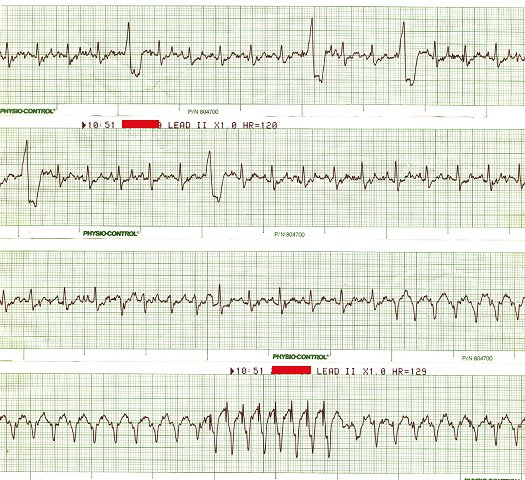
Sinus tachycardia at 120/minute with frequent PVCs, this rhythm deteriorates into an atrial tachycardia with aberrant conduction. The morphology would indicate an atrial rather than a ventricular tachycardia, but of course this is only a Lead II monitor rhythm and viewing multiple leads would be necessary to make a definitive diagnosis.
I would like to thank Peter Bonadonna EMT-P (Director of Paramedic Education; Monroe Community College, Rochester, New York) for his input on this one. Thanks again, Peter!
"The example you show (ekg61) is interesting in that the patient has a
anti-tachycardia pacer (a burst pacemaker) This is evident in the bottom
tracing. One can see the onset of a tachycardia and then after a five second
detection time, the unit delivers the classic 8 interruption spikes of the
burst pacer trying to terminate the tachydysrhythmia in this case without
success."