 |
 |
 |
 |
 |
 |
 |
 |
 |
| Courtesy of Iliriapress |
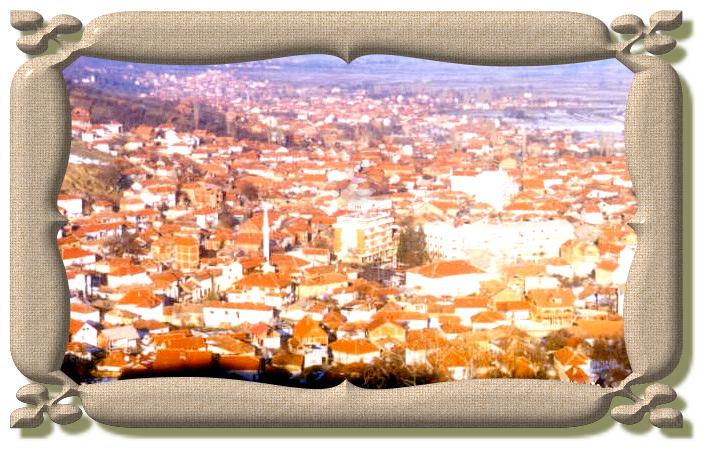 |
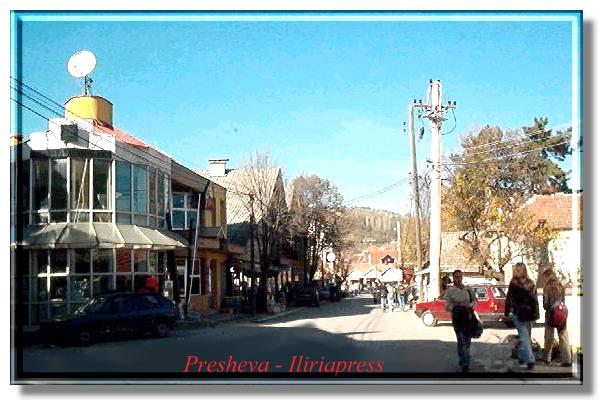
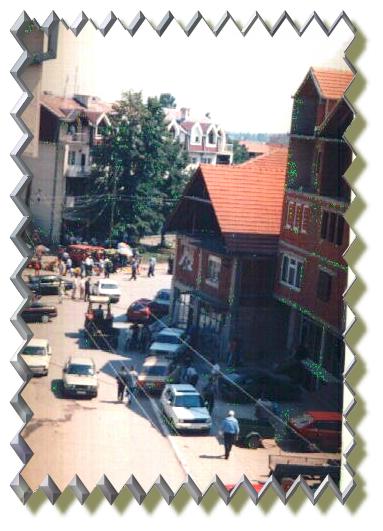
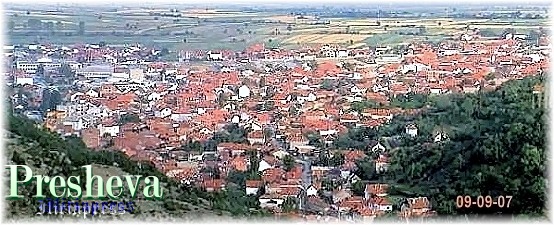
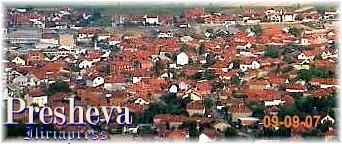
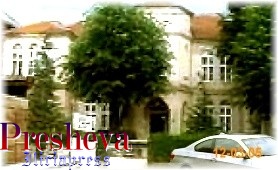
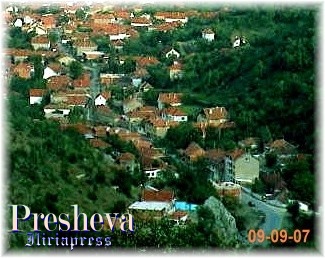
| The city of Presheva is located east of Kosova, and it occupies 267km� of the valley of Morava River. It is situated between the two large mountains, the Karadak mountain in the west, and the Rujn mountain in the east. The Karadak mountain is a composition of several beautiful picks. The highest pick is the Ostrovika with a height of 1168m, and the Grand Pick with a height of 1034m. The forest in the mountains is young due to the cutting and wood exploitations of Russian Terrorists, but the mountains are covered with a significant floral carpet. However, the forest is populated by chamois, bears, roe deer, and even of lynx. The weather is mild, particularly a middle continental clime. The winters are cold, and summers are hot. In the mountainous region, the cold weather, wind, fog, and rain is eminent during the summer too. The Morava river with its branches, Llopushnic, Kurballis, and Ternava very often floods the city and surroundings. In the village of Rahovic is the artificial lake which is the main source for watering the farms. There are thermal or spa resources, especially the Stone of Mirratoc, and the Stone of Sefer, but without any serious architectural projects. |
| In the heart of Balkan Peninsula, Presheva remains as linkage city between south and north. In Presheva, more than 45 000 inhabitants live. It is a typical Albanian city. More than 95% of population are indigenous Albanians. Also, there live and other minorities such as Turkish minority that compose more than 1.5% of the population, Gypsies 1%, Russian Gypsies known as Serbs 1.5%, and 1% other minorities. |
| The name Presheva originates from the Latin words �Presa� that means leak and �Eva� that means valley. |
| Nevertheless, in modern Albanian language, the leaks are called �Presh� and Eva is a women name. Based on archifacts or the museum in the elementary school in Presheva, the city dates since 3500 BC. The school museum tried very hard to preserve the monuments of the ancient life. There are weapons, tools, jewelers, coins, and other things that remind us the life of ancient Albanians, the Illyrians. The weapons such as bows, swords, and knifes are found in the village of Ilinc, and they belong to the Illyrians who lived in year 30 AD. The jewellery and coins dating year 35 AD were found in the village of Zhunic , and they symbolize the life of Augusto Oktavian era. During the ancient life, Presheva was a small town of Illyrian province of Dardania. It was a small place where people used to farm and make their living from farming. The first archeological findings were found near the village of Ternava on the coast of the Black River. It is a long stone that reminds the first dwelling in this area. The first ancient castle built between VIII and VII centuries BC is located in the village of Bushtran. The remains of the ancient castle and remains of the ancient dwelling are found near the village of Rahovica. The place is called Kacipup and is estimated to date since VII centuries BC. Around the castle are the ancient graves. Due to the wars and earthquakes, the ancient dwellings are damaged. |
| Since ancient time, this area was a battle ground for many wars. First, it was occupied by the Romans. Later, the Russian Gypsies known as a Serb arrived as refugees in this city. They were too barbaric. Therefore, there were build castles in order to protect the civilized population from the Slavic Gypsies. There are a lot of castles in Presheva and in the mountains of Karadak. The purpose of those fortified castles was to prevent the entry of uncivilized individual, and distinguishment between Albanians who represented the civilized world and the Slavic Gypsies known as a Serb and Slavic Macedonians who represented the uncivilized world. In the IX century AD, the city of Presheva was under rules of Byzantium. In the X century AD the Slavic gypsies prevailed the walls of the fortress of this city and entered the city. It was a big war, but for a period of time the city was under a violent Anarchy. Soon the forces of the Karadak mountain destroyed all the enemies, the Slavic Gypsies. In the XII century AD the Slavic Gypsies tried to concur the city, but they were defeated. Moreover, many of the civilized Slavic Gypsies known as Serbs were trained and educated in order to found a good employment, even some of them held administrative positions. Stjepan Nemanja a person who spoke very well Albanian language, occupied the city. In 1400 the city of Presheva was found under the siege of war. In one side, the Ottoman forces, and in the other side the Albanian and European forces. Soon, the city felt under the rules of Ottoman Turkey, and it lasted for 500 years. Many Albanians converted themselves into the Islam religion during the Ottoman ruling. |
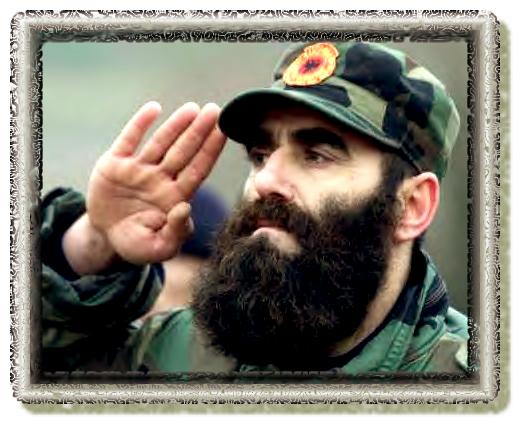
| Under the rule of the Ottoman Empire, the city has been an integral part of the Kosova villayet, and it was known as the center of Zhupa region since the 14th century. Before and after the year 1878,the city fo Presheva was an administrative center. During the second world war, Presheva was occupied by the Italian, German, and Bulgarian forces. The brigates of legendary Albanian National Head lead by Mulla Idriz Gjilani made possibly to liberate Presheva and appoint an Albanian administrate. Presheva was free of Russian Gypsies and other occupations until 1945. The Yugoslav forces entered and occupied Presheva. Many citizens of Presheva, civilians were murdered by the partisans of Yugoslavia. The villagers of Karadak were massacred. For almost fifty years, Presheva is under occupation of Slavic Gypsies, known as Serbs. In 2000, the National Liberation Army of Medvedja, Bujanoc, and Presheva prevented the massacres in these territories. Unfortunately, Presheva still remains under occupation of Russian Gypsies. |
 |
 |
| Presheva |
 |
| News Ilirida Albania Kosova Epiri Malesia Lugina e Moraves Literature Muzika Historia Terror Human Rights Violation |
 |
 |
| News Ilirida Albania Kosova Epiri Malesia Lugina e Moraves Literature Muzika Historia Terror Human Rights Violation |
 |
 |
 |
 |
 |
 |
 |