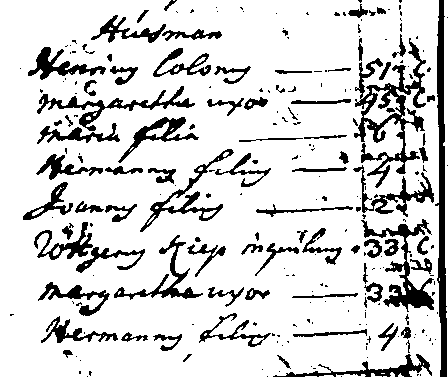
Henricus is the earliest known ancestor on the Huisman line, so far. The records of St. Vitus Catholic Church in Altenoythe, Germany (near Friesoythe in northwest Germany) have provided all the information currently known about Henricus, his children and grandchildren. Henricus is a latinized version of Heinrich, and is used in all the church records referring to him.
Another set of Huisman descendents, documented in a set of Ostfriesisch Ahnenlisten (East Frisian ancestor tables) at the LDS family history library in Salt Lake City, traces their ancestry to a Gerhardus Huismann, born in 1687 in the Noordbrabant Province of the Netherlands, and died 14 May 1765 at age 78 in Altenoythe (his death record is in the St. Vitus records). This other Huismann line descends from Gerhardus' son Joanny Engelbertus Huismann, born 22 Aug 1738 in Altenoythe, and died 15 Oct 1810 in Loga. The occupation of Joanny is given as Schneidermeister (master tailor), which coincidentally is the occupation of my Huisman ancestor who also migrated to the Loga area. There is one more connection: That Gerhardus and his wife Maria Zarratt had a child named Anna Margaretha on 26 Aug 1742, and Margaretha Kiep was the godmother. It seems pretty likely to be the wife of this Henricus who was that godmother. Despite the coincidences, I have not been able to concretely link the two Huisman families. It's also a relatively common surname in that part of the world. (Joanny is the way the LDS records spelled the name. I think it was probably Joannes in the church records. A final letter 's' in the old German script looks similar to a modern 'y'.)
Joanny Engelbertus Huismann from the LDS records is the same person whose name is spelled as ``Engelbart Geerts Huusmans'' in the Loga Ortsippenbuch. Engelbart and his wife Lukke Harmanssen Cantzen had 9 children between 1767 and 1792: Geert, Carel Julius, Taalke, Harmannus, Maria Tekla, Maria, Tekla, Trientje, and Engelbartus.
The Huisman family and other ancestors that I've traced to Altenoythe were all Roman Catholic. There's a very good historical reason for this, dating back to the 30 Years War. The 30 Years War ran from 1618--1648 and resulted in much devastation all across German lands. In a large part, it was a conflict between Protestants and Catholics, with troops and soldiers from many nations joining in on both sides, including many mercenaries. The armies were supported by plundering whatever territory they were occupying or passing through, with little distinction between friend and foe. The part of the 30 Years War especially relevant to Altenoythe begins in 1623. Up until 1622, the Muensterland (including Altenoythe), alled with the Catholic German emperor, had suffered little in the war. On the Lutheran side, an army of Count Ernst von Mansfeld was in control of East Frisia (Ostfriesland, just west of Altenoythe). Von Mansfeld's army began moving on the Muensterland, conquering and plundering Cloppenburg in January of 1623 and also the cities of Vechta and Meppen. The Muensterland generals moved to secure their borders with East Frisia, and the Lutheran armies decided that the weak point in the Catholic defenses was at Friesoythe. On December 19, 1623, the Lutheran armies, on orders from Von Mansfeld, attempted a three-pronged attack against Friesoythe, but were repelled by the imperial armies there. The Lutherans fell back to and occupied Altenoythe .
On Christmas Eve, 1623, the imperial armies encircled Von Mansfeld's army and attacked them in the darkness. The battle engulfed the whole village of Altenoythe, with bloody single combat between the houses. 150 of Von Mansfeld's men were killed and the remainder withdrew into the Altenoythe church and entrenched themselves behind the thick walls of the rectory. Eventually, the Lutheran army realized it was hopeless for them and they were forced to surrender unconditionally. Altenoythe suffered greatly in the battle. Nearly all the houses near the church were burned down and the church itself was badly damaged and its bells had to be removed from the severely damaged tower.
The battle of Altenoythe meant the end of Von Mansfeld's reign of terror in East Frisia. The army suffered from much disease and was dissolved in 1624, so once again the Muensterland had peace. The victory of the Catholic side here also meant that the Lutheran reformation had virtually no presence in this part of Muensterland. Altenoythe and the surrounding countryside remained a firm bastion of the catholic church.
As an interesting footnote: It was only Christmas to the Catholic side in the battle. The Catholics had adopted the Gregorian calendar (by decree of Pope Gregory in 1582). Since the protestant countries had not yet adopted the Gregorian calendar, it was 10 days earlier to them.
You can read more of this history at http://www.heimatverein-altenoythe.de/ (in German).
Back in the 1600s, Altenoythe was the largest of the nearby towns, but now it is subordinate to Friesoythe. In 1974, Altenoythe's municipal government was dissolved and Altenoythe was incorporated into Friesoythe.
Sources for this individual: @S223@ @S250@ @S251@ @S31@