Literature Circles

What are Literature Circles?
It is a method of instruction in which students are given a
chance to talk about a selected novel with their peers. Students facilitate the
discussion. It is a very student-centered activity. Teachers take a very
passive role. They are merely observers of what the students are doing.
Teachers may participate in a literature circle, but only as an equal to the
students. Students do everything from selecting the novel that they wish to
read, to deciding how many pages of the novel are to be read by the next class
meeting.
Roles
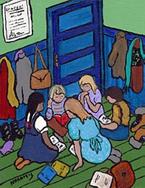
***The students rotate the roles throughout the course of the
novel.
·
Discussion
Director
o
This
person develops discussion questions or topics that the group will explore
during their discussion. The focus isn’t on the small details. It’s more about
big ideas in the novel and the readers’ reactions to these ideas.
·
Literary
Luminary (Passage Master)
o
This
person selects passages from the text that he or she wishes to hear read aloud.
These can be passages that are important to the novel or passages that are
funny to be heard read aloud. It’s the Literary Luminary’s job to mark the
passage and then indicate the reason for picking the passage.
·
Illustrator
(Artful Artist)
o
This
person draws some type of picture that is related to the novel. This picture
can be metaphorical in nature or literal. It’s important that the Illustrator
doesn’t “give away” the picture. The other members of the group should view the
picture and discuss what they see in the picture, relating it to what they’ve
read.
·
Connector
o
This
person connects the novel to other resources, to the outside world, or the
personal experiences. The connector can also relate the selected novels to
other works by the same author.
·
Summarizer
o
This
person summarizes the section of reading that was assigned from the previous
day. It’s important that the summarizer touches upon the main points in the
section of reading, so that the groups’ memories can be refreshed before
beginning the
·
Vocabulary
Enricher (Word Wizard)
o
This
person looks for important or special words in the novel. These can be
unfamiliar words, interesting words, or words that are important to the novel.
The Vocabulary Enricher marks the word and page. He
or she then looks up the word in order to provide his or her group with a
definition during the
·
Travel
Tracer
o
If
the group is reading a novel where the characters move around a lot, having a
travel tracer is important. This person tracks the characters’ actions,
including where the action begins and ends.
·
Investigator
o
This
person researches background information about the novel. The information can
be about the setting of the novel, the author of the novel, major issues
discussed in the novel, or even music that reflects the novel or the time of
the novel.
Resources:
The following is
a list of resources that focus on Literature Circles:
·
LiteratureCircles.com
(http://www.literaturecircles.com)
o
LiteratureCircles.com
discusses all aspects of Literature Circles. Their goal is “to support
conversation and idea-sharing among people who are exploring this important
‘best practice’ strategy.”
o
LiteratureCircles.com
has a section called For Teachers where there are links to other information,
such as:
§
Defining
Literature Circles
§
Classroom
Coaching: Ask a Colleague
§
Articles/
Video Clips
§
News
and Events
§
Book
Recommendations
o
LiteratureCircles.com
also has a section called For Kids where there are links to other information,
such as:
§
Book
Reviews by Kids
§
Great
Book Projects
§
Find
a Discussion Partner
·
ABC
Teach (http://www.abcteach.com/Reading/litcircles/litcirclestoc.htm)
o
This
website has a number of printable worksheets that can be used during Literature
Circles.
§
Literature
Groups Planner: lists student jobs, session dates, etc worksheet
§
Literature
Circle Notes: vocabulary word lists, questions, notes about the novel worksheet
§
Mark
Those Words: vocabulary word worksheet
§
I
Just Have to Ask These Questions: questions about the text worksheet
·
Education
World (http://www.educationworld.com/a_curr/curr259.shtml)
o
This
website discusses a number of issues involving Literature Circles. There are
nine sections on this webpage:
§
Defining
Literature Circles
§
Discussion
Roles
§
Teacher’s
Role
§
Grouping-Heterogeneous
or Homogeneous
§
Age
Groups
§
Tool
for At-Risk Students
§
Giving
Students a Choice
§
Highly
Adaptable Teaching Method
§
Other
·
Web
English Teacher (http://www.webenglishteacher.com/litcircles.html)
o
This
website has a number of hyperlinks that will take visitors to websites about
Literature Circles. These links include lesson plans, a website that discusses
the 12 Ingredients of Literature Circles, tips on organization and process, the
roles involved in Literature Circles, and handouts that can be used for Literature
Circles.
·
Stenhouse
(http://www.stenhouse.com/pdfs/0333ch01.pdf)
o
This
website has a book for sale entitled Literature Circles: Voice and Choice in
Book Clubs and Reading Groups by Nancy Daniels. The website has a hyperlink
that allows visitors to read the first chapter (16 pages) of the book.