| HANDBELL MUSIC COMPOSERS |
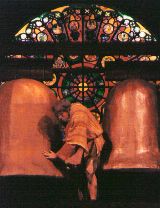
| QUASIMODO. One of the earliest and arguably the least recognized composers of handbell music is Quasimodo. His work on large bellringing techniques at Notre Dame in Paris during the Middle Ages led to many of the modern techniques used throughout the English bellringing world. Quasimodo is credited to have pioneered and perfected the "Tower Swing" technique and the seldom used practice of throwing burning oil on audiences that fail to appreciate the difficulties inherent in handbell choir performance. |
 |
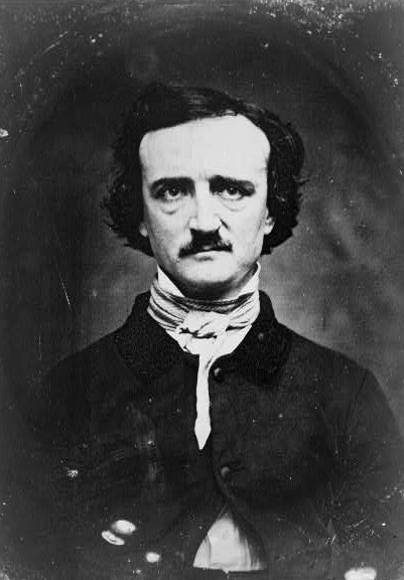
| EDGAR ALLEN POE. Edgar Allen Poe is best known as the author of hundreds of short stories and poems, among them "The Bells." See Bell Verse for Stanzas V and VI. Poe's musical accomplishments are largely ignored by academicians. An American, handbell musicologist, whose name is being withheld on condition of anonymity, believes that the above-referenced poem is Poe's personal lament over failed efforts to publish his own bell choir compositions. The musicologist has studied the poem and concluded that the alliteration and meter of the poem is actually a secret code that discloses the location of a tenement building in Baltimore, Maryland (unfortunately demolished in 1999). It has been suggested that behind a wall in the basement of that building, Poe concealed a cache of handbell music manuscripts along with a cask of amontillado. The obvious value of this music is forever lost to the modern handbell music world; as Poe so eloquently wrote: "Quoth the raven, 'Nevermore.'" |
 |
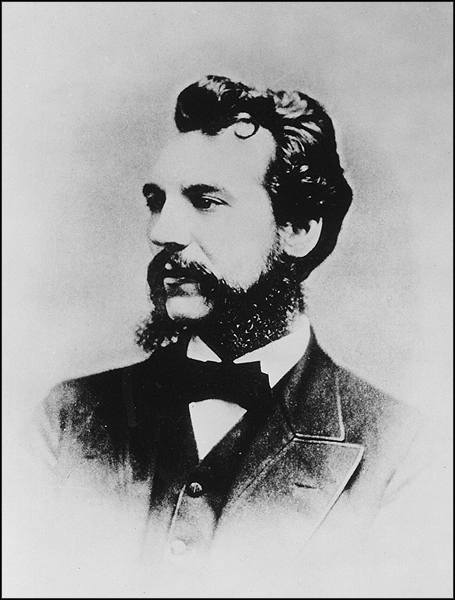
| ALEXANDER GRAHAM BELL. Well, okay. So Alexander Graham Bell wasn't a composer of handbell music. But he did have an ear for sound devices and his name has a certain ring to it. |
 |
| SERGEI RACHMANINOFF. One might argue that the famed Russian composer Sergei Rachmaninoff (1873-1943) had a real fixation with the above-referenced Edgar Allen Poe poem. He actually crafted an entire choral symphony around it. Why he didn't just compose a handbell piece based on it is unfathomable and unforgiveable to some American handbell choirs! Don't expect us to describe the symphonic piece on this page because we are still snubbing him for the oversight. If you really want to know more about the piece, here is a link that describes the Bells by Rachmaninoff. |
 |
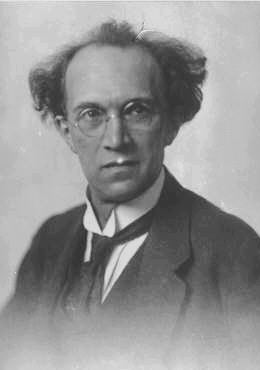 |
| FRANZ SCHREKER. This Austrian composer (1878-1943), who was plagued by a perpetual "bad hair" day during his lifetime, wrote an amazingly risque opera titled Das Spielwerk. The opera is set in the Middle Ages and centers on an imagined instrument, a carillon of bells, created by the old master-craftsman Florian. The sound of the bells, misued by a wicked princess for wild orgies, has lost its purity. (Now there's a new use for incidental bell music.) The music is restored for the moment with the appearance of a wandering flute player, whom Florian entertains in his house. (Freud could've had a field day analyzing this plot.) The original drama ended in the tragedy with the destruction of the bells and the poor man's house. However, the revised version replaces the ending with one of greater serenity. |