 The HundredYears War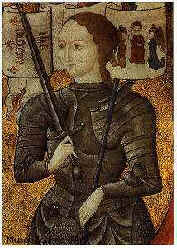
From the
Middle Ages to the Dawn of the Renaissance
I.
Causes
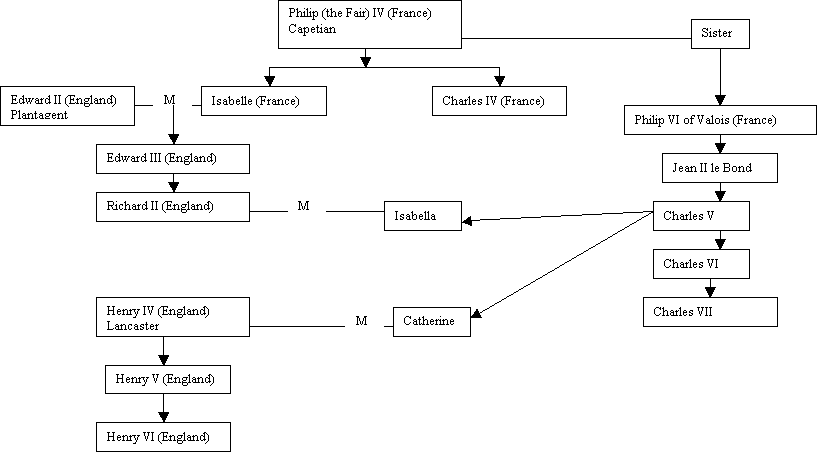
1. Conflicting
claims to the French throne....
2. Economic conflicts over trade
with Flanders (modern Belgium)
- Merchants have grown wealthy
from the wool trade with England
-Triangular Trade: English wool to
Flanders, finished cloth to southern France, Wine to
England
-France attempts to reassert control
and taxation
3. Factional fighting in France over
territory (remnants of feudal vassalage)
- France is a collection of
states with rivals for most of the thrones: Brittany,
Normandy (claimed by England), Comte Franche, Aquitaine (claimed
by England), Flanders
II. The Spark
1337
- Edward III of England decides
to press his claim to the throne of France
- The wealthy merchants of
Flanders give him their support.
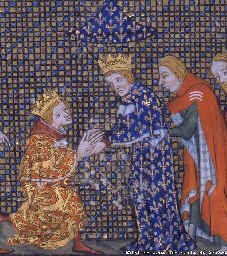
- Philip VI declares Aquitaine
and Normandy forfeit, because Edward does simple homage
and refuses to pay liege homage
III.The War
- 1339-1360, English gain
substantial lands in the North and West at the battles of
Crecy and Poitiers, both of which are overwhelming
victories for the English, in spite of having smaller
armies, fighting ends with the Treaty of Bretigny in
which France cedes the lands controlled by the English
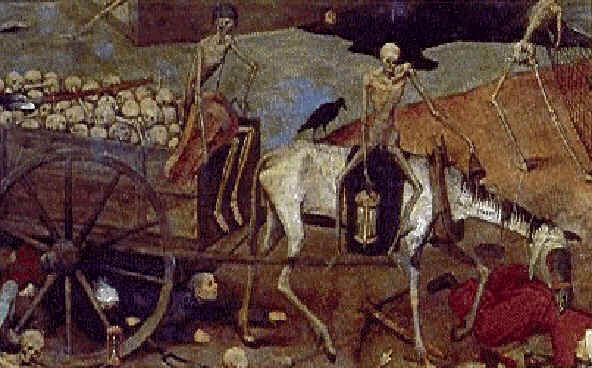
- Fighting is reduced by both
sides during the Black Death from 1347-1353

A. What made the English so
powerful?
- England was united under one
monarch
- French are divided and fight
with or against the English, depending on their leader's
interests
- Better weapons!!
THE LONGBOW
- The longbow first emerged as a
hunting weapon as early as 8,000 BCE
- Vikings, using a much improved
version of the bow, defeated the Welsh in the 600’s
and 700’s.
- The Welsh, using an even better
version of the bow, successfully defeated Edward I of
England in his first attempt to conquer them in 1280, but
later fell to greater English numbers
- The English began to develop
their own version, and made limited but successful use of
it against the Scots
- The English adopt the longbow
as a military weapon; to be used primarily as massed
infantry support
- English longbows were made from
a single piece of yew, cut from the center of the branch
or trunk to include both heartwood and sapwood, which
workedtogether like a bimetal strip. These bows were 60”
to 75” in length and had a draw weight of 80-100 lbs.
Arrows were 27”-30” in length and could hit
targets 200-250 yards away. They were tipped with narrow
iron heads that were dipped in wax and could pierce the
armor plate worn by mounted knights of the era.
- Edward III of England lay claim
to the throne of France and began plans to invade. He was
faced by superior French forces (France’s population
was three times that of England) and the need to
transport thousands of men (and armor and horses?) across
the channel.
- Edward III assembled an army
which included 10,000 longbow archers, who outnumbered
all other soldiers in the English force, combined.
- The English soundly defeated
the French at Crecy, largely due to the longbow archers
- Survivors of the battle said
the arrows coming from the English archers formed a cloud
that “darkened the sun.” 10,000 archers, firing
10 arrows a minute gave the English a fire power of 100,000
arrows a minute!! Historians estimate that 1 1/2
MILLION arrows were used in the course of
the battle. Close to 800 French soldiers were killed or
wounded for each archer killed.
- The English became the supreme
Military force in Western Europe and defeated the French
time and again throughout the first part of the Hundred
Years War, and were able to completely dominate Scotland
and Ireland.
- The mounted knights of the
nobility were no longer the mainstay of the English army,
and began to lose the special privileges given them when
they were so desperately needed by monarchs to fight
their wars. Instead, the monarchs now had to court
the peasant farmers to fight their wars. This led
to a leveling of political power and the beginning of
peasants having some political say.
B. Peasant Revolts
1358, The
Jacquierie in France put down by Charles “the Bad”
of Navarre, killing 20,000 peasants in the effort 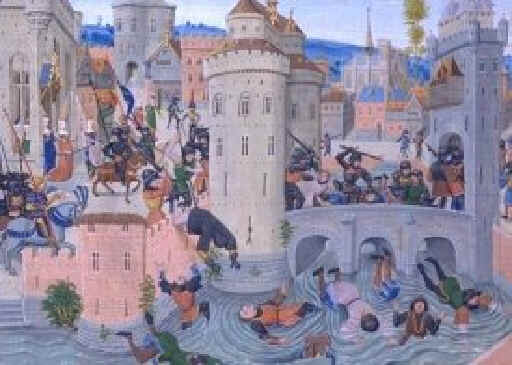
-
- 1381, Peasants Revolt led by
John Ball, a priest, Wat Tyler and Jack Straw
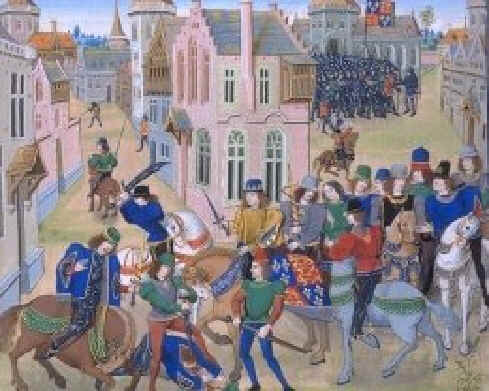
C. The Return of the French, 1369-1373
- Charles V assumes the throne of
France.By using hit and run tactics, wearing down the
English garrisons, avoiding pitched battles with the
English archers and making an alliance with the Kingdom
of Castille and their powerful navy (which destroyed the
English fleet), the French are able to recapture
most of the lands taken by the English.
D. Consolidation and Peace
- Charles V takes control of
Brittany and puts down a Flemish rebellion, Charles VI
takes over and makes his uncle, the Duke of Burgundy,
Count of Flanders.
- Truce of Leuinghen stops
fighting until 1404, Richard II of England marries
Isabella (Charles VI daughter) and agrees to a 28 year
truce
- English nobles, angered at
being cut off from French plunder, rise up and depose
Richard II (Plantagenet) in favor of Henry IV (House of
Lancaster)
E. Return to Fighting
- 1402 French troops assist the
Scots in an unsuccessful invasion of England, 1403 begin
raiding the English coast, 1405 assist the Welch
rebellion, 1406 attack the remaining English possessions
in France.
- 1407, the Duke of
Burgundy assassinates the Duke of Orleans, brother of the
King, and France is divided between the Burgundians (who
also control Flanders) and Orléanists (Armagnacs), both
appeal to Henry IV for help in 1411
- 1413, Henry V assumes the
throne of England when his father dies and accepts an
alliance with the Burgundians.
F. Return of the English
- Henry V invades northern
France, and defeats a superior French force at Agincourt.
- Most of the leading nobles of
the Armagnacs/Orléanists are killed or captured, gravely
weakening them against the Burgundians. Both sides
establish governments, Orléanists in Paris, Burgundians
in Troyes.
The Height of
English Power in France
- Henry V captured Normandy while
the Burgundians captured Paris and central France. The
two eldest sons of Charles VI are killed while in
Burgundian custody, leaving Charles (VII) as heir.
- 1420, Henry V imposes the
treaty of Troyes, which provides for his marriage to
Catherine, Charles VI’s daughter and his assumption
of the French throne on Charles death. Charles is
suffering from severe mental illness and his daughter
passes this into the English line.
- 1421, dauphin Charles (VII,
heir to the throne) takes the field against the English
only to suffer a series of defeats. 1422, Henry V dies
leaving his ten month old son in the hands of a regent,
his brother John of Bedford, who continues the campaigns,
up until the siege of Orleans in 1429
III. The End of
the War
- Jeanne (Joan to the English) de
Arc becomes symbolic leader of Orléanist forces and
unites all of France but Burgundy behind her. Breaks the
siege of Orleans and captures several towns. Charles VII
crowned king of France.
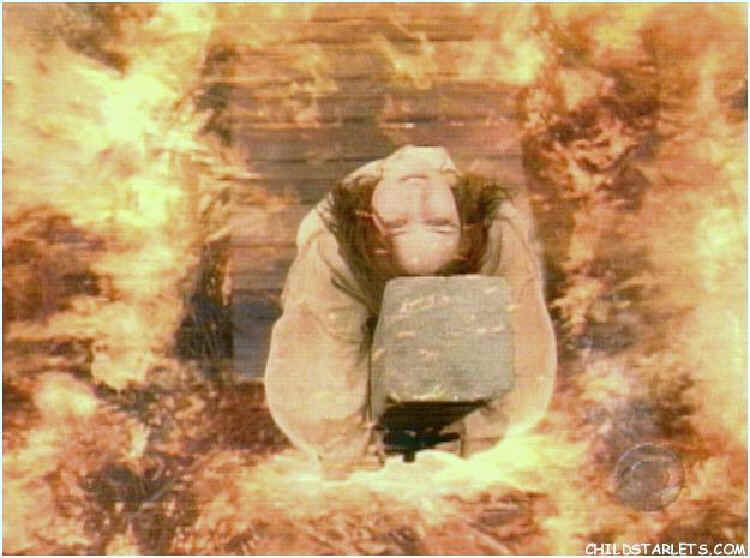
- Jeanne captured by Burgundians,
turned over to the English, tried by the Inquisition and
burned at the stake in 1430.
- Orléanists and Burgundians
reach a settlement and create an alliance against the
English in 1435
- Fighting continues until the
Truce of Tours in 1444
France’s
Ultimate Victory
- From 1445 to 1450, Charles VII
reorganizes his military, builds up his navy and plans
his moves.
- In 1449 the English break the
truce and Charles invades the English territories. At
Formigny in 1450, the French defeat an English army of
longbow archers for the first time by using small barrel,
mobile cannon to disrupt the English formations.
- Charles retakes all of northern
France except the port of Calais
17 July 1453, in the battle of
Castillon, the French, using 300+ cannon and handguns, rout an
English army and retake the last territory still held in western
France. 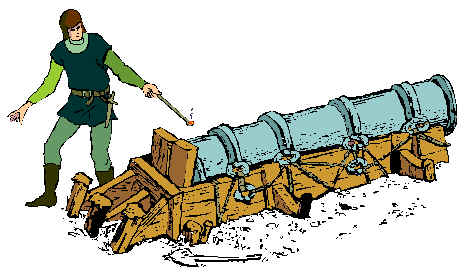
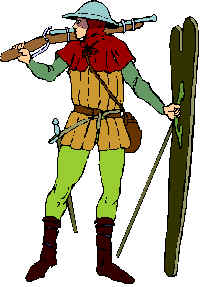
The
Hundred Years War is at an end.
IV. Results of
the War
1. Creation of professional armies
ends the need to cater to the mounted knight representing the
nobility and makes the peasant more important.
2. Introduces the gun as an
important new weapon as well as different tactics.
3. Began the development of national
monarchies in France and England and ended the feudal age in both
countries.
4. England is able to become the
champion of Protestantism and a challenger to Spain and her
Catholicism
5. England turns to maritime
expansion
6. Liberation of the French church
from Rome, but still subject to the French crown