Synthetic Division
In any division problem, the objective is to find the quotient and remainder. For example, 14 divided by 4 gives a quotient of 3 with a remainder of 2. The divisor is 4 and the dividend is 14. Notice that 14 = (4)(3) + 2.
" Dividend = (Divisor)(Quotient) + Remainder"
When we divide polynomials, we usually us a process called long division. However, if the divisor is a polynomial of the form x + a, we use a shorter process called Synthetic Division.
Synthetic Division helps us to do the following.
Divide
Factor
Find Function Values
Find Zero's of Functions
The process of Synthetic Division is best described with an example. We do this in example 1 below.
Example 1. (x3 + 2x2 + 4x - 7) ÷ (x + 2).
We will use synthetic division to find the quotient and remainder. (Consult your textbook for a detailed explaination of how/why this process works.)
First we take the opposite of the constant term in the divisor and place it in a box. (See below.)
Next we take the coefficients (no variables) from the dividend and write them to the right of the box. (See below.)
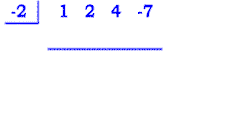
Set the division up as in the first picture below.
(Set Up)
(Synthetic Division Process) Watch the animation until you understand the process.
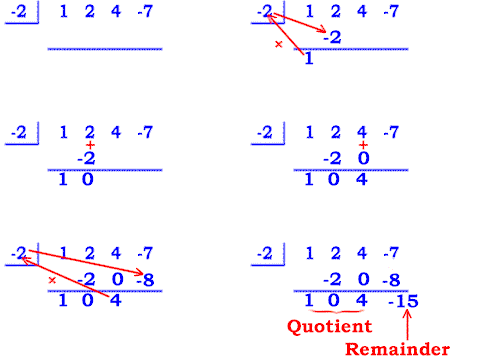
(Finished Division)
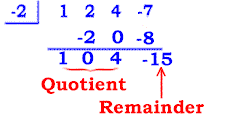
The bottom row gives us the quotient and remainder.
The Quotient is x2 + 0x + 4, or just x2 + 4.
And, the Remainder is -15.
Example 2. Divide x3 - 13x + 12 by x - 3.
When we set up the synthetic division, we use a zero as the coefficient of x 2.
(Set Up)
3| 1 0 -13 12
___________
(Finished Division)
3| 1 0 -13 12
3
9 -12
1 3
-4 0
The quotient is x2 +
3x - 4.
The remainder is 0.
Important Observation: Since the remainder is 0, the divisor (x - 3) is a factor of x3 - 13x + 12. The quotient x2 + 3x - 4 is also a factor of x3 - 13x + 12. In fact, we can factor the dividend as follows.
x3 - 13x + 12 = (x - 3)(x2 + 3x - 4)
In this section, we used synthetic division to divide and to factor. In the next section, we will use synthetic division to find function values and to find zeros of polynomial functions.