
Dennis Kennedy
Cleveland, OH 44125
[email protected]
Security Program
Trillion Dollar Business, Presentation
'The World' is in Your Business
(Preliminary, May 16, 2002 by Dennis Kennedy)
(Also see: 'Cooperative Effort', 'by the Numbers' and 'yet another $Trillion')
The Security Program is actually a Security Solution.
Although there are many more levels to this security program and many more details to each level, it should be easily apparent that this should quickly generate extraordinary income for the computer industry while at the same time safeguarding America and then the world against cyber-terrorism (including theft), with yet many more benefits too numerous to mention.
Furthermore, it should also be apparent that this Security Program, both in theme and in principal, ties in well with our Presidents new plan of cooperation for our Homeland Security as it was announced that a Security Program to thwart cyber-terrorism has been sanctioned by the U.S. Federal Government and Defense.
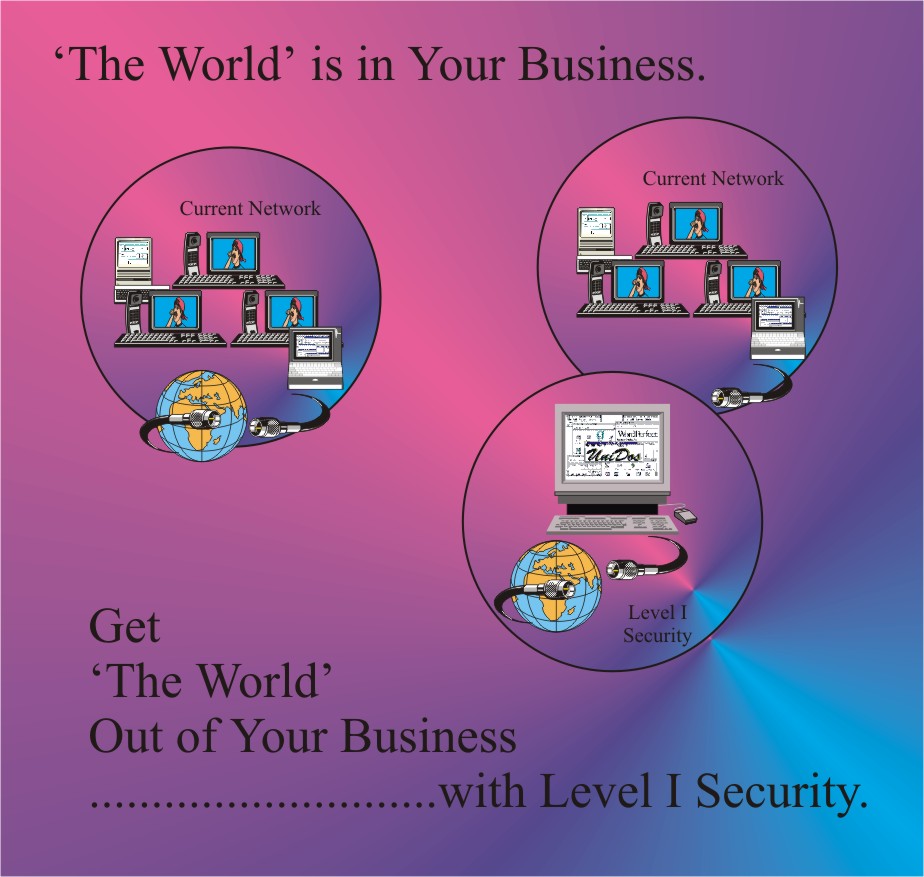
Level I Security provides the most economical method of protecting your valuable information as well as protecting your business integrity.
Level I Security merely wraps your current network in a way that allows you total access to �The World� (the Internet), yet protects your network from undesired intruders.
Technically (yet simply) stated, Level I Security provides a �read-only system�, where nothing can be changed by �The World�, yet �The World� can see whatever you want them to see.
Level I Security is actually an extremely sophisticated �Firewall Interface� that constantly improves upon itself towards the ultimate goal of providing 100% network security.
Note: Level I Security, the lowest level of security, insulates the corporate network from the internet (the "World"). It does so by "wrapping" the current computer network with an interface to the World. This is a hardware and software solution and should be of particular interest to companies such as IBM, Microsoft, Apple, Hewlett Packard / Compaq, Sun Micro, Cisco, etc.
I have designed the wrapper to become a plug-in buffer between the current computer network and the world. This approach begins with a computer that can only be read from and not written to. As a server to the internet, it is a client machine to the second layer, with a proprietary interface between the two. Although there is much more to this level, I'll leave it for further discussion. But it obviously must be powerful enough to insulate classified networks
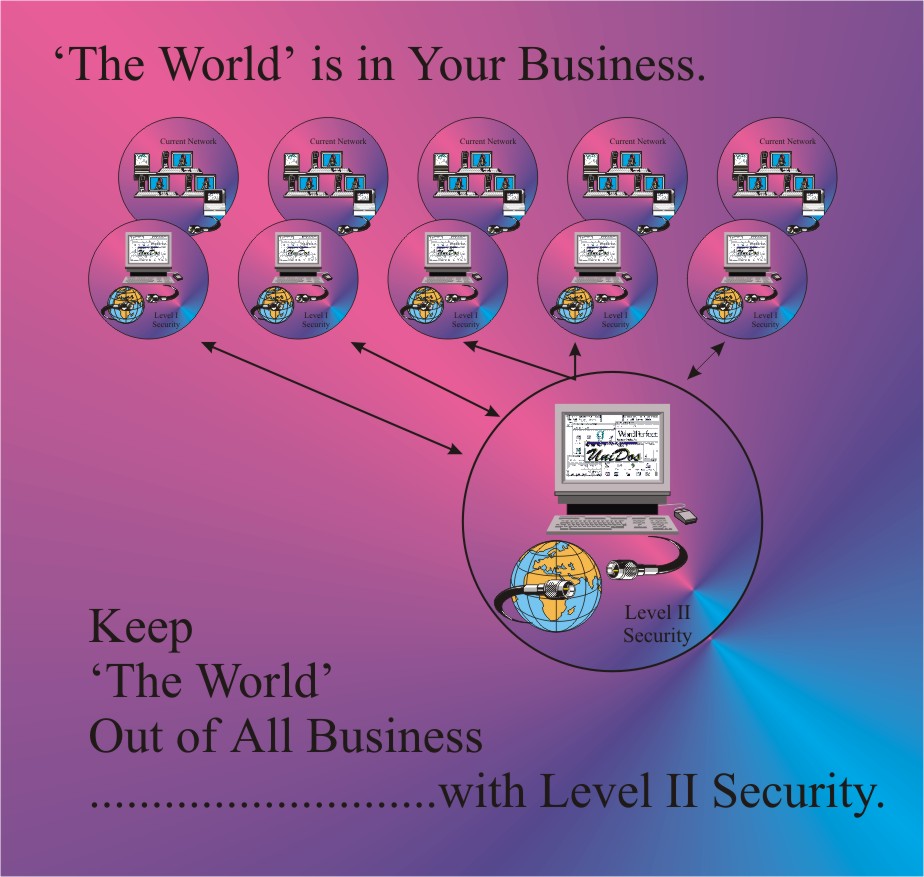
Level II Security adds the Central Repository to Level I Security.
Level II Security constantly communicates with each of the Level I Security Systems installed throughout the world, receiving (and tracing) intruder alerts as they occur, while issuing a warning to all other systems on our network.
Technically (yet simply) stated, Level II Security tracks down any possible intruder attempt, whether from attempts at mere vandalism, from attempts at theft or from cyber-terrorism.
Through the Level II Central Repository, it then immediately shares this information between businesses, stores this attempt and provides reports to the proper authorities.
Level II Security can help thwart cyber-preditors, too.
Note: Level II Security, the second level includes a Central Repository for the storage of information to be shared with all systems sold to the customer. As a result, any information (such as virus information) can immediately be shared within the entire security program network - to all business and government customers sold. This Central Repository should also be redundant and replicating with major stations owned, maintained and operated by IBM, Microsoft, Apple, etc., as well as perhaps Oracle, Informix, etc. (for monthly fees, of course). (Note that we have already begun this level for enterprise-internet capabilities.)
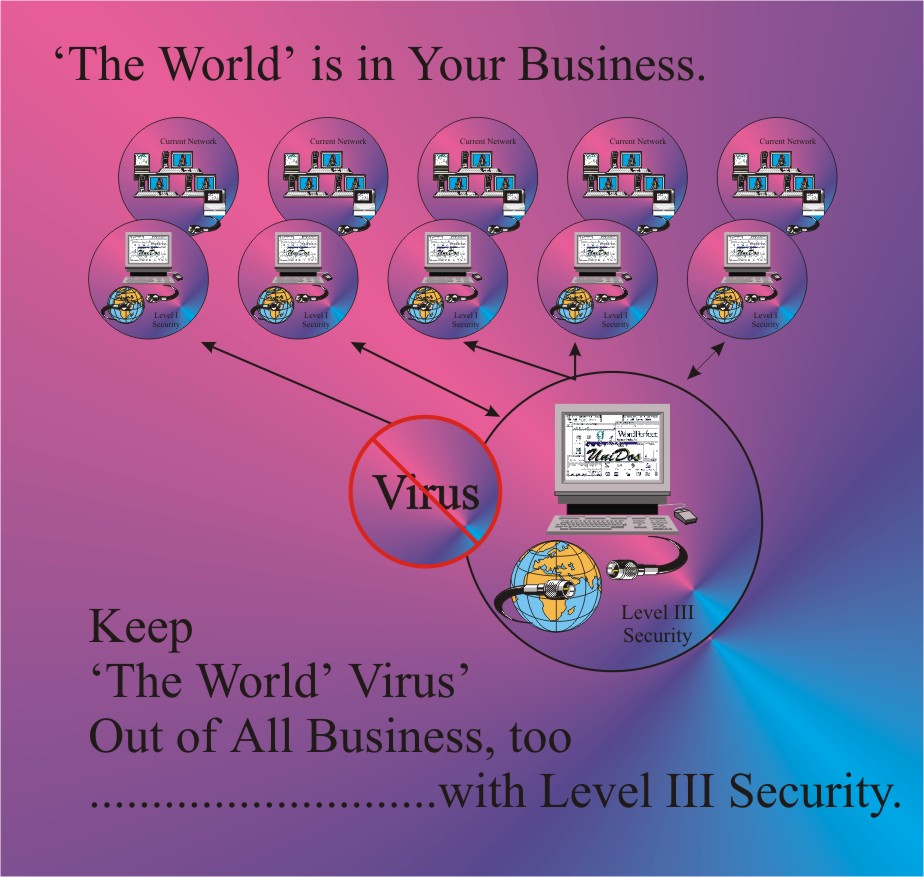
Level III Security adds Virus Protection to the Central Repository Level II Security.
Level III Security constantly communicates with each of the Level I Security Systems installed throughout the world, receiving (and tracing) each virus as they occur, while issuing a warning to all other systems on our network.
Technically (yet simply) stated, Level III Security finds each virus, at their first occurrence, then allows for immediate anti-virus (inoculation) measures.
Through the Level II Central Repository, it then immediately shares this information between businesses, stores this attempt and provides reports to the proper authorities.
Think of Level III Security as a singular Central �Clearinghouse�.
Note: Level III Security, the third level adds Virus Protection to the Central Repository and should be of particular interest in participation by McAfee and Norton, for which any virus detected would immediately be sent to the Central Repository for analysis, etc. and made available to the entire security program network.
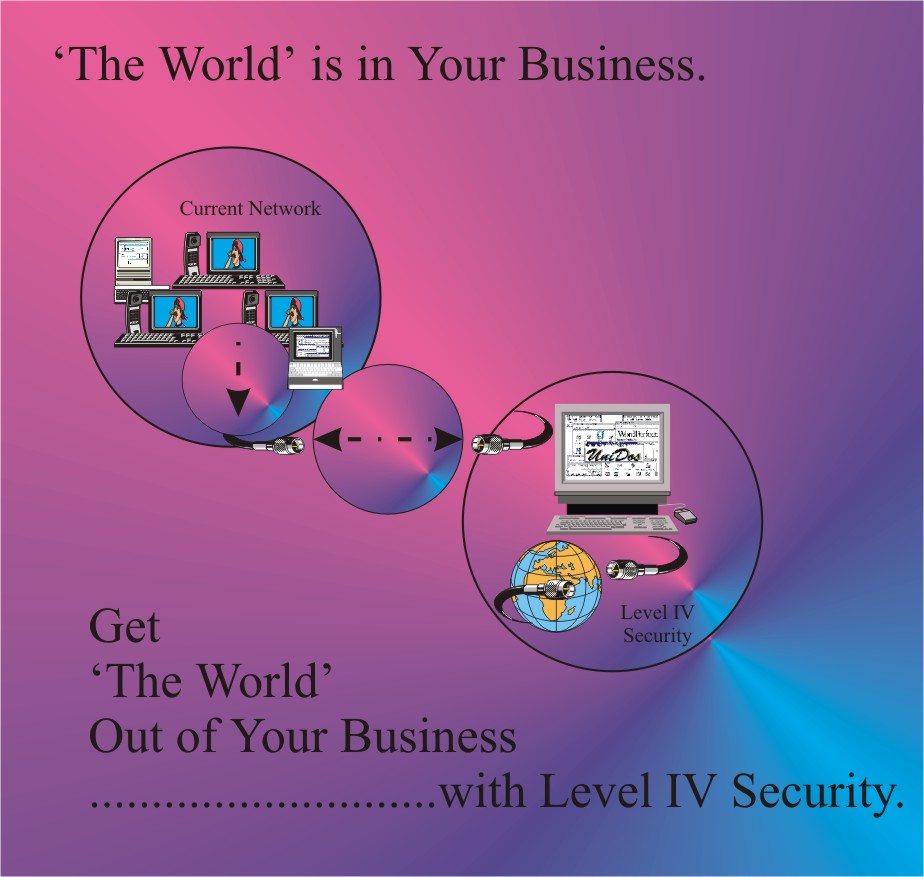
Level IV Security adds Data Encryption to the Level I Security Interface.
Level IV Security merely encrypts your current data in a way that allows you approved access to your data, yet additionally protects your internal network from internal undesired intruders.
Technically (yet simply) stated, Level IV Security provides a multi-level encryption method, which is multi-dimension and (can be) multi-computer, yet �Users� can see whatever you approve them to see.
Level I Security is actually an extremely sophisticated �Encryption Method� that constantly improves upon itself towards the ultimate goal of providing 100% data security.
Note: Level IV Security, the fourth level of security adds to current database design the ability for data encryption (multiple level through my own uncrackable encryption method). This would be of particular interest to Oracle, Informix, Microsoft, Sybase, etc.
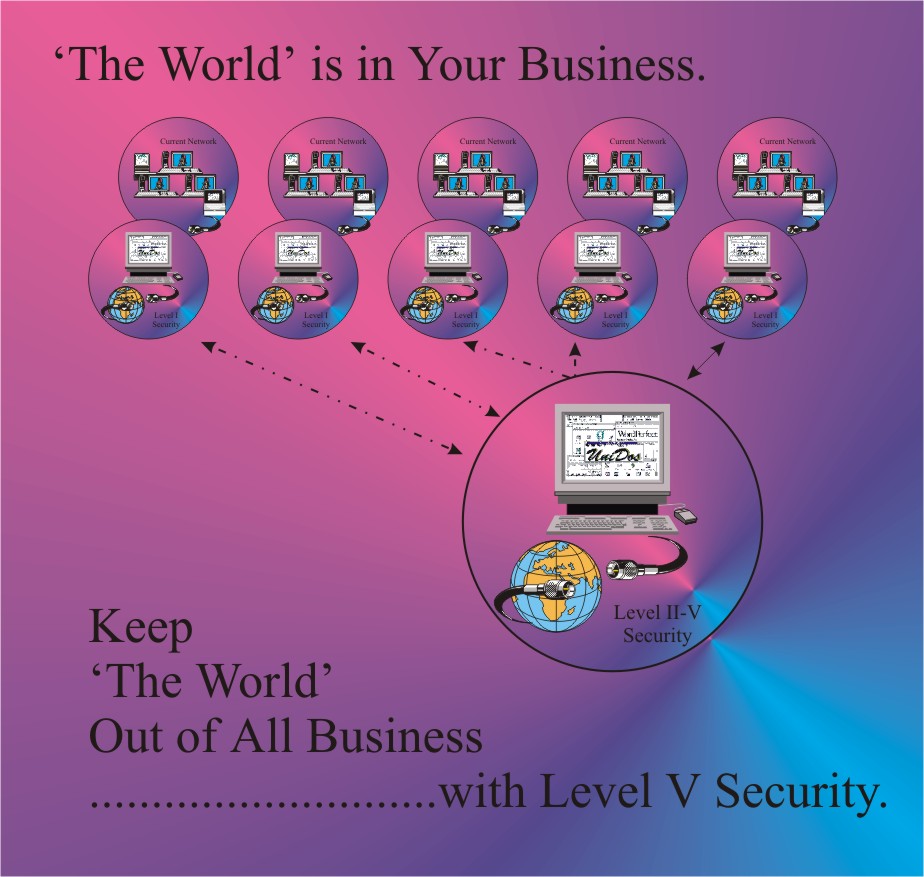
Level V Security improves the delivery of data by extending the Encryption Method of Level IV Security.
Level V Security actually contains two (2) pieces.
First of all, Level V Security allows for the decryption of data to be done at �the Client� level.
The �Browser� or the �Screen� would do the decryption.
This would stop any undesired interceptions.
Secondly, the Level II Central Repository automatically allows for a much higher level of data encryption between Level I systems.
This creates an extremely secure and private network between Level I Security systems, which allows you to work at home with the same confidence as you would have at work, as well as allowing much greater security connections between businesses in the system.
Note: Level V Security, the fifth level of security adds to the data delivery from server to client, both over the internet and over the intranet, by delivering encrypted data from the server and decrypting at the client. This would be of interest to Microsoft (Internet Explorer), America Online (Netscape), SAP (Enterprise Solutions), Oracle (Forms and Reports), etc.
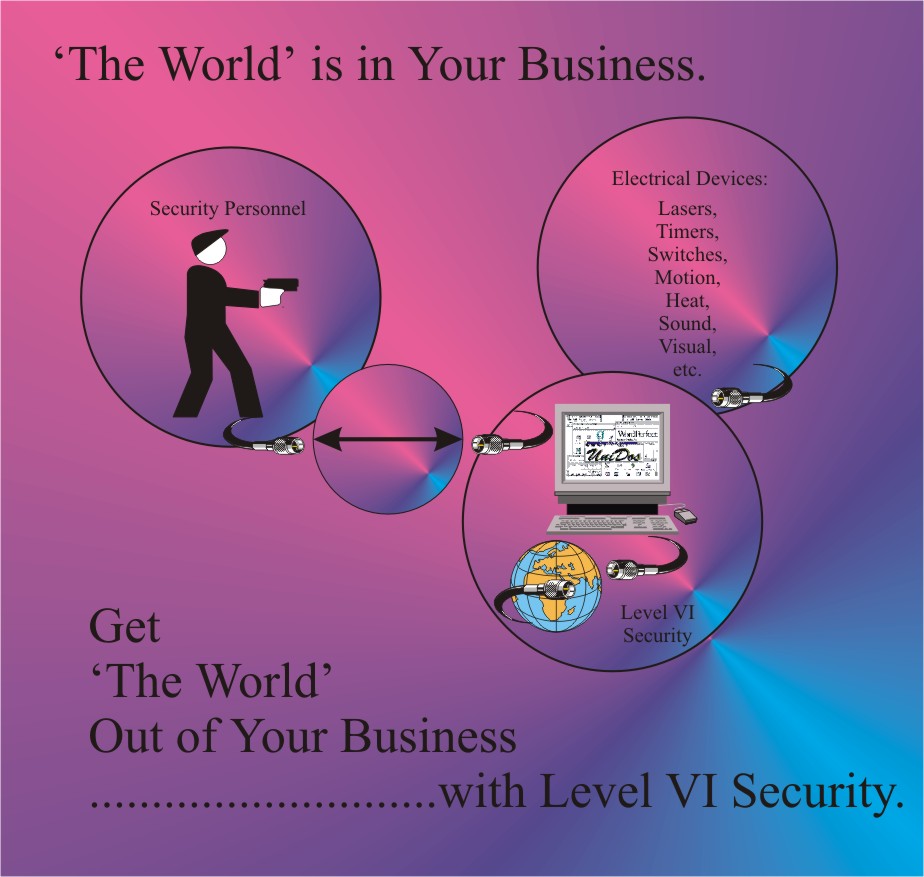
Level VI Security provides for Level I Security to protect itself, as well as to communicate with Security Personnel.
Level VI Security adds the installation into a secure area, with electronic security devices wired into the system.
This allows the Security Program to protect itself. Instantly.
Level VI Security also adds two-way communication with Security Personnel, such as Security Guards or the Police.
This not only allows for the Security Personnel to protect the Security Program, but also allows for the Security Program to help to protect the Security Personnel.
Of course, Level VI Security can help to protect employees, too.
Level VI Security, communicating through the Central Repository, can instantly alert any outside help required.
Note: Level VI Security, the sixth level allows for the hardware security (X10) of the computer system, itself (also in conjuction (teamwork) with "human" security guards) allowing the security program to protect itself from physical intrusion, too.
(Preliminary, June 16, 2002 by Dennis Kennedy)
This design and presentation is based on the Security portion of UniDos as originally designed in 1991.
Note that this is confidential and proprietary information, owned in completion by Dennis Kennedy.
Note also that this is the first public appearance of this information.
Also note that more information about me can be found at ( http://www.advsrv.com/dkflyer ).
(I can be reached by phone at 216-244-7227 and by email at [email protected].)
Author: Dennis Kennedy
Copyright © 1991, 1993, 1998, 2002 dkFlyer
If you have any questions, email me.