
|
Presentation - Library
The Search for The Perfect System
(Or, The Search for Truth within the Hype)
(Note: I explained this concept to Sun Microsystems in 1994 - in actuality, this resulted in 'Java'.)|
(Original writing: June, 1996.)
As a Business and Computer Consultant, the single most frequently asked question that I hear is:
I spent five (5) years (from 1990 to 1995)
During this time, I got to see:
During this time, I also got to see: With Hardware, I tried out Acer, Altos, Apple, Dec (PC and Mini), Dell, Gateway, Hewlett Packard (PC and Mini), IBM (PC, Mini and Mainframe), Intel, Packard Bell, Sun (PC and Mini) and Wyse. In Operating Systems, I tried out Apple A/UX Unix and Macintosh, Berkley BSD Unix and FreeBSD Unix, Dec Vax, HP-BOS (3000), HP-UX Unix 9.xx and 10.xx, IBM AIX Unix and OS/2, Linux Unix, Microsoft Dos, Windows, Windows NT and Xenix, Minix, Novell 3.x, 4.x and Univel and Unixware Unix, SCO Unix and Sun Interactive and Solaris Unix. With Databases, I tried out Clipper, DB2, DBase IV, Visual DBase and Paradox, Informix 3.0, SQL, 4GL and R4GL, Microsoft Access 2.0 and 7.0, FoxPro 2.6 for Dos, Mac, Unix and Windows and 5.0 for Windows and Microsoft SQL, Oracle SQL 6.xx and 7.xx and Pro-C, Progress, RBase and Sybase. In Languages (on many different platforms and versions), I tried out Assembler, Basic and Visual Basic, C, C++ and Java / J++, Cobol, Fortran, Pascal and Delphi and PowerBuilder. With Applications, I tried out Corel Office (WordPerfect), Lotus Smart Suite, Microsoft Office along with many, many packages, such as Aldus (Adobe) PageMaker, CorelDraw, etc. And, I set up Client Server and Peer to Peer Networks with AppleTalk, IPX, MS-Lan, NetBEUI, TCP/IP (with NFS) and TNS (Oracle) over Arcnet, Ethernet and Serial (including SLIP, PPP and UUCP). And, I worked on them all Extensively!
Now, I have my own solution to this question that could |
The Library
|
(Original writing: June, 1996.)
Purchase and Build a Library of Callable Functions
|
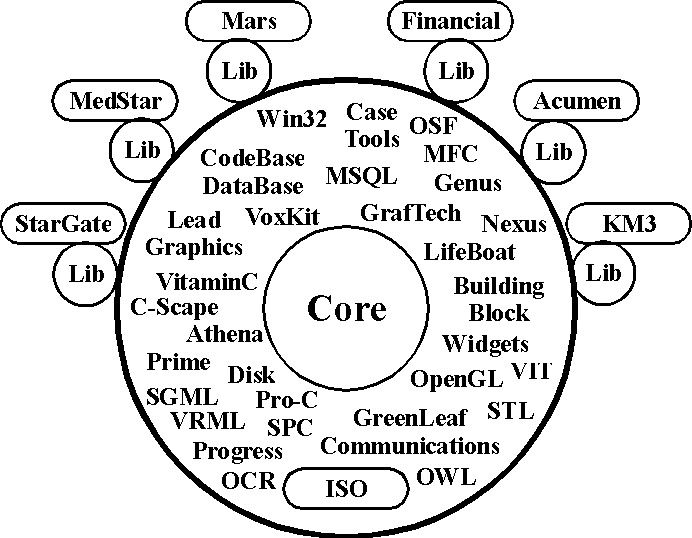
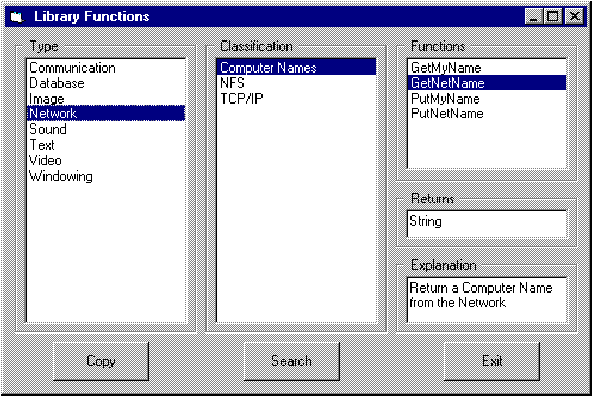
ComputerX
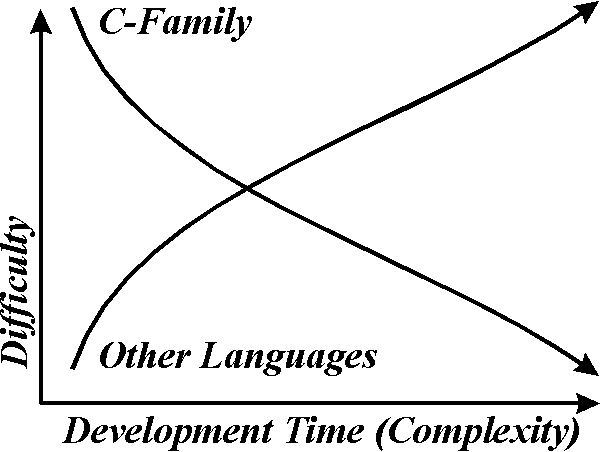
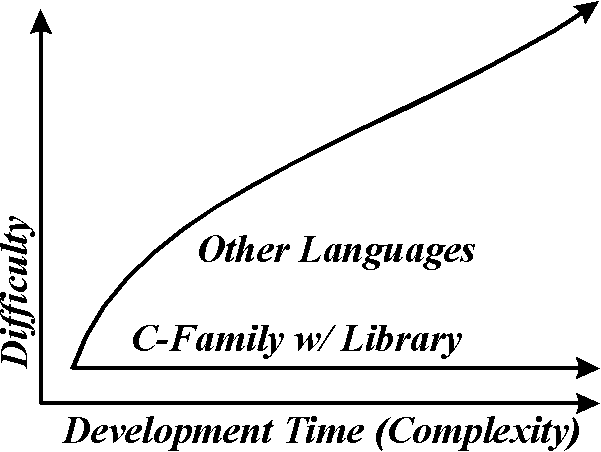
Development Time Lines between Languages
|
(Original writing: June, 1996.)
The Cross-Over Point between Visual Basic and C used to be about 300 Hours. In other words, if you were going to write a Simple Program, you would use VB. If you were going to write a Difficult Program, you would just use C.
Now, with Borland C++ Builder (or Browsers), it is more like 50 Hours or Less.
Basically, Simple Beginnings are meant Only for Simple Programs.
Plus, the ComputerX Principle can be applied to Every Aspect of the Computer.
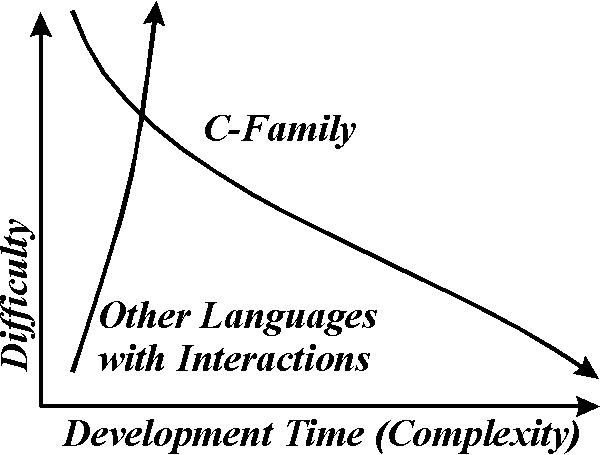
Furthermore, Interacting Programs, such as using ODBC and Extra, or mixing Visual Basic with Access, SQL, Excel, etc. cause Exponentially More Programming Costs, Errors and Headaches which you almost Never get with the C-Family.
Language Work-Arounds cause even More Programming Costs,
Now, the Library would Turn the ComputerX 'Upside Down'.
|
The Perfect System
|
(Original writing: June, 1996.)
Business PC's should work just like 'Mainframe Terminals',
First and foremost comes Hardware.
The following decisions requires the understanding of the costs involved in educating and training From this comes the choice of Operating System and Software.
The primary uses of software include databases, word processing,
Virtually every commercial software package on the market can be purchased in quite similar form with the source code.
So, why would any business even think of buying a 'Hundred' or a 'Thousand' -Site License If you are purchasing five (5) or more of a specific package, you should be purchasing the source code, instead. Then, once you own the source code, you are legally allowed to put your own new program on any and all computers that you choose, saving potentially millions of dollars in purchases, upgrades and education and training costs, as well. You could choose to add sound, images, video, and on and on. Any changes could be either purchased or programmed and you could create several modified versions for different employees and for faster or slower computers, recovering now obsolete hardware.
You would then also have the flexibility of creating your own
I am now using a version of Unix (Linux) that comes with the source code.
And, I am currently working on a Browser / Server (and OS) that supports
And, because I still (temporarily) need to use a few commercial packages Designing and building your own networked computer system, based on current source code available on the market, is by far the cheapest and most reliable method that you could choose today. You could get out of having to learn and use multiple software packages just because one package has one or two different features than another.
You could purchase the source code to create files for, or to link to major commercial software packages such as Excel, Lotus 123, Ami Pro, Word Perfect, Word, etc You could create features specific to your own business needs. You could utilize tremendously cheaper hardware. You could get a bug fixed your own self. You could actually have control. You could even choose to do something absolutely unheard of: You could choose to make your own computer system - simple. |
Turning 'The Presentation' into 'The Plan'
|
(Original writing: June, 1996.)
Buildables |
||
| Item | Comment | |
| We need Numbers on the Failure of the 'Name Brand' PC's. | From our meeting, it was more than 33% (with half of that right 'out of the box') within only 30 days. | |
| We need Costs of the 'Name Brand' PC's to compare with our own. | Our Buildables could also Re-Use the 3Com Ethernet Cards currently in the 'Name Brands'. | |
| We need Facts and Opinions on the Ease of Setting Up and Fixing our Buildables compared with the Difficulties of the 'Name Brand' PC's. | Including the Difficulties in using So Many Different Ethernet Cards, Video Cards, CD-Roms, etc... as well as the Fact that it is Our Buildables that are the Real, Quality PC's, while Theirs are the Generics. | |
Library |
||
|
What was the Cost of our Custom Software Development for the Last One to Five Years? What is in our Budget for Custom Software Development for the Next One to Five Years?
What was the Cost of our Software Purchases (including Licensing)?
What was the Cost of our Software Training (both Custom and Purchased)? |
||
|
What is the Budget for 'Software and Development' (for comparison)? Are we an Alternative? Or, a possibly an extremely inexpensive Hedge if 'Software and Development' doesn't work? |
||
|
How do all of these costs compare with the Total Costs of the Library? |
||
Author: Dennis Kennedy
Copyright © 1996 dkFlyer
If you have any questions, email me.