
Astronomy and Astrology were interwoven and seen as the same study. In working out horoscopes (Janmakundali) the nine planets (plus two mythical demons or evil forces) were considered. The janmakundali�s were a mixture of religion and science. (Birodkar, 2.) With crude instruments, the astronomers of ancient India were able to arrive at near perfect measurement of astronomical movements and predict eclipses. (Birodkar, 3).
There were 27 nakshatras, which are similar to the constellation grids modern astronomers use to plot out the night sky. Nakshatras were important for determining the times of the year, and also can be used to determine the time periods of great historic events that are referred to in ancient Indian texts. The cycle of equinoxes were determined by the Vedic astronomers to be 25,870 years, this was calculated by them many years before modern astronomers were able to determine this number. How they came up with this complicated number is a great mystery. Knowing, for example, that in the Rig Veda they refer to the full moon being in the nakshatra of Janus, this will only happen every 25,870 many years. Therefore the event took place around 4000 B.C.E. (Harris, 1, 2.)
More than seventy temples and shrines have been noted to be aligned in such a way to accentuate the sun (Malville, 1). Many being positioned so that during a solar eclipse the light cascades through the colonnades and corridors of the massive stone buildings. Some temples of Shiva were not truly �sun worshiping� as we think of other cultures, like Egyptians. They believed the sun, as a lesser god, was prostrating itself to the god Shiva. The sun was actually asking forgiveness for his lack of compassion for human suffering. (Malville, 2).
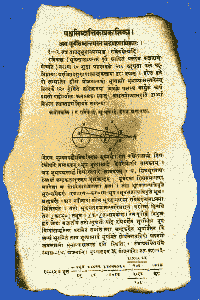
In the 5th century, an Indian astronomer named Aryabhatta made many great contributions to the field of Astronomy, for example he believed the earth was a sphere. He also proposed the Heliocentric theory of gravitation, predating Copernicus by almost one thousand years (Birodkar, 3).
�Sarva Dishanaam, Suryaha, Suryaha, Suryaha.� This is an old Sanskrit verse meaning that there are suns in all directions (Birodkar, 4). This is important because it shows that the Vedic people realized the stars visible at night are similar to the Sun visible during the day. They recognized that the sun is one of many stars.
In the Vedic literature the Sun is referred to as the �center of spheres�, along with a term Gurutvaakarshan (Birodkar, 6). This is the Sanskrit term for gravity, translating as �to the attracted by the Master.� The function of attracting heavenly bodies was attributed to the sun. This means that the Sun is not only the source of all life, the center of creation, but also the center of the universe (solar system) (Birodkar, 5).
This idea of gravity in India was discovered by another astronomer named Brahmagupta in the 7th century. He said: �Bodies fall towards the earth as it is in the nature of the earth to attract bodies, just as it is in the nature of water to flow� (Birodkar, 5). Brahmagupta was also the first astronomer to estimate the circumference of the earth, at 5000 yojanas (Birodkar, 4). A yojanas is around 7.2 kilometers, calculating to be 36,000 kilometers. This is rather close to the actual circumference of 40,075.16 kilometers.
Ancient texts found in Tibet discuss a major revelation as to the technology of ancient India. These texts, referring back to the Rama Empire of 3500 B.C.E., include directions for building and piloting a sort of hovercraft (Childress, 2). It is thought that these ships, called Astras, used some sort of anti-gravity mechanism and were used regularly and often. There were even references in the text to a trip planned to the moon with these mercury fueled ships. In other texts from the Rig Veda, there is reference to great fighting ships, with destructive powers, during a huge war between Rama and another people, thought to be possible Atlanteans. In documents from Alexander the Greats campaign against India, there is witness of �flying, fiery shields� that dove at his troops. In the last century, a city Rishi of Mohen Jodaro, was excavated and they found high readings of nuclear destruction, reading at similar radioactive rates to Hiroshima, Japan (Childress, 4).
Whether these references to great flying machines are true or not we may never know. But, it is known that India had many advances to Greek, Roman, and Persian astronomy. Before Galileo and Copernicus, there were many Vedic astronomers looking into the deep sky, finding our place in this huge galaxy.
1. Malville, J. McKim. �Archaeoastronomy and Cultural Astronomy in India.� Archaeoastronomy and Ethnoastronomy News. Number 15 March Equinox 1995.
2. Harris, Eirik L. �Astronomy of Vedic India.� www.astronomy.pomona.edu/archeo/india/india3.html. Printed 3/29/2004.
3. Childress, D. Hatcher. �Ancient Indian Aircraft Technology.� The Anti-Gravity Handbook. Adventures Unlimited Press. Revised edition 2003.
4. Birodkar, Sudheer. �Ancient India�s Contribution to Astronomy.� http://india.coolatlanta.com/GreatPages/sudheer/astro.html. Printed 4/21/2004.