Making Do with
What You’ve Got
Modern Medical Care in Vilnius, Lithuania
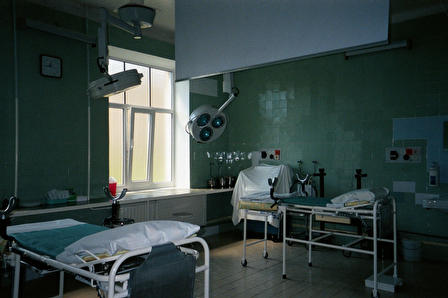
One of three labor and delivery rooms in the Women’s Clinic, Vilnius, Lithuania.
Part One: Medical Rotations
Lithuania
is, in some standards, a very new country: having won independence in 1991,
they’ve had just 12 years to completely change their systems of government,
social structure, and health care. However, Lithuania’s
colorful history includes strong medieval and renaissance city-centers of
science and learning, complete with what was, in the 1700s, some of the most
advanced medical knowledge in Europe. The following 300
years have been difficult for the Baltic people. Wars with different Scandinavian
tribes, Russians, Poles, and more recently, occupation first by WWII Germany
and then annexation into the USSR,
have left the country poor in resources, struggling in autonomy, and in many
ways unable to “catch up” with the technical advancement of their more
affluent, stable European neighbors. My visit to Vilnius,
the capital city of Lithuania,
illustrated this several times over.
I
began my rotation at the Santariškiu Klinikos, a large hospital facility in the
outskirts of the city. It was built in the late 1970s, and most of it has not
been renovated since. Each day, I was paired with a different attending on a
different service, introduced to the residents on service, attended bedside
rounds, and sat in on Grand Rounds in the auditorium. This latter event was
comprised of a rundown of what had occurred on each of the various main
services overnight (in Lithuanian, and a resident would often translate for me)
followed by a lecture given by a senior resident (often in English). The room
was beautiful and up-to-the-minute with incredible sound, slide and laptop
computer projection, and lighting systems. I didn’t fully appreciate the
discrepancy between the furnishings of this room (for education) and those of
patient rooms (for healthcare) until a few days into the rotation. The
difference was amazing.
Patient
rooms housed 2 to 8 patients, and had at least 2 unscreened windows
which were open as often as
possible. Most patients had a bottle of spring water, a large box of juice, and
other foodstuffs on a little table at the bedside – families would bring patients
food and water, as hospital meals were notoriously unpalatable and small in
quantity, and the pipes provided unfiltered and odd-tasting water. Beds were
narrow, metal-framed, and flat, usually without any mechanization or ability to
raise or lower the head or foot. The frame held a thin mattress covered with a
flat sheet, with a lightweight duvet-type covering encased in a worn, removable
cotton sack for the coverings. Perhaps 1 or 2 ports for oxygen were available
for use in any room, some had none. There were, in most routine rooms, no
monitors, no IV stands, no patient call buttons for
the nursing station. One overhead light provided for the entire room during nighttime
hours only. Televisions and telephones were absolutely absent from patient rooms.
The
exceptions, of course, were in the intensive care units. Here, all linens were
white, and most patients had cardiac telemetry (a continuous computerized
monitoring of heart activity). Beds were positionable and IVs were occasionally
seen. However, windows remained wide open, the breeze ruffling the gown of a
woman who’d had an MI (heart attack) the day before. In the bone marrow
transplant unit, windows were shut – perhaps the only few rooms in the hospital
where this was the case, and necessarily so as patients here cannot fight any
sort of infection on their own. And only in this ward did I see a TV: a small
black and white unit, brought in by the patient himself, as he could have no
visitors and could not leave his 8x8’ room until his leukemia-destroyed immune
system became stronger.
Most
of my days were observational in nature, as the majority of patients over the
age of 25 or so spoke only Lithuanian or Russian (as they had been forced to
learn and speak during the Soviet era). I learned that hospitalization was the
norm for wealthier patients requiring seemingly routine clinic-based,
outpatient workups of common conditions had they been in the US.
Checking out a patient with high blood pressure to rule out rare but curable
causes of the disease, or figuring out an appropriate insulin dosage and
schedule for a diabetic, usually meant admission to a newly-painted wing of the
uppermost floors of the hospital. The system doesn’t allow for procedures or
tests in clinic settings, but pays for hospitalization and services for patients
who could help defray cost. Few can afford this luxury. The alternative: no
workup at all. Preventive care is infrequent, and patients are treated once
problems have already occurred.
Patients
without money, and who are not surgical candidates, are far worse off. If you
need medication in Lithuania,
you must pay for it. While prices for most pharmaceuticals are a fraction of
what they cost in the US,
they remain too high for a substantial portion of the country’s citizens. If
you cannot pay for it, you will not get it. This was starkly illustrated for me
when rounding with the pulmonary team in an internal medicine ward. I met a
woman in her early 20s, hospitalized with a particular viral pneumonia. She had
underlying airway disease, and her situation was staying the same and occasionally
worsening. She could not afford the antiviral medication that would have
treated her pneumonia, and therefore, she did not receive it. In the weeks to
come her doctors would watch her battle the illness, improving or dying
depending on the strength of her immune system. An attending physician told me
that it really was fine that she couldn’t afford it; the hospital didn’t stock her
medication, anyways.
Surgical
patients are a completely different story in the Lithuanian health care system.
Patients do not have to pay for necessary surgery, and their hospitalization
cost – in this case, including medications, IV therapy, and the like – is
covered in large part if not completely. Needed surgery could be coronary
bypass, appendectomy, toenail removal, or tonsillectomy, as anything if it is necessary
to do in order to restore health.
I
spent two days on the general surgery service, scrubbing in on a variety of
surgical cases as an assistant. I saw a lap chole (gallbladder removal using
only small incisions and a tiny camera), and the technical skill of the
surgeons was better than any I’d observed doing the same procedure in the U.S.
I observed a repair of an abdominal wall hernia which had grown to
approximately the size of a basketball. For the most part, surgical suites and
procedures were very similar to those I’m used to at home. Most differences
were due to equipment and material and would be the same differences I’d see
comparing the US
to most any Western European country. Others were due to a consciousness of how
much materials cost, and a concerted effort to use cheap materials whenever
possible. Sutures were used instead of staples; “one time use” equipment was
thoroughly sterilized and re-used after determination that it had not become
unsafe to use again (i.e., no cracks, holes, or defects). Days from surgery to
patient discharge was comparable to our hospitals.
I
spent one additional day in surgery, and was introduced to the director of the
cardiothoracic surgery division and invited to scrub on heart cases. I
participated in an aortic valve replacement, an open-heart procedure requiring
heart-lung bypass. To hold the beating heart of a human being in my hands was
one of the most profound moments I’ve had in medicine. The procedure went
smoothly and the patient did well with her new heart valve. I visited another
suite where a 3 week old baby was having his heart repaired in order to
survive. I watched as several patients underwent cardiac catheterization,
screens in the observation room showing us the arteries of the heart as x-ray
sensitive intravenous dye coursed through them. An enthusiastic cardiology
resident told me about an exciting new theory of heart disease involving both the
muscular layer and the innermost cell layer of the arteries, and his study
using two IV agents – one to constrict
the arteries, and
another to open them again – during these catheterizations. While he obtained
verbal consent (how “informed” this consent was remains muddled) from each
patient, he readily explained that he could never publish his data: what he was
doing was dangerous, unprecedented, and without placebo control. It was not
approved by an ethics or human subjects committee. He had never asked for such
approval. Others are aware of his investigation, and it continues openly. It is
likely that he will continue until there is an adverse effect. Unfortunately,
that effect may be the death of the patient, but the “study” continues, and no
one seems concerned with the issue.
In
working with the residents on the various services and spending time with them
discussing medicine both on the wards and over a cup of coffee at the end of
the day, it became clear to me that medical education in Vilnius
is wonderful. Their texts are in English, German, or Russian, and are of the
same vintage as mine. They access the internet to research new drugs,
procedures, and theories of disease. They learn about the newest technology and
are instructed in its use. However, after my time at Santariškiu, some of it
seemed to be a waste. There is simply not enough money in the pockets of the
healthcare institutions or their patients to make use of these wonderful
medications and technology. One knows that the means exists to help patients a great deal, but often that means is not
available. Most doctors go to the US,
Canada, Australia,
or to Western Europe for advanced training in their
specialty field. But unless they themselves or their institution can afford the
technology it may require, the additional income that comes with a bigger
patient load – in part attracted by the prestige of a certificate from a
respected foreign program – is at times the only perk. The patient benefits
from more knowledge about diseases and affordable prevention and treatments,
but with the narrowing of specialization in so many fields and the cost that
comes with it, true patient benefit lags because of the country’s financial
woes.
After
Santariškiu, I spent a few days at the Moterų
Klinikos, the Women’s Clinic. A stream of patients requiring ultrasounds
took up my first morning in a suite in the corner of the large building, unlit
and with high ceilings and open windows covered by white-painted iron bars.
Women came for abdominal ultrasounds to see their fetuses and determine both
due date and the health of the baby. Others came for pelvic ultrasounds to
evaluate the potential causes of pain, bleeding, or palpable masses. They
waited together in a small yellow room on black padded benches, entering one by
one and lying on the low examining table with their tummies exposed. Others
requiring the vaginal ultrasound probe were given a hint of privacy behind a
folding screen for her undressing, but the exam was conducted in front of an
audience of two (the doctor performing the exam, and
the nurse recording the results) to six (depending on how many other residents
and students were there). There was no embarrassment on the part of the
patients or residents; the lack of privacy was the norm. (Not having your
fellow patients also watching was, for some who remember similar experiences
from only ten years before, was a new luxury – and there is little “patient
demand” at all to be catered to.) Residents took turns operating the new,
sophisticated GE machine with its screen instructions and labels all in
English. Women went away happy with ultrasound pictures of their children in
utero for the first time ever, or a slip of paper with medical mumbo-jumbo for
their doctor to decipher for them at their next visit.
The
labor and delivery ward was starkly different from most in the US.
Women came in to be evaluated, and were done so in front of any other patients
who might have arrived at the same time. Those who complications of pregnancy
or premature labor were shuffled into bright, sunny inpatient rooms housing 4-6
women. They dressed in everyday clothes, and as had become familiar to me
earlier, often had food and drink provided by family and friends. As many came
from villages far away from the Klinikos, they stayed in the ward (sometimes
for weeks) rather than going home and returning for frequent, even daily,
clinic appointments.
Women
in labor were registered, given a hospital gown, and ushered into a delivery
room (see photo, above). They were given an enema, a pillow, a sheet if they
requested, and hooked up to a blood pressure and fetal monitor. She was then
left alone to labor in an unfriendly, sterile room full of cold tile and metal.
Her husband could accompany her if arrange before, but most preferred to pace
the hallway near the entrance to the clinic. Many smoked cigarettes and waited
for the infrequent updates provided by nurses with a free moment. The rate of Cesarean
Section was 25%, and 33% received episiotomies – a routine procedure for some
staff doctors. Forceps were not used, and vacuum extraction was rare. 86% of
live births were full-term babies. I had the privilege of observing two
deliveries, both done by kind resident doctors who interacted very little
verbally with their patients. Moms were left half-naked and shaking from their
body’s own hormones and contractions, unsure if they could cover themselves
again. Their labor pains and cries were familiar, but they asked few questions
and only rarely had requests of nursing staff. Little explanation of any
procedures on mom or baby occurred, and for most aspects of labor and delivery
the mother was given few or no options or information. It seemed, as was the
case nearly everywhere I’d rounded so far, that a “this is the way it is” mentality
pervaded medicine and a paternalistic air hung thickly in the hospitals and
clinics. No one protested, though, and perhaps the lack of vocal
dissatisfaction is part of what has resulted in little change in the approach
to the patient over the last several decades in Vilnius.
This
is not the same all over Lithuania,
however; in Kaunas, midwives are
more popular, and the patient is much more involved in the process. Delivery
suites are private and comfortable, and WHO standards are adhered to much more tightly. A sociologist living in a town halfway
between Kaunas and Vilnius
and who has studied and worked in the healthcare field in both cities explained
that the Soviet style of medicine has persisted moreso in Vilnius
than anywhere else, and either patient protest (unlikely) or strong outside
influence would be vehicles for change in the system. She sees it as a slow
process but believes that as more young people begin to move about the country,
and foreign business moves in, the picture of healthcare will change.
In
some places, this picture *has* changed. I spent time in two private clinics,
run independently by general practitioners in the heart of the city. Clean,
spacious offices with modern equipment and a Western feel (plus a
fee-for-service setup) offered exams, procedures, advice, prescriptions, and
referrals for patient problems. In one clinic, I was offered the opportunity to
examine patients and discuss diagnoses and differences in how we would treat
patients in our respective countries. Patients were pleased at the ease of
getting appointments, not waiting in crowded waiting rooms for hours on end,
the proximity of the clinics, and the relaxed atmosphere. Most patients were
middle class or well to do individuals or families, and some expressed
dissatisfaction with care received at other larger state-paid facilities which
cater to the population at large. Since they have the money to purchase care
that would be free, but less comfortable, elsewhere, they do. Money is talking
in Lithuania, and
enterprising young doctors are listening.
My
final days in Vilnius were spent at
the Baltic-American Clinic, a unique institution in Lithuania.
It was founded by a Lithuanian-American podiatrist who saw the need for
Western-style health care in the midst of what he (an American-born, educated,
and medically trained man) saw as suboptimal care. He brought together a small
group of nurses and primary care doctors and convinced a local hospital to
allow use of a small, unused wing for his clinic. He ensured that all staff
spoke both fluent English and Lithuanian, and hired an additional person to
process insurance claims. The clinic formed affiliations with 30 specialists
who came to the clinic anywhere from twice a week to once a month, depending on
demand. The clinic billed itself as being a Western medical clinic, and
developed a clientele of wealthy Lithuanians and expatriates from a variety of
countries worldwide. As it required no upfront payment from those with insurance
(even foreign), and left financial dealings to the insurance company and
patient themselves, it became popular with foreign ambassadors and their
families, business visitors, and American tourists. They bill for services at a
rate comparable to rates where the patient resides (outside Lithuania),
which is without exception many times higher than what the state would
reimburse for identical care for one of its citizens. However, after the
initial investment of furnishings for exam rooms, inpatient facilities and equipment , they found little overhead cost. They have
turned a healthy profit and will move to their own clinic building within the
year.
Here,
I could participate in medicine the way medical students can in their rotations
in the hospitals and clinics in the US.
The clinic had three exam rooms plus two inpatient rooms, as well as an OR
where affiliated doctors could provide nearly any procedure a patient required.
I could see (and speak to) patients and be involved with their care much more
fully, and as most patients were English speaking (being either American or
from elsewhere in Europe, leaving English as the only
common language between themselves and clinic staff) could discuss their
perspectives on Lithuanian medical care as compared to their expectations and
experiences at “home.” One woman expressed her great relief at the clinic’s
practice of sending one of their own staff nurses with a pregnant woman to the
Women’s Clinic when it came time for delivery, to act as a go-between and fill
in the gaps between the women’s expectations and desires and what the
Lithuanian medical staff there was used to providing. Staff is paid well, and
as the clinic director said, there is hope that the clinic will serve as an
example for others regarding health care standards of care and patient service.
She acknowledged that foreign investment will be crucial to development of an
affordable healthcare system, and pointed to the clinic’s commitment to pro bono work, especially for poor
children, as a way to both provide excellent care and introduce a desire for
better care into the population at large. With money in the system, the system
itself may be able to slowly change when and if patients begin to demand more
from it. She is optimistic and excited.
Part Two: Expectations and Contributions
My
contribution to the facilities I visited was mostly in the form of answering
questions about American medical education and current methods of diagnosis and
treatment. In this, my contributions were not what I had expected: I was unable
to provide hands-on care for the vast majority of my rotation. Low patient
volume amenable to residents’ care, paired with the system in place of medical
students not having hands-on experience until their last year (and usually not
substantially until well into the intern year) placed me, a 3rd year
medical student (equivalent to their 5th year) in a position of
observation almost exclusively.
I
had the great fortune of accidentally lining up my various sites for this in an
ideal order. I went from scenarios of health care that were the most foreign
and seemingly unfair to those that were familiar and full of hope for the
future. I also was lucky enough not to know what at all to expect when I got
off the plane in Vilnius. The 30
year lack of renovation at Santariškiu, the necessity of using reclaimed brick
from buildings bombed during WWII to build a clinic for women because there was
no room for obstetrics in the main hospital nor money to build a new,
well-equipped building, and the absence of the drug acyclovir for my CMV
pneumonia patient were specific illustrations of what I found most difficult
about the rotation – a feeling of great injustice at my privileged education
and ability to provide treatment I’d learned about versus that of my colleagues
in the country of my heritage. Everyone asked me why I, an American, had chosen
to come to Lithuania
for a medical school experience. No matter how I tried to explain my desire to
see their medicine at work, to observe the similarities and differences, to
understand how one makes do with what one has – the only explanation that
seemed to make sense to anyone was that I have family here. I felt defeated in
being unable to share reasons that were much more important to me in a way that
made sense to my conversation partners.
As
evidenced by my proposal, I also expected to get a much better picture of the
current face of HIV/AIDS in Lithuania.
Here, I ran into a large brick wall. There are still public education campaigns
in the form of posters at bus stops which focus on awareness rather than
treatment or prevention. (As a first step, it’s wonderful. But after 5 years since
I saw my first awareness campaign there, I’d hoped that the public campaigns
had advanced to address the subsequent issues as well.) An AIDS hotline in the
city was Lithuanian-speaking only, and served to counsel scared locals about
prevention and testing moreso than providing resources or statistics for the
medical community. No doctors I worked with had ever treated an HIV-positive
patient, to the best of their knowledge, nor ordered an HIV test. A nurse at
the Women’s Clinic stated that HIV testing was offered in pregnancy, but there
were few takers. An English-language tourism magazine noted that the gay and
lesbian community in Lithuania
is virtually nonexistent except a very small expatriate population, and that
sexual and health education in schools is poor at best. Some complained that
the only AIDS or sex education was sponsored by condom companies, and that the
only reason for the education was so that these companies could sell their
products and make money. Denial that a problem existed, or that drugs were
effective at treating the disease, frequently cropped up in my conversations
with nonmedical acquaintances. An attitude that victims had deserved or brought
the disease on themselves was mildly pervasive, as was the thought that no one
engaged in behaviors that would make HIV an issue for Lithuanians. The very
young mothers, attitudes and behaviors of youth in public, and casual
conversation with high school and university students in Vilnius quickly made
apparent that risky behavior was rampant and protection unpopular. However, the
information I could find showed that the incidence of HIV in Lithuania
remains very low. A combination of xenophobia and Catholic roots seem to be the
main psychological weapons against AIDS. The medical community with which I had
contact seemed uninterested in HIV as a local issue.
Part Three: Fellowship Money Usage
The
majority of my fellowship was used for airfare to and from Lithuania.
The remainder was used for my lodging in Vilnius,
public ground transportation to/from and within the city, and my meals. Because
I was required to purchase separate tickets to Europe
and then on to Vilnius in order to
stay within my budget, fellowship monies also went towards a one night hotel
stay and transportation to/from the intermediate airport. A very small amount
went towards personal items (i.e., toiletries) while living in Vilnius.
No other monies were received to support this study abroad experience.
Part Four: Advice
If
any student wished to do a rotation in Lithuania,
I have a couple of specific pieces of advice – some may be worthwhile in other
Eastern Bloc countries as well, and perhaps other
areas in Western Europe. The first: look at plane fares
from your location to your final destination. Then break your trip into two
smaller hops, and search for fares for them individually. For instance, I
discovered that Minneapolis to Vilnius
was prohibitively expensive, despite having plenty of time before my trip. I
found that flights from Paris or Amsterdam
to Vilnius were relatively
inexpensive, and finding an excellent student ticket to Paris
was easy. I’d recommend using Student Universe (the student division of Orbitz)
online for fares. Also, if you are under 26 years old, SAS has excellent deals
into and around Scandinavia. (Beware, though, your seat
will invariably be in one of the last two rows!)
For
Vilnius in particular, I’d
recommend arranging a rotation through a university or medical school directly,
rather than on your own. Preceptors are great, but being part of a structured
program may be a better experience depending on your perspective. Knowing the
language is imperative for direct enrollment in a rotation, though. (This was
my hitch.) Public transportation is
wonderful, and housing can be found relatively cheaply, even for an apartment.
The Lithuanian youth are wonderful, so don’t fear apartment-sharing. It works
well!
Overall
my experience was thoroughly enjoyable and fun, and I’d
do it again in a heartbeat!!!