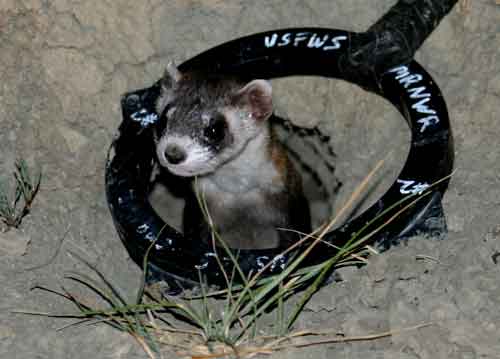
While a lack of large patches of habitat and disease may explain the failure of some sites to maintain a self-sustaining ferret populatin, an alternative explanation may be the role of fine-scale habitat quality. How ferrets use and select for areas on a prairie dog town and what characteristics are critical for female ferrets with litters are critical questions that need to be addressed.
My research focuses on the use of newly developed spatially explicit resource selection models to assess ferret resource selection at a fine-scale based on the spatial distribution of prairie dogs.
I believe that detailed investigations into ferret resource selection will refine how we currently assess habitat suitability and suggest ways of creating and enhancing habitat for long-term ferret recovery.
To learn more, the link to the right contains my MS thesis completed in May 2007.