home | what's new? | tips | bad things | calendar | q & a | resources | links | contact | guestbook
How to do a Slip Stitch

A lot of the instructions on my site will call for finishing with a slipstitch. Usually in pillows, but anything that requires a turning right side out of the project and the need to sew it shut. The idea of the stitch is to one, close the sewing project, and two, be invisible.
Now, to avoid confusing you beyond all comprehension, I am going to copy word for word the instructions for the slipstitch out of my favorite sewing book, Reader's Digest Complete Guide to Sewing: Revised and Updated Step-by-step Techniques for Making Clothes and Home Furnishings. This is from their Glossary of Hand Stitches, pg 146.
|
Slipstitch This is an almost invisible stitch formed by slipping the thread under a fold of fabric. It can be used to join two folded edges, or one folded edge to a flat surface. Even Slipstitch is used to join two folded edges. It is a fast and easy way to mend a seam from the right side, especially one that would be difficult to reach from the inside. Work from right to left. Fasten thread and bring needle and thread out through one folded edge. For the first and each succeeding stitch, slip needle through fold of opposite edge for about 1/4 inch; bring needle out and draw the thread through. Continue to slip the needle and thread through the opposing folded edges.
Uneven Slipstitch, also known as slipstitch hemming, is used to join a folded edge to a flat surface. Besides being a flat hemming stitch, it is useful for attaching patch pockets, trims, and coat and jacket linings, as well as for securing the edges of a facing to zipper tapes. Work from right to left. Fasten thread and bring needle and thread out through the folded edge. Opposite, in the garment, take a small stitch, catching only a few threads of the garment fabric. Opposite this stitch, in the folded edge, insert needle and slip it through the fold for about 1/4 inch, then bring the needle out and draw the thread through. Continue alternating stitches from garment to fold. |
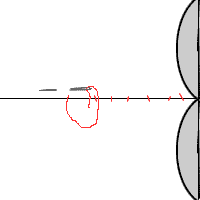
So, that is the official instruct from the book. See why I didn't want to try to explain it? Basically, read this over a couple times, study the pictures, and it should come to you. It took me about five stitches to figure out why my stitching was not invisible the first time I did this. But once you get the hang of it, you're projects will go from amateur to pro.

Click to subscribe to the Cat Smith DIYing Newsletter!!
home | what's new? | bad things | tips | calendar | askCat | resources | contact | guestbook
Cat Smith DIYing and its contents are ©2002
Contact the Web Mistress regarding any questions, comments or problems:
DIYgothicCatGrrl