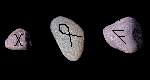
Runes
Overview
Runes are very similar to the Tarot or the I Ching (we mightbe covering I Ching
later in the book). The difference is that Runes are a set of 25 stones instead of 78 cards or a set of sticks
with patterns. As with the Tarot, most of the Runes may be rightside up, or up side down, the meaning
differing with the case. There are also some Runes that can not appear up side down. In practice, the
Runes may be made of any material; ceramic, stones, sticks, or drawn on cards.66
History
Before the Germanic peoples of ancient Western Europe possessed a true alphabet, they used pictorial symbols
to carve into stones their ideas and thoughts. The earliest of these pictorial writings date from about
1300 BC. They were probably linked to Sun and Fertility cults. Among the signs were parts of the human body,
weapons, animals and variations on the circle, square, and swastika. These pictoglyphs later evolved into the
more abstract glyphs that were composed of lines resembling no particular objects. That there was power
endowed to those who were adept at the use of these glyphs is indicated by the name given to the glyphs
themselves. These glyphs were called Runes, from the Gothic Runa, meaning 'a secret thing, a mystery.' The
Runic letter or Runastafr was use to foretell the future by Runemal, or the casting of the Runes. The
Runes were inscribed into tools, weapons, rocks, alters, and other personal items. Runes were also used
by the clergy as an alternative to the Latin alphabet.
It is believed that Runes were derived from a northern
Etruscan alphabet used among Italic tribes in the Eastern Alps. They may have been developed by people
living in the area of Bohemia. From the beginning Runes were used for the casting of lots, for divination
and to evoke higher powers that might influence the 'luck' of man. There were Runes that influenced the
weather, the harvest, curses, the tides, love, and healing. The Practicianer of Runemal was easily
recognizable by the very clothing they wore. As the 13th century author of the 'Saga of Erik the Red' said,
"She wore a cloak set with stones along the hem. Around her neck and covering her head she wore a hood
lined with white catskins. In one hand she carried a staff with a knob on the end and her belt, holding
together her long dress, hung a charm pouch." As you can also see from this passage, many of the Rune
Masters were women. As time wore on, the Runes themselves became standardized through out Europe.
Although in some places the Runes numbered as many as 36 or as few as 16. Twenty-four of these were the
basic Runes, or futhark. The name futhark comes from the first 6 Runes. There were 3 families of 8 Runes
each, named after the Norse Gods Freyr, Hagal and Tyr. These three aettir, as they were called were:
Freyr's Eight: Fehu, Uruz, Thurisaz, Ansuz, Raido,
Kano, Gebo, Wunjo
Hagal's Eight: Hagalaz, Nauthiz, Isa, Jera,
Eihwaz, Perth, Algiz, Sowelu
Tyr's Eight: Teiwaz, Berkana, Ehwaz,
Mannaz, Laguz, Inguz, Othila, Dagaz.
The Anglo-Saxons are credited with spreading Runes and Runecraft through out Europe. It is unfortunate that
more than 300 years ago the last of the Rune Masters died taking with them the true art of Rune casting. In
recent years people such as Ralph Blum have tired to revive the ancient art of Rune Casting through books,
casting Runes, and through research into ancient books and manuscripts for references to Runes.



27