Palmistry
FINGERS
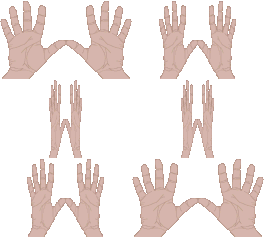
Each finger has three phalanges/parts : the one on which the nail grows is the first phalange, the next to it is the middle phalange and the one adjacent to the palm is the third phalange.
The finger next to the thumb is called the Index finger. It represents the ego of a person and his desire for recognition or prestige. If the Index finger is longer than normal it is indicative of a person's desire to dominate others; smaller than normal it represents a lack of ambition. Such a person is only a follower, never a leader.
The finger next to the Index finger is called the Middle finger. It represents the balance of mind, sagacity and the love of solitude. It is, in most cases, longer than the rest of the digits or fingers. If it is equal in length to the index or the third, or Ring finger, it is supposed to be a small middle finger. A person with such a finger will be petty-minded and those having a very long middle finger shy away from human company.
The third or the Ring finger is indicative of a person's desire for ostentation and fame. A person with a small ring finger is totally devoid of the tendency towards ostentation. Nor do persons with such fingers take any risks. If the Ring finger is longer than usual, i.e., if it is longer than the Index finger, a person would be given to too much ostentation and would love to take risks. Those risks include speculation, gambling and other games of chance.
The fourth or the Little finger represents eloquence and wit. A Little finger which extends to the end of the first phalange of the third finger is considered to be of average length. If it is longer, these qualities become more pronounced in a person. Converse is the case if the finger is of less than average length. A person with a small Little finger suffers from an inferiority complex and he does not have the courage to speak out his mind.
MOUNTS
Palmistry divides the palm into nine divisions. They are called the Mounts.
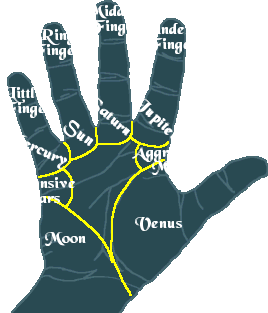
Each palm has nine zones or pads more popularly known as Mounts. Each mount denotes mental as well as physical peculiarities etc of the individual. The mounts are Jupiter, Saturn, Sun, Mercury, Moon, Venus, and Mars- Lower, Mars-upper.
The mount at the base of the index finger indicates a person's desire to lead others, his ambitions and his ego. Palmists call it the Mount of Jupiter. That is why the finger has the peculiarities of Jupiter.
The small area at the base of the middle
finger is indicative of the placidity of character, the analytical power, the
desire for worldly goods and the yen for solitude. It has been named after
Saturn as the Mount of Saturn.
The Mount of Saturn is generally found in a depressed state, but, because the
finger associated with it, the Middle one, is longer than the rest, it offsets
the deficiency The middle finger has all the peculiarities of Saturn.
The small area below the third or ring finger, is indicative of a person's zeal, desire for ostentation and the love of fine arts. It is called the Mount of the Sun or Apollo and the third finger has all the peculiarities of Sun.
The area below the little finger is indicative of a person's pragmatic bent of mind and eloquence. It is named as the Mount of Mercury and this finger has all the peculiarities of Mercury
A small area below the Mount of Mercury is indicative of a person's patience. Western palmistry calls it the Upper Mars (Defensive Mars). The area below the Mount of Jupiter is called the Lower Mars( Aggressive Mars) by Western palmists. It is indicative of the amount of courage a person has.
The area below the Defensive Mars, extending up to the edge of the palm in one direction and the wrist in the other represents the imagination and the desire for change in a person. This area is known as the Mount of the Moon.
The area under the Aggressive Mars which extends from the base of the thumb to the wrist shows the sex urge, the vitality and the amount of human sympathy in a person. It has been named as the Mount of Venus.
The area which lies within these mounts is known as the Plain of Mars. If it appears to be full, a person has excess of physical strength and he does not easily lose courage. If it is depressed, a person loses courage in the struggle for life. If a mount in the palm is prominent, it is known as a developed mount. A person having a particular mount in a developed state is likely to have the qualities associated with that mount. Converse is the case if a mount is depressed or under-developed.



19