War protester talks from heart
Thousands of protesters rally against war with Iraq
Woman recalls Gulf conflict Thousands march peacefully
CATHERINE PORTER
STAFF REPORTER
When Yanar Mohammed grabbed the microphone yesterday to protest a potential
American-led war on Iraq, she spoke from her heart — and experience.
Baghdad was her home the last time American bombs lit up the midnight sky.
"When we were under Saddam's oppression, we thought we were living in hell," her voice echoed over the clumps of shivering protesters flooding Queen's Park. "We learnt what that was only when the American planes came and bombed us. That showed us really what hell is."
The 42-year-old woman — who joined the diaspora of refugees fleeing Iraq after the Gulf War — was just one of many speakers who addressed the crowd, estimated at between 3,000 and 6,000, that gathered yesterday to protest peacefully economic sanctions and the possibility of war against Iraq.
The protest, which stretched several blocks down University Ave. for four hours, was largely peaceful. There were no reports of arrests. Similar demonstrations are planned in 25 cities across the country today.
U.N. weapons inspectors are going to Iraq next week, after being given approval by President Saddam Hussein. But U.S. President George Bush says he's set to declare war if Iraq doesn't comply with the inspection program.
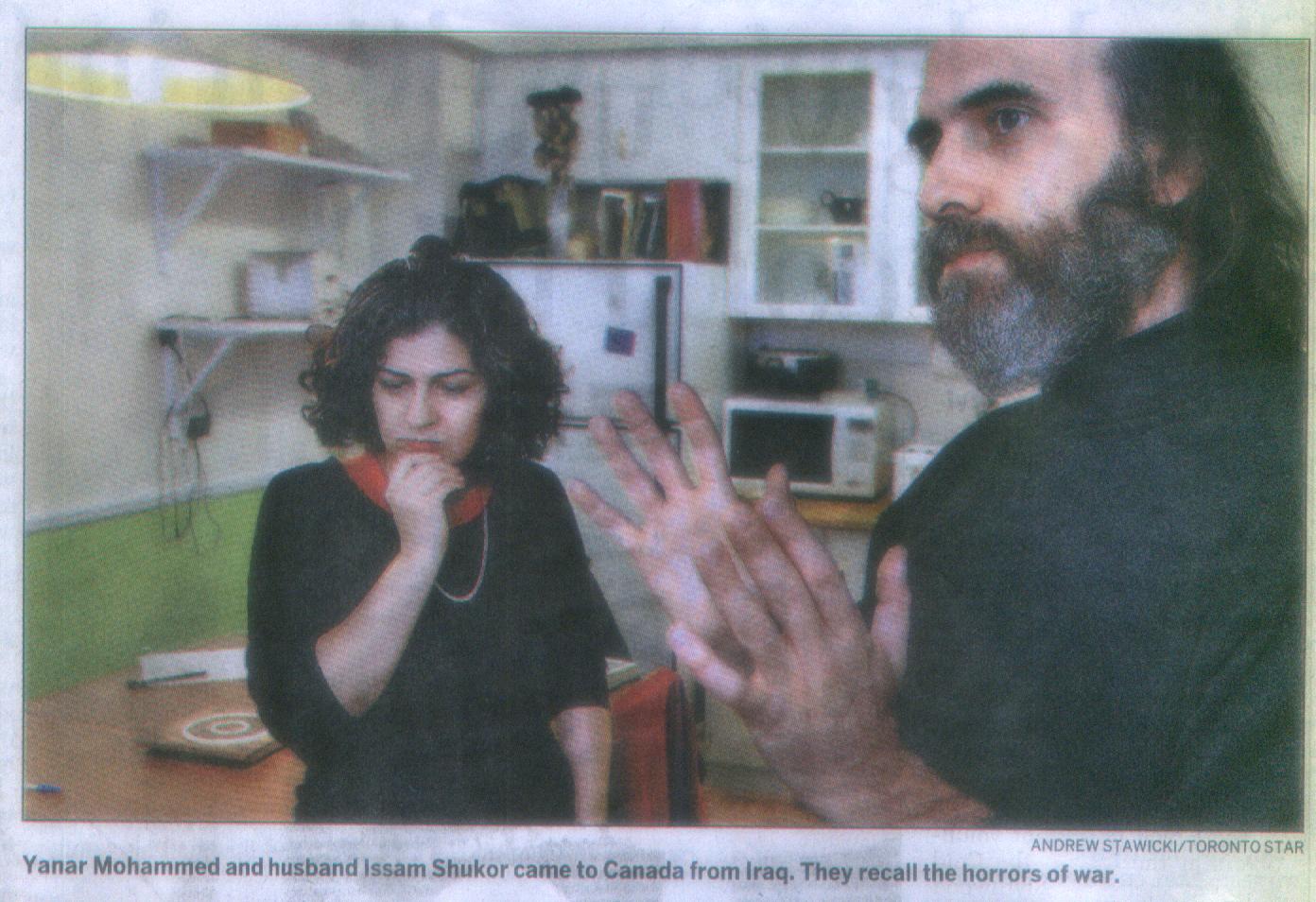
That daunting prospect has turned Mohammed and her husband Issam Shukor into anti-war activists.
Together, they have converted their new semi-detached home in Scarborough into an action center, drafting newsletters on a laptop computer, writing speeches, and making plans for future peace in their homeland.
"I can't detach myself from Iraq anymore," Mohammed said yesterday morning in her kitchen. "I have one single obsession. I need to work making things better for people there, and especially for women."
Almost 12 years after the bombing stopped, she can still hear the rattling of explosions and hiss of missiles that shook her awake that first night of the Gulf war, she said. She had grabbed her two-year-old son, and huddled with her husband in a dark corner of their Baghdad home, too afraid to go to the washroom. "When they say terrorism, that's what I remember," she said, brown eyes glinting up from over a coffee cup. "I was terrorized."
The electricity was cut. The phone lines were down. Her husband turned the knob on an old radio, searching desperately for information about the attack. At dawn, they quickly packed and rushed to the nearest air-raid shelter.
"They said (Iraq's deputy prime minister) Tariq Aziz was coming there with his family," Shukor said. "It would definitely have been bombed." Instead, they drove to her parent's home in the suburbs — one of the few houses in the area with a basement.
Despite the growing shadow of Saddam Hussein, up till then their life had not been much different from the one they now enjoy in Canada. He worked at an architecture firm while Mohammed was finishing her master's degree in architecture. They owned a car, socialized with friends at clubs at night, swam in public pools.
"It was not like Afghanistan because they were devastated. It was a very sophisticated modern life," Shukor said.
Although he had been conscripted to the army following Saddam's invasion of Kuwait a few months earlier, they still didn't believe the Americans would attack their beloved city.
The bombings lasted 45 days. Electricity would come on only in spurts — never for more than three or four hours. After they ran out of gas for their car, Mohammed would pedal an old bicycle to the store and stand in lines for hours, waiting to buy food. When the gas in her parents' stove sputtered out, she started to bake bread on a heater.
Each morning at 4 a.m. her husband left to report to the military command. Often, he wouldn't return for days, and she would sit shivering, wondering what had happened to him. "I didn't know if he was dead or alive," she said. "The phones were cut so he couldn't call."
The fear they both lived through then was enough to spur them out of the country. After the Americans declared victory in February, they began to save the money needed to buy their passports. It was only $600 (U.S.) — but in the devastated economy, it took them months and the sale of their car, couch, television set and clothing to scrape it together. They made it Lebanon and from there began to prepare their immigration application for "a decent country" — Canada.
Here for five years now, they have both found good jobs in downtown architecture firms, and their son Diaz, now 14, is excelling at computer programming in high school.
But they are still haunted by the sound of B-52 bombers rumbling overhead and their friends and families left behind. "It's like I'm living the scenario all over again," Mohammed said, bundling into a car to get to the protest. "We can never have a typical Canadian life here. Our hearts are still there. All the people we love are threatened, they may be killed."
Shukor joined the Committee for Lifting Economic Sanctions on Iraq, one of the organizers of yesterday's rally.
Mohammed helped form the Defense of Iraqi Women's Rights, a group of women lobbying against the fundamentalist Muslim Sharia laws now governing Iraq and oppressing women there. These are the same women who have been dying under the heavy hand of U.N. economic sanctions, in place since 1991, Mohammed said. And the same women who will become "collateral damage" in another U.S.-led war on Iraq.
Next month, the couple plans to return to the northern part of Iraq — protected as a "no-fly" zone imposed by the United Nations — for a conference plotting the democratic future of the country. Once Saddam has been deposed, both want to return to help rebuild their homeland. The U.N. sanctions have not hurt Saddam Hussein, Shukor believes, only weakened the Iraqi people.
"If they are empowered (by the lifting of sanctions),
the 25 million people of Iraq will make a great force."