SYNOPSIS FOR THE BOOK ‘108 Divya Ragams’ By S.Parthasarathy
Amritha Parthasarathy
VOLUME-I is in Paperback size- 350 pages
VOLUME-II is in A-4 size- 115 pages
Carnatic music and Hindustani music of India are two of the oldest forms of music. Like many things Indian, classical music of India has a colourful history and has evolved greatly over the years. By reading this book, you will gain new insights on how to appreciate Carnatic music. We believe that the author has successfully combined anecdotes, jokes , cryptic crosswords, puzzles and questions/answers to bring out the beauty of Carnatic music. 108 Divya Ragams clearly articulates reasons why we should appreciate Carnatic music and tells you how you can go about the task. Once you know the principles, you can generate your own methods for music appreciation that are uniquely suited for your specific needs.
You may well ask ‘What does Carnatic music offer to me, a new listener?’ Primarily, it is an additional and a beautiful option to enjoy life! The author says he enjoys his life 100% with Carnatic music, Cryptic crosswords , Computers and visiting temples with another 100% coming from his family, relatives, friends and reading and the third 100% from his work, exercise, cricket, other sports, TV etc. In case you wonder about his arithmetic, he says he enjoys his life 300%. This book is a sincere attempt by him to make you also enjoy your life better and improve the quality of your life.
The book has been brought out in two volumes. The first volume comprises of 8 chapters, which connect together with the main theme. The titles for each chapter are the names of compositions sung in a typical Carnatic music concert. The author has chosen present tense and first person to move the topics along as he feels that the readers will identify with the narrator. Formatted for easy reading, the book comes to approximately 325 pages between covers.
1. The first chapter is called VARNAM, which is usually the first piece in a Carnatic music recital. It is a brisk piece and sets the stage for the concert to follow. You are introduced to the various aspects of Carnatic music through a number of interesting questions. Some of the questions answered in this chapter are - What does Carnatic music offer to a new listener?, What is the origin of Carnatic music?, Is there anything common between Indian (Carnatic/Hindustani) and Western classical music? , What can I expect to get and hear in a typical Carnatic music concert? What is Ragam in Carnatic music?, What is Talam in Carnatic music? , Is Carnatic music Hindu music? Do you think persons of any age can appreciate Carnatic music? And so on…
2. The first few pages of the second chapter called KRITHI give you the rationale for the title and a brief introduction to 108 Divya Desams, which are sacred to Vaishnavites. The importance of the number 108 and the author’s concept of Divya Ragam are then explained. You get to know about Ragam in Carnatic music through answers to a number of questions. Finally you are taken on an exciting voyage into the world of 108 Ragams selected by the author. There are a lot of anecdotes and interesting material about the Ragams. To cite one – ‘Ustad Abdul Karim Khan, famous Hindustani musician has rendered Tyagaraja's Kharaharapriya krithi, Rama nee samanamevaru..., which is an attestation of how Tyagaraja's music captivated even musicians not trained in Carnatic music.’
3. The third chapter called RAGAM TANAM PALLAVI tells you the importance of lyrics in Carnatic music and takes you to meet a large number of composers. Over 400 composers have composed lyrics in Carnatic music and you get to know 72 important composers. This chapter, as all others, has Questions-Answers and a lot of anecdotes. To cite one –‘ Harikeshanallur Muttaiyya Bhagavatar was so captivated by Gottuvadyam (now called Chitrveena) that he learnt it from Narayana Iyengar for a few years when they were colleagues in the Royal Court of Mysore.’ Pride of place is given to Saint Tyagaraja (1767-1847), a composer par excellence and considered the greatest personality in the world of Carnatic music by devoting some pages of this chapter to him as well as the Tyagaraja Aradhana that is performed every year..
4. The fourth chapter called TANI AVARTHANAM tells you about the musicians- both vocalists and instrumentalists. The chapter starts with the importance of voice and vocalists in Carnatic music and moves on to tell you about all the instruments like Veena, Violin, Mridangam, Ghatam etc in use in Carnatic music. The last part of this chapter takes you to meet the instrumentalists . This chapter, as all others, has a lot of Questions-Answers and anecdotes. To cite one –‘Gandhiji wished M.S.Subbalakshmi to render his favourite bhajan, "Hari tum haro," and a response had gone from husband Sadasivam that she did not know how to sing this particular bhajan MS would sing another bhajan and somebody else could sing "Hari tum haro". A reply promptly came back from the Mahatma: "I should prefer to hear it SPOKEN by Subbulakshmi than SUNG by others’
5. Just as the tempo in a Carnatic music concert changas after Tani Avarthanam, the tempo of the book changes from the fifth chapter and touches the lighter side of Carnatic music. The fifth chapter called JAVALI talks about the use of Carnatic music in Tamil films. This chapter, as all others, has Questions-Answers and anecdotes.This chapter also has a list of over 500 songs in Tamil movies based on Carnatic ragams.
6 The sixth chapter called TILLANA is an introduction into the fascinating world of Cryptic crosswords. The author introduces you to the different types of clues in Crosswords such as Anagrams, Charades etc. and gives you clues on Carnatic music for you to solve. Solving these crossword clues will make you remember the terms and Ragams for a long time.
7. The seventh chapter called RAGA MALIKA is a medley of Jokes, Cryptograms, Puzzles, Trivia and Limericks about the various aspects and personalities of Carnatic music with the twin purpose of learning and enjoyment. The book contains 108 quotations on music out of which 18 are in the form of Cryptograms. One of the 27 riddles is - What Ragam does Mrs. Ravi sing when her husband goes away? The answer is Bhairavi (Bye-Ravi). One of the 36 Trivia questions is- What was the original name of Purandaradasa? The answer is Srinivasa Naik.
8. The eighth chapter is called MANGALAM as all Carnatic music concerts end with this invocation for universal peace and prosperity. Through answers to a few questions, the author provides the details of websites and books from which materials have been used in this book and discusses what you can do to learn to appreciate Carnatic music and promote it.
Volume-I of the book was meant for persons with a little or no knowledge of Carnatic music. But the ninth chapter called KEERTHANA is meant for concert-goers. So this has been brought out as a Volume-II. This contains an alphabetical list of over 10000 compositions giving the Ragam and the name of the composer in the 108 selected ragams by selected 72 composers. This will assist you initially to identify a Ragam before you learn the nuances by constant listening.
The book does not end here. There is a multimedia CD-ROM accompanying the book which contains Introduction to Carnatic music: Vocalists and instrumentalists: Technical details about and compositions in all the 108 Ragams: some excerpts from Tamil film music based on some of these 108 ragams and much, much more. It is a verbal and vocal delight.
INTRODUCTION to the book is by
This is what the author says about the purpose of his writing this book, ’Every lover of Carnatic music should undertake to introduce Carnatic music to a few persons. This work is missionary in character and this book and the CD-ROM are a part of my mission to get some of you interested in Carnatic music.’ We hope that you will constantly view and listen to the CD and later graduate to attending live concerts.
The book was released on 11th September 2004 and has been dedicated to the memory of Mrs. Kamala Srinivasan, the author’s mother who passed away on 20th August 2003.
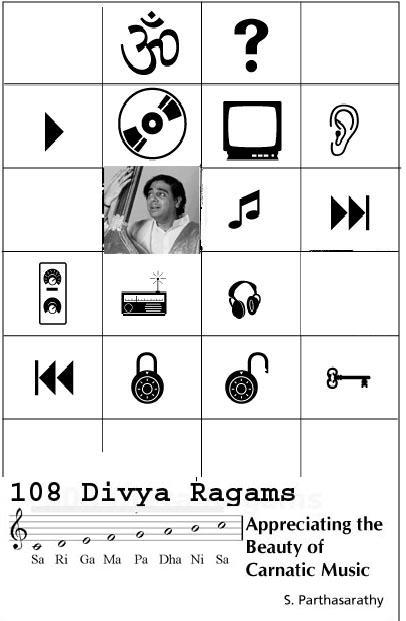
The cover for the book (seen on top of this page) was designed by Aarthi Parthasarathy, a budding professional designer now studying in Srishti School of Design, Bangalore.
We will be setting apart Rs. 36 for every copy sold for the twin purpose of promoting Carnatic music and 108 Divya Desams.
11th September 2004
for Publishers
Copies are now available only in Chennai and can be booked on 2534 7570 or 2534 7575 during working hours or on 2644 9251 on Saturday/Sunday/Holidays and will be delivered free within Chennai. We hope to tie up with bookshops soon. The cost per copy (consisting of Volume-I, Volume-II and a multimedia CD) is Rs. 378/-.
Forward to Extracts From the Book
Back
