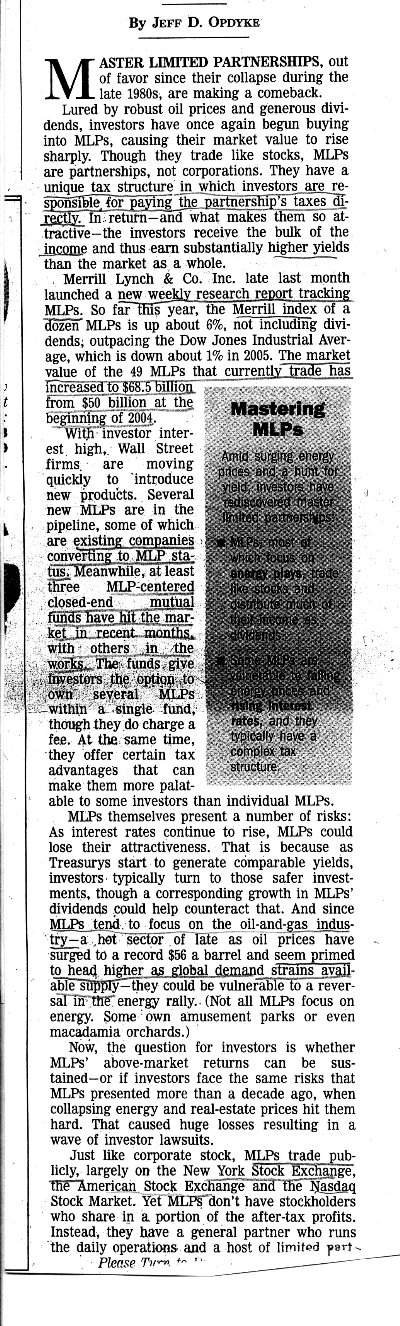
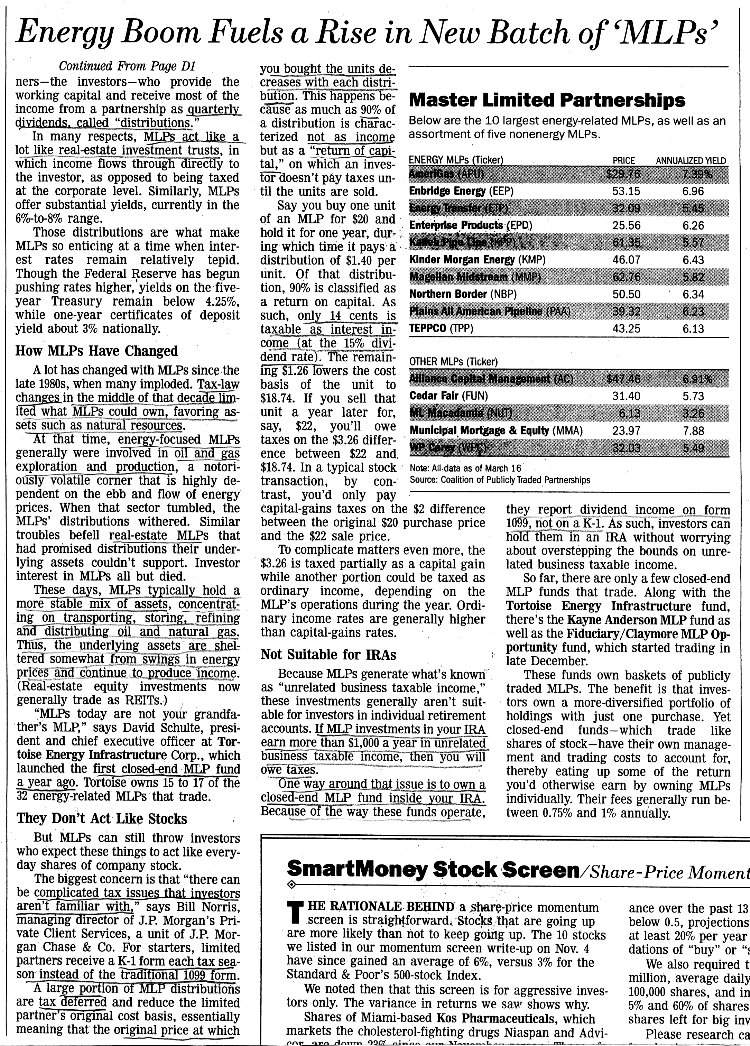
Absolute Return Money Out of a Pipeline Lisa W. Hess, 09.06.04, 12:00 AM ET Master limited partnerships in energy are a good place to be during this market funk. They offer good yields, tax breaks and strong growth potential. Martha and the Vandellas recorded A 1965 Motown classic that began: "Nowhere to run to, baby/Nowhere to hide." With the stock and bond markets not going much of anywhere, you may despair of finding any good liquid investment for your cash. Of course, you can tie up your money for long periods with hedge funds and their ilk, hoping for decent returns. But there are some good alternatives, particularly in the energy sector. In this issue, fellow columnist Richard Lehmann discusses royalty trusts, which focus on oil and gas extraction (see p. 206). For me, a good place for investment truffle hunters to start sniffing is the field of master limited partnerships, which have the twin advantages of high yields and tax benefits. These publicly traded securities are mostly concentrated in fuel storage and pipelines. Energy price zigzags don't affect MLPs much. They earn their money from the volume of oil and gas they handle. With growing demand and insufficient infrastructure for it, MLPs have big growth in their future. Special Offer for Forbes.com members -- receive a Free Trial Issue of Forbes Magazine... no risk... no obligation! Click here for your Free Issue! For the time being, however, you wouldn't know that. Because people buy them for the fat yields, MLPs are unjustifiably tainted by the Federal Reserve's rate-tightening. Even though the cost of borrowing money has just a small impact on their performance, MLPs are down 3% in 2004. This spells a buying opportunity. MLPs have shown superb appreciation over time. Since 1998 an index of MLPs created by Jerry V. Swank of the Cushing Fund has measured a 14.7% annual return versus 2.1% for the S&P 500 and 5.3% for the ten-year Treasury. And Swank found the MLPs weren't correlated to the S&P or any other major securities index, meaning the broader market has a limited effect on them. So they are a good way to diversify. Further, fads among institutional investors aren't a factor since the big boys steer clear of MLPs. Open-end mutual funds are legally barred from buying them and pension plans fear that such a tax-advantaged investment would queer the plans' tax-exempt status. Yielding between 6% and 8%, MLPs have a nice spread over ten-year Treasurys at 4.2%. Further, MLPs handily outyield the energy titans such as ExxonMobil (2.4%). The reason is that MLPs are exempt from corporate taxes and pass through almost all their distributable cash flow to investors. And the grace note is the MLP tax treatment. Typically only 10% to 20% of an MLP distribution is currently taxable (at up to 35%). The reason: Because of the heavy depreciation charges these outfits can claim on their tax returns, the IRSviews a large part of their payouts as a return of capital rather than as taxable income. The return of capital lowers your tax basis in the stock and thus raises your capital gain down the road. In the meantime, you enjoy largely untaxed income. The downside is the complexity of your tax return. Attaching a K-1 form to your tax return is a hassle. And depending on how the MLP deals with depreciation, you could get thrown into the harrowing alternative minimum tax. Another caution: the hefty MLP management rake-off. Managers, who own a chunk of MLP shares and thus get the same nice dividends you do, also are entitled to increasing payouts as the distribution increases. Their take can reach as high as 50%. The idea is to motivate management to expand the business. Thus far the motivation has worked. Dividends have been going up. Kinder Morgan Energy Partners(43, KMP) recently announced its twentieth distribution increase since the MLP's 1997 launch, a 9% hike for the second quarter over the prior-year period. The largest of the publicly traded MLPs, it yields a nice 6.6%. The Kinder Morgan partnership has pipelines carrying natural gas, crude oil and carbon dioxide. For 2004's first half it logged an impressive 14% earnings increase, to $387 million on $3.8 billion revenue. Absurdly, the price this year has slid 11%. Energy Transfer Partners(41, ETP), the product of a February merger between natural gas shipper Energy Transfer and Heritage Propane, has seen a flat stock price this year. Its 7.2% yield reflects the vulnerability of the propane business to the weather. Since the merger the MLP has made several helpful acquisitions, such as KeySpan's propane business. Finally, there are two new closed-end funds, Tortoise Energy Infrastructure(24, TYG) and Energy Income & Growth Fund(20, FEN), recently formed to invest solely in MLPs. These funds are C corporations; they pay state corporate taxes and are therefore free from the qualifying income rules. Their advantage is that they eliminate the tax headaches of filing K-1s. But they are too young to have a track record. Money Out of a Pipeline Lisa W. Hess is a New York money manager. Visit her homepage at www.forbes.com/hess. Special Offer: Get a Free Trial Issue of Forbes Magazine!
http://www.forbes.com/forbes/2004/0906/204_print.html
------------------------------------------------------------------------From the Wall Street Journal