|
|
| PLACES OF INTEREST IN GOZO AND COMINO |
|
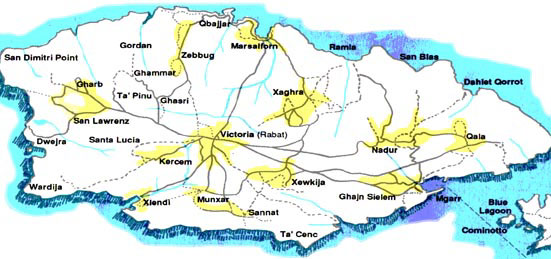
Gozo is just four miles away to the northwest across a clear blue and very deep channel. The two islands are connected by regular car and passenger ferry and a helicopter service. Gozo is where Ulysses is said to have been held captive entranced by the nymph Calypso. This sister island is almost entirely agricultural, and life is simple but comfortable. It is an island of farmers and fishermen, and their way of life dominates the character of Gozo. If you arrive by sea, Mgarr Harbour is picturesque with all kinds of seacraft. The neo-Gothic Lourdes Sanctuary, built in 1888, watches over it. In Victoria, the capital, go up to the Citadel or Gran Castello and walk around and breathe the ancient atmosphere. This was the fortified refuge of the Gozitans when the island was attacked by the Turks or pirates. The late-medieval houses in this area are unique in the Maltese Islands. There is the magnificent Cathedral and various museums. The tree-lined square in Victoria, known as It-Tokk (meaning the point of rendezvous), is the hub of Gozitan life. There is a market from 7 a.m. until 1 p.m. The market is best known for remnants or pieces of discarded cloth bought in bulk from fashion houses abroad. The majestic Basilica of St George dominates the square behind It-Tokk. Built in 1673, the church is also called "The Golden Basilica" because of its richly-gilded interior and the dominant bronze canopy centrepiece, imitating that of Bernini at St Peter's in Rome. This is the only church in Gozo portraying two altar paintings by renowned Italian artist Mattia Preti (1613 - 1699). Ggantija Prehistoric Temples date from between 3600 and 3000 BC - one thousand years before the Pyramids at Giza, in Egypt (2600 BC). They are the greatest undertaking of the pre-Phoenician Gozitans. These temples are so named as early historians in the 16th century thought that they were the homes of Malta's first settlers, a mythical race of giants. They are the best preserved of all the temple sites on the islands. The Guinness Book of Records recognises these as the oldest free-standing structures in the world. Ta' Pinu Sanctuary dominates the countryside. The most conspicuous way in which the people of Gozo demonstrate their faith is the building of churches and chapels in honour of the Blessed Virgin and the saints. Ta' Pinu was consecrated on December 13,1931, after Our Lady is said to have appeared to a country woman here in 1883. On May 26, 1990 Pope John Paul II celebrated Holy Mass on the parvis of the sanctuary and later placed a halo of five stars on the head of the Blessed Virgin. Lunzjata Valley is the island's green heart and one of the greenest places all the year round. It served as a hunting ground for the Knights. It runs between the eastern tip of the higher ground on which the town is situated and the village of Kercem, and abounds with natural springs. Ir-Ramla Z-Hamra, the Red Sandy Bay, is the most unspoilt beach in Malta and Gozo. Once there the visitor can get an idea of the beauty of the island's beaches centuries ago. Ramla Bay was perfect for an invader's landing. Hence after 1715, the Knights built a battery on either side of the entrance to the bay. Marsalforn is an important fishing village and the most popular resort on the island with both locals and tourists. Here one can find a good number of hotels, a large variety of restaurants and several watersports clubs. Xlendi is one of the three main fishing villages and a popular summer resort. Wedged between majestic cliffs in the southeast of Gozo, it is definitely one of the most picturesque and romantic spots on the island. The whole island of Gozo is a showplace of the life and customs of a typical Mediterranean community, but it also prides itself with several typical museums. These include the Museum of Archaeology, the Citadel Armoury, the Folklore Museum, the Natural History Museum and the Cathedral Museum, all within the Citadel; a folklore museum at Gharb, Ta' Kola Windmill in Xaghra, a Maritime Museum at Nadur, and the Gozo Heritage at Ghajnsielem. COMINO With its many caves the rugged coastline of Comino renders it a haven to modern seacraft. Marauding crews from the 13th century onwards found them equally inviting: so much so that in 1411 Comino was described as a pirates' den. In 1618 Grand Master Alof de Wignacourt decided to finance the construction of a watchtower. Saint Mary Tower, as it was called after the dedication of the chapel in Comino, is manned to this day by a unit of the Armed Forces of Malta. The Blue Lagoon is among the clearest areas of sea in the Mediterranean. Water skiing, for those with access to powerful boats, is a firm favourite. The area around Comino, including Santa Marija Bay, provides some of the finest spots on the islands for snorkelling and swimming, with several spectacular caves to explore. |