Heading north out of Echuca, we passed the town of Strathmore, home of
the "Strathy Hot Bread" bakery, which had won an all-Australian beef pie
contest. Got a 10" beef pie for $7.65! And it really was good! Had that
and part of a similar-size cheesecake for supper, from "The Cheesecake
Shop" back in Echuca. They have a shop in one other Australian
town - and one in Poland!
Entering New South Wales, we were greeted by 'Speed Cameras' and, for
trucks (Heavy Vehicles) - 'Elapsed Time Cameras'. 'Big Brother' lives!
We went almost straight north to Parkes, where there is a huge radio
telescope dish. Usually reserved for deep-space radio astronomy, it was
used during the first moonlLanding as part of the communications with
the astronauts when the regular system 'went down'. There is a movie,
'The Dish', that everyone in Australia seems to have seen, about this
incident. We tried unsucessfully to find a VHS tape of it (Australia
uses European-type TV). The movie does make the Australian scientists
look a bit like hicks, but it's still interesting. They also gave
invaluable aid during the Apollo 13 flight. Although not technically
part of the system at that time, they of course were tracking the flight
out of their own interest, and within minutes of realizing there was a
problem were sending technical data to Houston, before it was even
requested; they recieved a special commendation for their help. Outside
the visitor's centre there is a small apple tree which is a cutting of
the famous apple tree where Issac Newton had his 'falling apple' insight
into gravitation. Also an 'Upside Down' globe to show schoolkids, and
adults, that Australia isn't REALLY 'Down Under'. The visitor centre is
manned by real scientists from the observatory, which is neat, because
you can get intelligent answers to questions. Rick Twerdy, one of the
scientists, was on duty the same as he was when I was here in '97. He
said he remembered me. He designs a lot of the stuff on display, very
education-oriented. We got there shortly before the 4 pm closing, and he
asked if we'd like to see the 3-D film they'd developed. We said we
would but didn't have time. He said, "So I close at 5 instead of 4",
and shrugged. This friendliness and helpfulness was typical of so many
Australians. The film was quite good, by the way. We got some great
The next day we visited the town of Cowra, where a prisoner-of war
camp was during World War II. The camp housed both Italian and Japanese
prisoners. The Italians were so happy to be out of the war that they
were trusted to get jobs in Cowra and on local farms. After the war,
many chose to settle permanently in the area. The Japanese, though, were
so ashamed at being captured that they were very hostile and finally
staged a breakout which cost several Australian lives and over a
hundred Japanese lives before they were all rounded up. In the Chamber
of Commerce Visitor's Center there has a charming little show wherin a
trick projection system is used to project the image of a young lady on
a sort of diorama of artifacts from the breakout, and explains what
happened. It's so well done that she really looks almost like a
miniature, 6-inch tall girl.
Go to
Part 7: From Cowra to Sydney
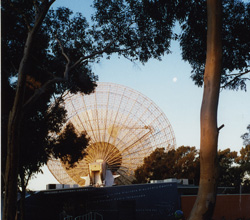 photos of the dish, lit pink by the setting sun, and pointed toward the
moon. Last time I was there the dish was immobile, but this time we got
to see the huge thing swerve around twice.
photos of the dish, lit pink by the setting sun, and pointed toward the
moon. Last time I was there the dish was immobile, but this time we got
to see the huge thing swerve around twice.