|
Two possible origins of Kaolin chert have been noted. They are the Vienna limestone formation and a secondary geological deposit of unknown origin. The Vienna limestone formation being the earlier derived origin of Kaolin chert (Spielbauer 1984). Vienna limestone is a Mississippian limestone outcropping in Southern Illinois (Willman 1975). The only known Kaolin outcrop is found approximately 4mi west of of Cobden Illinois at Iron Mountain (Winter 1984, Morrow 1988, Hofman 1989). Iron Mountain is a ridge that runs north and south.
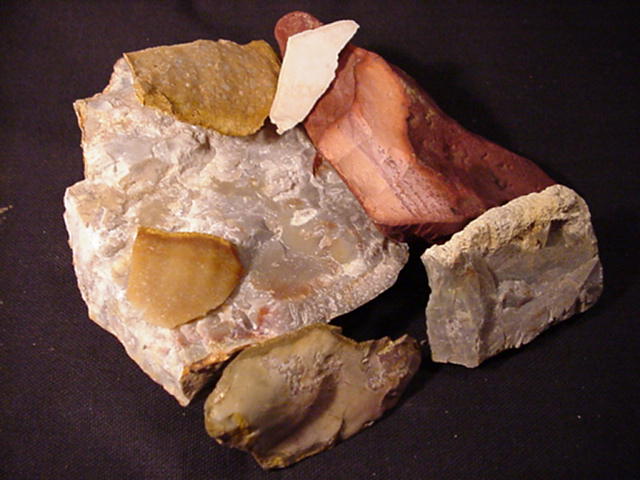
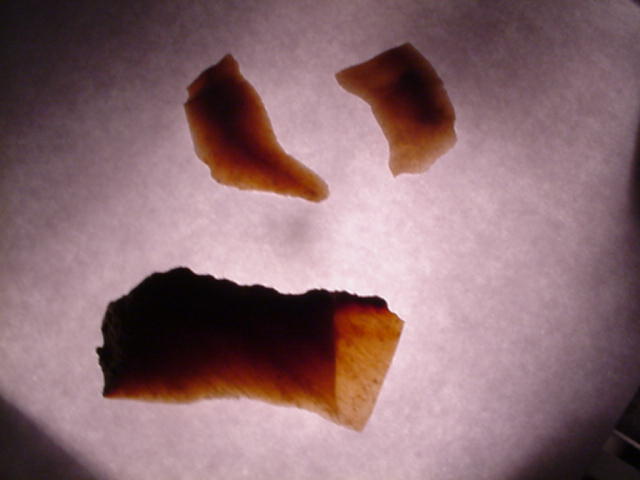
Some Kaolin chert has been called noviculite and calcedony because of its high quality (Hofman 1989). A webbed like pattern of banding occurs because of light refracting off of fractured edges or because of a more porous area being stained. The texture of Kaolin chert is course to fine grained. Kaolin's cortex has a pitted texture with yellow, white, or black color (Spielbauer 1984). Nodules of Kaolin chert are lenticular or discoidal (Morrow 1988, Hofman 1989). |
|